Have you ever felt completely overwhelmed by how chaotic the world seems? I know I certainly have.
For the longest time, I looked around and saw nothing but random, disconnected events. I couldn’t figure out why massive, “too-big-to-fail” companies suddenly went bankrupt. I didn’t understand why moving to a larger city felt incredibly exciting, yet utterly exhausting at the exact same time.
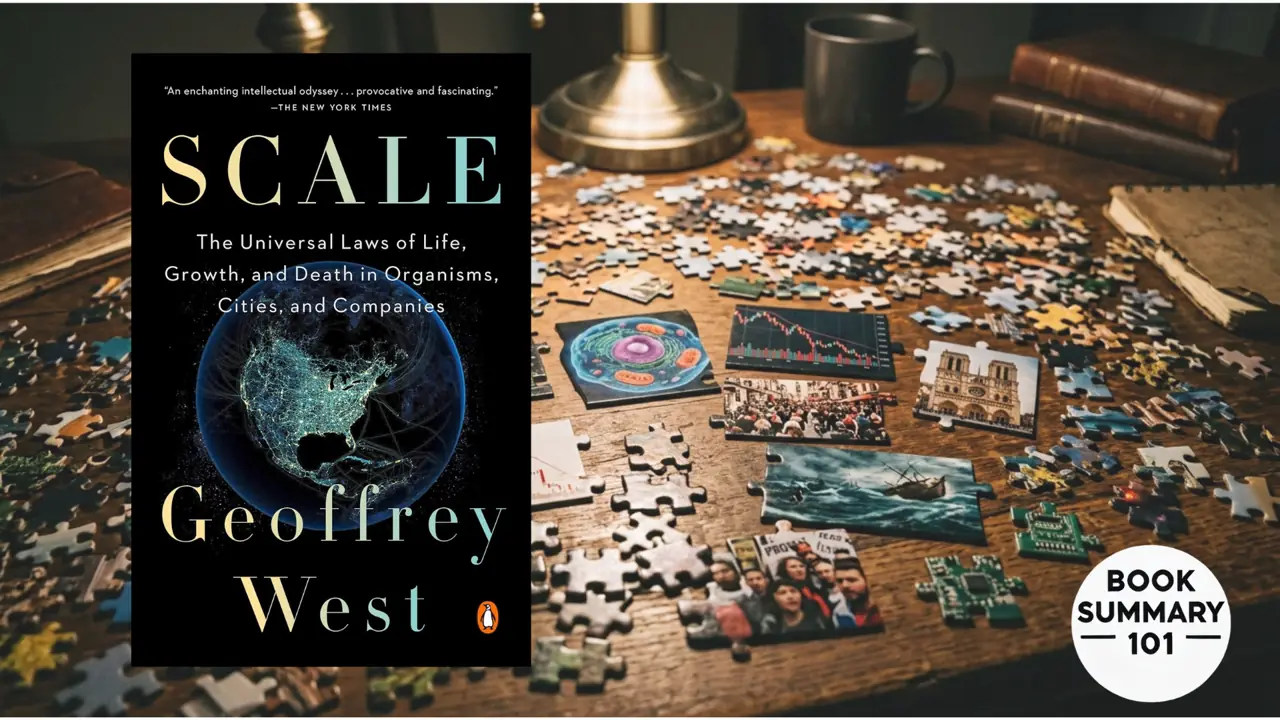
I just assumed biology, economics, and urban planning were entirely separate universes. It felt like I was staring at a thousand tiny puzzle pieces, missing the picture on the front of the box.
Then, I finally picked up Scale: The Universal Laws of Life, Growth, and Death in Organisms, Cities, and Companies by Geoffrey West. Honestly, it was like someone handed me the decoder ring to reality.
Instead of a dry, academic textbook, reading this felt like sitting down with a brilliant physicist who patiently explained the hidden matrix of our world. It turns out, everything from the beating of your heart to the traffic in Tokyo follows the exact same set of invisible mathematical rules.
Why Should You Even Bother Reading It?
If you’re a curious person who loves connecting the dots, this book is an absolute goldmine. You don’t need a PhD in physics or a background in calculus to appreciate it.
It’s perfect for entrepreneurs trying to understand why scaling a business is so difficult, or city dwellers wondering why the pace of life feels so fast. It’s also great for non-tech professionals who want to understand the foundational rules that govern complex systems.
In a world that feels increasingly unpredictable, knowing the universal laws of growth and decay offers a surprising sense of comfort and clarity.
- Why Should You Even Bother Reading It?
- The Universal Blueprint: 5 Hidden Laws That Control Our World
- The Magic of Networks (Everything is Connected)
- Sublinear Scaling (Why Elephants Outlive Mice)
- Superlinear Scaling (The Superpower of Cities)
- The Death of Companies (Why Businesses Go Extinct)
- The Innovation Treadmill (The Race Against Collapse)
- My Final Thoughts
- Join the Conversation!
- Frequently Asked Questions (The stuff you’re probably wondering)
The Universal Blueprint: 5 Hidden Laws That Control Our World
Once you understand these five foundational concepts, you will never look at a bustling city, a massive corporation, or even your own heartbeat the exact same way again.
The Magic of Networks (Everything is Connected)
Imagine trying to water a massive, sprawling garden using only a single, tiny watering can. You would be exhausted, and most of your plants would probably die of thirst.
Now, imagine installing an automated sprinkler system with a thick main pipe that branches off into smaller hoses, which then branch into tiny drip lines. That branching system effortlessly delivers water to every single leaf. This is the ultimate biological analogy for how complex systems survive.
In the book, West explains that life is entirely governed by fractal, branching networks. Whether we are talking about the blood vessels in your body, the roots of an oak tree, or the highway system in a sprawling metropolis, the design is mathematically identical.
Nature uses these space-filling networks to distribute energy as efficiently as possible. Because these networks have to reach every single cell (or every single home in a city), the mathematics of how they branch out ultimately dictate how fast the organism can grow.
Think about your home’s internet router. It connects to the massive fiber-optic cables running under your city, which branch into neighborhood lines, and finally into the Wi-Fi signal hitting your phone. The internet literally mimics the exact same circulatory system that keeps your heart pumping!
Simple Terms: Everything in life relies on branching, tree-like networks to move energy around efficiently.
The Takeaway: The physical constraints of these networks—how they branch and spread—determine the ultimate size and lifespan of every living thing, city, and business on Earth.
Sublinear Scaling (Why Elephants Outlive Mice)
Let’s say you are cooking dinner for yourself. It takes a certain amount of time, energy, and money. Now, imagine cooking for a family of four.
Does it take exactly four times the effort, four times the electricity, and four times the time? Of course not! You are using the same oven, the same pans, and roughly the same prep time.
This is the concept of “economies of scale.” In the biological world, Geoffrey West calls this sublinear scaling.
As animals get bigger, they actually become incredibly efficient. Every time an animal doubles in size, it doesn’t need twice as much energy to survive; it only needs about 75% more. Because bigger animals use energy more efficiently, their cellular pace of life slows down.
A mouse has a wildly fast metabolism, a racing heart, and a very short life. An elephant, on the other hand, moves slowly, has a slow, rhythmic heartbeat, and lives for decades.
Yet, here is the mind-blowing part: both the mouse and the elephant will experience roughly 1.5 billion heartbeats in their lifetime! By scaling up, the elephant slows down time and buys itself a longer life.
Simple Terms: As biological organisms get larger, they become more energy-efficient and live at a slower pace.
The Takeaway: Bigger bodies require comparatively less energy to run, which is why massive animals live longer, slower lives than tiny animals.
Superlinear Scaling (The Superpower of Cities)
If biological organisms slow down as they get bigger, you would expect cities to do the same thing, right? Think again.
Imagine hosting a party. If you have five friends over, it’s a quiet gathering. But if you pack fifty people into that same room, the energy doesn’t just increase proportionally—it explodes. People start mingling faster, ideas fly around, and the music inevitably gets turned up.
This is what West calls superlinear scaling. Cities do not act like biological animals; they act like social reactors.
Whenever a city doubles in population, it doesn’t just double its output. It systematically produces about 15% more of everything per capita. You get 15% more wealth, 15% more patents, and 15% more innovation per person.
This is exactly why New York City or Silicon Valley feels so electric and fast-paced compared to a small rural town. People walk faster, talk faster, and invent things faster.
However, there is a dark side to this magic trick. That same 15% rule applies to negative things, too. When a city doubles in size, it also generates 15% more crime, 15% more pollution, and 15% more disease per person.
📖 “Cities are the most complex, most massive, and most important things human beings have ever created, and they are the engines of civilization.”
Simple Terms: Unlike animals, cities speed up and produce significantly more output per person as their population grows.
The Takeaway: The physical proximity of human beings in a city creates an unstoppable compounding effect, driving both incredible innovation and increased social problems.
The Death of Companies (Why Businesses Go Extinct)
Think about bringing a brand-new puppy into your home. It’s wildly energetic, highly adaptable, and constantly exploring its environment.
Now, picture that same dog fifteen years later. It’s slower, set in its ways, and perfectly content to just sleep on the same rug every single day.
According to West’s data, companies follow this exact same biological lifecycle. While cities scale superlinearly (and therefore essentially live forever), companies scale sublinearly, just like animals.
When a startup is young, it is agile and focused entirely on innovation. But as it grows into a massive corporation, the math shifts. The company begins to prioritize efficiency, administration, and bureaucracy over new ideas.
Think about Blockbuster Video. At their peak, they were an incredibly efficient machine, opening thousands of identical stores. But that massive, rigid bureaucracy made them completely unable to adapt when Netflix introduced streaming. They got too big and too stiff to change direction.
Because companies scale like animals, they also die like animals. West’s research shows that a company’s mortality rate is remarkably predictable, regardless of its industry. Eventually, the bureaucracy suffocates the innovation, and the corporate organism simply expires.
Simple Terms: Large corporations eventually stop innovating and become bogged down by bureaucracy, leading to their inevitable death.
The Takeaway: Businesses act like biological organisms that age and die, proving that endless corporate growth without constant reinvention is mathematically impossible.
The Innovation Treadmill (The Race Against Collapse)
Imagine you are running on a treadmill. It starts at a nice, easy walking pace. But every few minutes, someone bumps up the speed.
Soon, you are jogging. Then, you are running. Eventually, you are sprinting as fast as you possibly can, knowing that if you don’t keep up, you are going to fly off the back of the machine.
This perfectly describes the fate of human civilization and our rapidly growing cities. Because our cities scale superlinearly, they demand resources at a constantly accelerating rate.
To avoid running out of food, energy, or space, we have to invent our way out of the crisis. We transitioned from wood, to coal, to oil, to nuclear power, to solar. We moved from horse-drawn carriages to trains, to cars, to airplanes.
But here is the terrifying catch: the time between these massive, paradigm-shifting innovations is mathematically shrinking.
📖 “Continuous growth requires a continuous cycle of paradigm-shifting innovations, but the time between them gets shorter and shorter.”
We used to have thousands of years to adapt to the Agricultural Revolution. We had centuries to adapt to the Industrial Revolution. Now, we are trying to adapt to the Artificial Intelligence revolution in just a handful of years! We have to run faster and faster just to stay in place.
Simple Terms: To sustain continuous growth, humanity must invent major technological breakthroughs at a faster and faster pace.
The Takeaway: Our survival depends on constant, accelerating innovation, forcing us into a relentless race to out-invent our own resource depletion.
My Final Thoughts
Reading Scale: The Universal Laws of Life, Growth, and Death in Organisms, Cities, and Companies completely shifted how I view the world.
It took the randomness out of daily life and replaced it with a beautiful, mathematical rhythm. It gave me peace of mind knowing that companies are supposed to fail eventually, and that cities are supposed to feel chaotic and fast-paced.
This book doesn’t just teach you about biology or urban planning; it empowers you with a universal framework for understanding change. Whether you are building a career, starting a business, or simply trying to navigate modern life, understanding these laws of scaling gives you an incredible edge.
You stop fighting against the natural forces of the world, and you start learning how to ride them.
Join the Conversation!
Which of these scaling laws surprised you the most? Do you feel like you are running faster on the “innovation treadmill” in your own life and career? Drop a comment below and let’s talk about it!
Frequently Asked Questions (The stuff you’re probably wondering)
Do I need to be good at math to read this book?
Not at all! While the underlying concepts are based on complex physics and calculus, Geoffrey West does an incredible job of explaining the meaning of the math using simple charts and relatable stories.
Is this book too technical for a casual reader?
It is definitely a “thinker’s” book, so it takes a bit of focus. However, the conversational tone and the sheer number of mind-blowing “aha!” moments keep it highly engaging. You don’t need a science background to enjoy it.
Why do cities live forever while companies die?
Cities encourage diversity, serendipity, and social interaction, which drives endless innovation. Companies, on the other hand, strive for top-down control and efficiency. That bureaucracy eventually kills their ability to adapt to a changing world.
Who is the ideal reader for this book?
Entrepreneurs, urban planners, biology enthusiasts, and anyone who loves big-picture thinking. If you enjoy books by Malcolm Gladwell or Yuval Noah Harari, this will be right up your alley.
Can these scaling laws be applied to my personal life?
Absolutely. Understanding the limits of growth and the need for efficiency can help you manage your own time, energy, and personal projects better. It reminds us that endless, unchecked growth always comes with hidden costs!