I remember hitting a specific moment in my late twenties.
I had the job title I wanted. I was making decent money. I had the “right” apartment in the “right” neighborhood. On paper, I was crushing it. But on Sunday nights, I’d stare at the ceiling feeling a weird, hollowing ache in my chest.
I kept asking myself, “Is this it? Is this just what adulthood feels like?”
I was climbing a ladder, but I had a sinking suspicion it was leaning against the wrong wall.
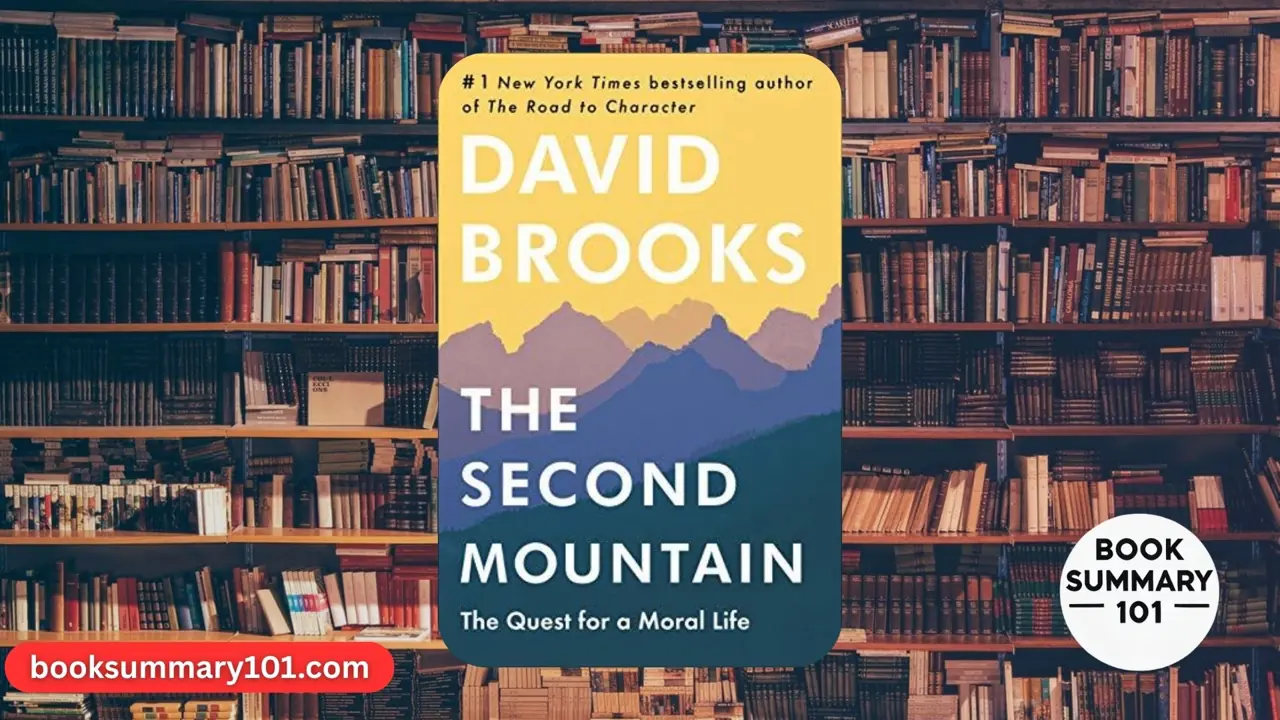
If you’ve ever felt that disconnect between your external success and your internal satisfaction, you aren’t alone. In fact, you are exactly where David Brooks starts in his masterpiece, The Second Mountain: The Quest for a Moral Life.
Reading this book felt less like reading a lecture and more like having a late-night conversation with a wise friend who sees right through your “I’m fine” façade.
It’s a book about why “making it” often feels like losing it, and how the real adventure starts only after you fall apart.
Why Should You Even Bother Reading It?
Honestly? You should read this because our culture is obsessed with the wrong things.
We live in a world of hyper-individualism. We are told to “live your truth,” “optimize your life,” and “be free.” But Brooks argues that this freedom is actually a cage.
This book is perfect for the “successful” professional feeling burnt out, the parent wondering how to instill values in their kids, or anyone currently walking through a “valley”—a divorce, a job loss, or a crisis of faith.
It’s the roadmap for moving from a life of fleeting happiness to a life of deep, resonant joy.
- Why Should You Even Bother Reading It?
- The Four Commitments That Define a Meaningful Life
- 1. The First Mountain: The Cult of “I”
- 2. The Valley: The Crash That Saves You
- 3. The Second Mountain: The Life of Commitment
- 4. Vocation vs. Career: Answering the Call
- 5. The Weaver: Radical Interdependence
- My Final Thoughts
- Join the Conversation!
- Frequently Asked Questions (The stuff you’re probably wondering)
The Four Commitments That Define a Meaningful Life
Before we break down the specific concepts, we need to understand the geography of Brooks’ world. He argues that life is defined by two mountains. The first is about ego, status, and self-definition. The second is about selflessness, relation, and surrender. Here is how you move from one to the other.
1. The First Mountain: The Cult of “I”
Imagine you are a sculptor. You spend years chiseling a statue. You polish it, you perfect the lighting around it, and you charge people admission to see it.
That statue is your “Self.”
The First Mountain is the journey we are all told to take. It’s about building an identity. It’s about “Resume Virtues.”
We strive for the corner office, the verified checkmark on social media, the perfect body, and the high-status neighborhood. The goal of the First Mountain is happiness, which Brooks defines as “victory for the self.”
It’s not that the First Mountain is bad—we need an ego to function. We need to pay bills. The problem is that the First Mountain is insufficient.
Real-World Example:
Think of the tech founder who sells their company for $50 million. They have “won” the game. But six months later, they are depressed, lonely, and starting a new company just to feel the rush again. They conquered the mountain, but the air at the summit was too thin to breathe. They have success, but they don’t have satisfaction.
Simple Terms: The phase of life dedicated to personal success, reputation, and acquiring things.
The Takeaway: Building a career and a reputation is necessary, but it will never satisfy your deeper need for connection and purpose.
2. The Valley: The Crash That Saves You
How do you get from the first mountain to the second? You usually fall.
Brooks uses the analogy of a seed. For a seed to grow into a tree, the outer shell has to crack open.
This is “The Valley.” It is the season of suffering.
It could be a divorce (which Brooks touches on regarding his own life), a cancer diagnosis, the loss of a job, or just a slow-creeping realization of boredom and apathy.
In our culture, we treat suffering as a failure. We try to numb it with Netflix, alcohol, or work. But Brooks argues that the Valley is where the ego dies. It is where you realize that you are not enough to save you.
This “breaking open” is the only way to expose the heart and make it ready for real love.
📖 “The valley is where we shed the old self so the new self can emerge. There is no growth without suffering, and there is no life without death of the old ways.”
Real-World Example:
Consider someone who gets fired from a high-powered corporate job. Initially, they are devastated. Their identity was “The VP of Marketing.” But in that unemployment, they start volunteering at a local food bank. They realize they love helping people directly more than they loved selling widgets. The firing (the crash) was the necessary mechanism to find their true calling.
Simple Terms: The period of crisis or suffering that destroys your ego and forces you to rethink what actually matters.
The Takeaway: Don’t run from your suffering; let it break you open so you can be reassembled into something better.
3. The Second Mountain: The Life of Commitment
If the First Mountain is about freedom from (freedom from bosses, from rules, from obligations), the Second Mountain is about freedom to.
Brooks uses the analogy of a “Grand Bargain” or a “Covenant.”
Think of it like Odysseus chaining himself to the mast of his ship to hear the Sirens without crashing. True freedom isn’t doing whatever you want; it’s choosing the right chains.
The Second Mountain is defined by Commitment.
While the First Mountain asks, “What can the world give me?” the Second Mountain asks, “What does life ask of me?” You stop trying to be interesting and start trying to be interested. You stop trying to be free and start trying to be rooted.
Brooks identifies four specific commitments that anchor us:
- Vocation (Work)
- Marriage (Family)
- Philosophy/Faith (Belief)
- Community (Place)
Real-World Example:
Think of a person who decides to stay in a “struggling” neighborhood not because they can’t afford to leave, but because they want to improve the local school board. They are voluntarily restricting their freedom (staying put) to deepen their commitment to a place. That is Second Mountain behavior.
Simple Terms: A life defined by making promises to others and sticking to them, prioritizing community over self.
The Takeaway: A meaningful life is built by shedding your options and fully committing to people, places, and beliefs.
4. Vocation vs. Career: Answering the Call
This is one of my favorite distinctions in the book.
A Career is a transaction. You give your time; they give you money. You look at the salary and benefits. It’s logical.
A Vocation is a summon.
Brooks compares this to falling in love. You don’t make a “Pro/Con” list when you fall in love. You are seized by it.
In a vocation, the work itself is the reward. You would do it even if it didn’t pay as well. You become obsessed with the standard of excellence in that field, not just the paycheck.
📖 “A vocation is not a career choice. It is a calling. You don’t choose it; it chooses you. You look at a problem or a beauty and you realize, ‘This is mine. I must pursue this.'”
Real-World Example:
Think of the difference between a doctor who checks the clock waiting for their shift to end (Career) versus the doctor who stays three hours late researching a rare condition for a specific patient because they have to solve the puzzle (Vocation). The second doctor has submitted to the discipline of their craft.
Simple Terms: Moving from working for money/status to working because you feel a deep, undeniable pull toward a specific mission.
The Takeaway: Look for the work that aligns with your deepest values, the work you can’t not do.
5. The Weaver: Radical Interdependence
Finally, Brooks introduces the hero of the Second Mountain: The Weaver.
Imagine society is a giant quilt. Currently, our quilt is tearing apart. We are lonely, tribal, and distrustful.
Weavers are the people who grab the threads and tie them back together.
A Weaver is someone who prioritizes relationships over efficiency. They are the people who know their neighbors’ names. They are the ones who stop to talk to the cashier. They operate on a logic of “Gift,” not a logic of “Transaction.”
In a transactional world, I do something for you if you do something for me. In a Weaver’s world, I do something for you because we are connected.
Real-World Example:
Brooks highlights organizations like “Thread” in Baltimore, where volunteers don’t just tutor struggling students; they become their extended family. They give them rides, pack their lunches, and stand in for them at court. They weave a safety net of relationships around the person.
Simple Terms: A person who builds community by creating deep, daily connections with the people around them.
The Takeaway: The ultimate cure for loneliness is to become a Weaver—to intentionally build thick, messy, real relationships in your local community.
My Final Thoughts
Reading The Second Mountain was a relief.
It relieved me of the pressure to just “be successful.” It gave me permission to value the things that actually felt good—my friends, my local coffee shop community, and the work I care about—over the things that looked good on LinkedIn.
Brooks reminds us that Happiness is what we get when things go our way. It is fleeting. But Joy is what we get when we transcend ourselves and help others. Joy is permanent.
If you feel like you’re climbing a ladder to nowhere, this book is your permission slip to climb down, walk through the valley, and start climbing the mountain that actually matters.
Join the Conversation!
I’d love to hear from you below: Have you ever achieved a big goal (a promotion, a purchase, a milestone) and felt surprisingly empty afterward? What was that moment like for you?
Let’s talk about it in the comments!
Frequently Asked Questions (The stuff you’re probably wondering)
1. Is this book super religious?
No, but it is spiritual. Brooks talks about faith as one of the four commitments, and he discusses his own journey toward Christianity and Judaism. However, the principles of the “Second Mountain” apply whether you are an atheist, agnostic, or a devout believer. It’s about morality and community, not dogma.
2. Is it a depressing read about suffering?
Not at all. While he talks about the “Valley” of suffering, the tone is incredibly hopeful. It’s about how that suffering leads to a much richer, more colorful life. It feels uplifting, not heavy.
3. Who is this book really for?
It’s fantastic for two groups: Young people (20s) trying to figure out what to do with their lives, and Mid-lifers (40s/50s) who have achieved success but feel burnt out.
4. Is it political?
David Brooks is a political commentator, but this isn’t a political book. He touches on how hyper-individualism hurts our society, but he doesn’t rant about parties or policies. It’s a book about culture and human hearts.
5. Is it hard to read?
No. Brooks is a journalist. He writes clearly, uses great stories, and avoids academic jargon. You can breeze through it, but you’ll probably want to read it slowly to let the ideas sink in.