We need to talk about the “Mental Gym.”
A few years ago, I hit a wall. On paper, I was doing all the right things. I was reading the productivity hacks, I was setting goals, and I was trying to add positive habits to my daily routine.
But I felt exhausted, stuck, and frankly, a little bitter.
It felt like I was running on a treadmill that was slowly increasing its incline, no matter how fast I ran.
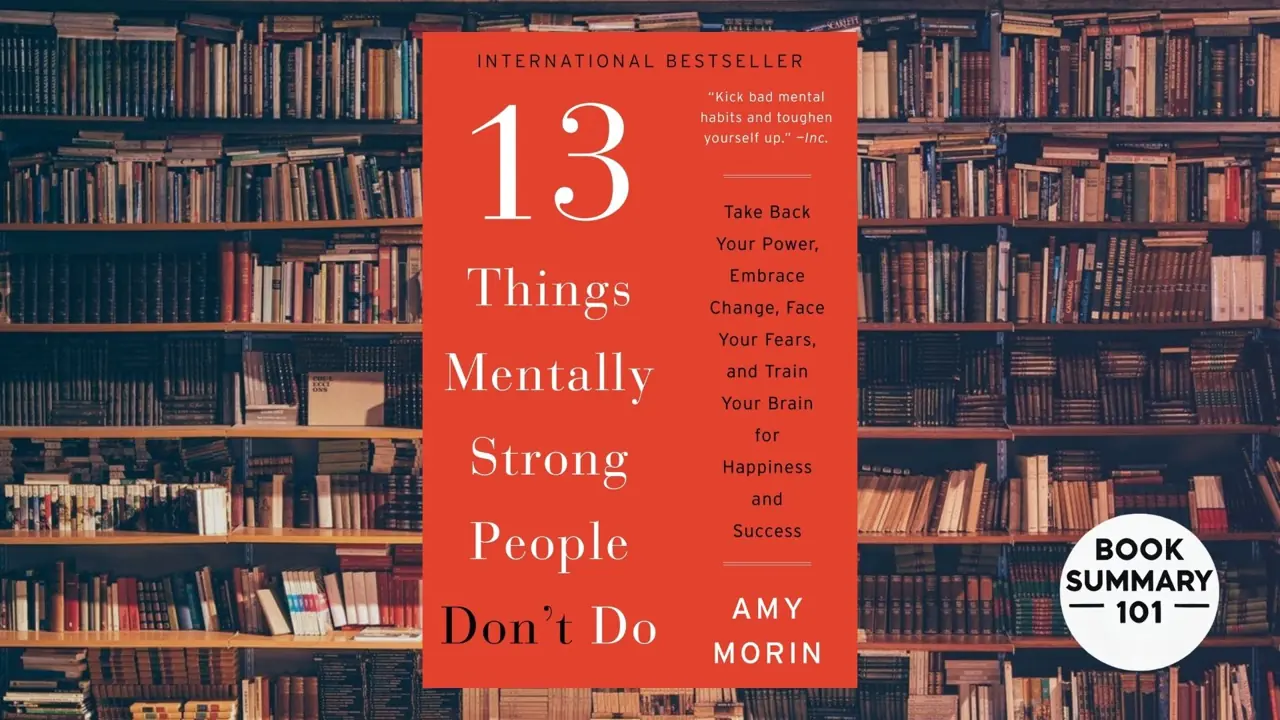
Then, I stumbled across Amy Morin’s book, 13 Things Mentally Strong People Don’t Do. And it hit me like a ton of bricks.
I realized I had been approaching mental strength all wrong. I was focused on adding “good” things to my life, but I was completely ignoring the “bad” habits that were sabotaging my efforts.
Imagine you’re trying to get physically fit. You go to the gym for an hour every day (a good habit). But then, you go home and eat three donuts for dinner every single night (a bad habit).
Are you going to see results? Absolutely not.
That’s what this book is about. It’s not a “to-do” list; it’s a “stop-doing” list. It’s about plugging the leaks in your mental boat so you can actually sail forward.
If you’ve ever felt like you’re your own worst enemy, grab a cup of coffee. Let’s break down how to take back your power.
- Why Should You Even Bother Reading It?
- The Habits That Are Holding You Hostage
- 1. The Quicksand Trap: Wasting Time Feeling Sorry for Yourself
- 2. The Remote Control: Giving Away Your Power
- 3. The Weather Forecaster: Focusing on Things You Can’t Control
- 4. The Comparison Game: Resenting Other People’s Success
- 5. The Seedling Mistake: Expecting Immediate Results
- My Final Thoughts
- Join the Conversation!
- Frequently Asked Questions (The stuff you’re probably wondering)
Why Should You Even Bother Reading It?
This isn’t just another fluffy self-help book filled with toxic positivity.
Amy Morin wrote the original list that inspired this book while she was navigating profound personal grief—losing her mother, her husband, and her father-in-law in a short span of time.
She wrote this for herself to survive.
Because of that, the advice is incredibly grounded and practical. It is perfect for:
- The Overwhelmed: If you feel like your emotions are driving the bus rather than you.
- The High-Achiever: If you’re working hard but feel like invisible barriers are holding you back.
- The “Nice” Person: If you struggle with people-pleasing and setting boundaries.
In a world that constantly tells us to do more, this book gives us permission to do less of the things that hurt us.
The Habits That Are Holding You Hostage
Mental strength isn’t about suppressing your emotions or acting like a robot; it’s about regulating your thoughts, managing your emotions, and behaving productively, despite your circumstances. Below are five of the most critical concepts from the book that reshaped how I view resilience.
1. The Quicksand Trap: Wasting Time Feeling Sorry for Yourself
We’ve all been there. Something goes wrong—a flat tire, a rejected application, a rude comment—and we spiral. We start thinking, “Why does this always happen to me?”
Morin compares self-pity to quicksand. The more you thrash around in it, complaining about how unfair your situation is, the deeper you sink.
When you are deep in self-pity, you are blind. You can’t see the solution because you are too focused on the problem. It stalls your life. You aren’t moving forward; you’re just wallowing.
The Real-World Example:
Think about a time you didn’t get a promotion you wanted.
- The Self-Pity Route: You spend weeks complaining to coworkers, slacking off because “they don’t appreciate me anyway,” and listing all the reasons the boss is unfair. Result: You look bitter and unpromotable.
- The Mentally Strong Route: You allow yourself a moment of disappointment (that’s healthy!), but then you shift gears. You ask for feedback, look for new skills to learn, or update your resume.
📖 “Self-pity is easily the most destructive of the non-pharmaceutical narcotics; it is addictive, gives momentary pleasure and separates the victim from reality.”
Simple Terms: complaining about how hard your life is actually makes your life harder.
The Takeaway: Acknowledge your pain, but refuse to host a pity party. Swap “I deserve better” for “I will do better.”
2. The Remote Control: Giving Away Your Power
Imagine you have a remote control that operates your brain and your emotions. Now, imagine you walk up to your annoying coworker, or your critical mother-in-law, hand them the remote, and say, “Here. Anytime you want to make me feel angry or small, just press a button.”
That sounds ridiculous, right? But that is exactly what we do when we lack emotional boundaries.
When you say things like, “My boss makes me so mad,” or “My partner ruins my day,” you are admitting that they control your emotional state, not you. You are giving away your power. Mentally strong people keep their remote control in their own pocket.
The Real-World Example:
Let’s look at “Road Rage.” You get cut off in traffic.
If you scream, honk, and let it ruin your morning mood, you just let a total stranger in a Honda Civic control your happiness.
Taking back your power means taking a deep breath and deciding that your peace of mind is more important than teaching that stranger a lesson they won’t learn anyway.
Simple Terms: Stop blaming other people for how you feel or act.
The Takeaway: You can’t control how others treat you, but you have 100% control over how you react to it.
3. The Weather Forecaster: Focusing on Things You Can’t Control
Trying to control everything is a recipe for anxiety. Morin uses a great analogy regarding the weather.
Imagine standing on your front porch during a thunderstorm and screaming at the clouds to stop raining. You worry about the rain, you pace back and forth, and you obsess over when it will stop.
Does the storm care? No. You are wasting energy on something that will happen regardless of your input.
We do this constantly. We worry about the economy, we worry about traffic, we worry about what other people think of us. This need for control usually stems from anxiety. We think if we worry enough, we can prevent bad things from happening.
The Real-World Example:
Consider an airline delay.
- The Control Freak: Screams at the gate agent (who didn’t break the plane), tweets angrily at the airline, and spikes their own blood pressure.
- The Mentally Strong: Accepts the delay is out of their hands. They use the time to read a book, catch up on emails, or simply rest.
Simple Terms: Identify what is out of your hands and let it go.
The Takeaway: Invest your energy in the only two things you can actually control: your effort and your attitude.
4. The Comparison Game: Resenting Other People’s Success
Comparison is the thief of joy, but resentment is the thief of success.
Imagine life is a marathon. You are running in your lane. Suddenly, you see the runner next to you speed up.
If you turn your head to stare at them, seething with jealousy because they are faster, what happens? You trip. You slow down. You lose your form.
Resenting someone else’s success doesn’t take away their success; it only hinders yours. It shifts your focus from your goals to their accolades. Morin explains that this usually comes from a “scarcity mindset”—the false belief that success is a limited pie, and if someone else gets a big slice, there’s less for you.
The Real-World Example:
Social media is the breeding ground for this. You see a friend from high school post about their new luxury house on Instagram.
If you feel a knot in your stomach and think, “Why them? I work harder than they do,” you are in the resentment trap.
The mentally strong person looks at that house and thinks, “Good for them. That’s proof that achieving big goals is possible. I’m going to keep working on mine.”
📖 “Resentment is like drinking poison and hoping the other person will die.”
Simple Terms: Blowing out someone else’s candle won’t make yours shine any brighter.
The Takeaway: Stop viewing life as a competition. Celebrate others, and you’ll attract more success to yourself.
5. The Seedling Mistake: Expecting Immediate Results
We live in an Amazon Prime world. We want next-day delivery on our goals.
Morin likens this to planting a seed in a garden. You water it, and then an hour later, you dig it up to see if the roots have grown. Then you bury it, water it, dig it up again the next day.
Not only will you not see results, but you are actively killing the plant by disturbing the process.
Whether it’s therapy, a new diet, or starting a business, real change takes time. The expectation of immediate results is actually a form of self-sabotage because it leads to premature quitting.
The Real-World Example:
The “New Year’s Resolution” syndrome. You go to the gym five times in January. You look in the mirror and don’t see a six-pack yet. You decide, “This isn’t working,” and you quit by February.
Mentally strong people understand that progress is often non-linear and invisible at first. They commit to the long haul.
Simple Terms: Good things take time; stop quitting just because you aren’t rich or fit by Tuesday.
The Takeaway: Treat your goals like a slow-cooker, not a microwave. Patience is a superpower.
My Final Thoughts
13 Things Mentally Strong People Don’t Do was a wake-up call for me.
It taught me that mental strength isn’t about adding more “hustle” to my day. It’s about stripping away the heavy, toxic habits that were weighing me down.
It’s incredibly empowering to realize that you don’t need to change the world, your boss, or your family to be happy. You just need to change how you respond to them.
When you stop giving your power away, stop expecting the world to be fair, and stop resenting others, you suddenly find you have a lot more energy to actually build the life you want.
Join the Conversation!
I’d love to hear from you. Which of these “bad habits” do you struggle with the most? For me, it was definitely #2 (Giving Away Power). Drop a comment below and let me know which one hit home for you!
Frequently Asked Questions (The stuff you’re probably wondering)
1. Is this book only for people who are grieving or depressed?
Not at all. While the author wrote it during a time of grief, the principles apply to everyone. Whether you are a CEO, a student, or a stay-at-home parent, these habits help you handle stress and achieve goals more effectively.
2. Do I need to be a psychology expert to understand it?
No. The book is written in very plain, accessible English. Amy Morin uses everyday examples and avoids heavy clinical jargon. It feels like advice from a wise friend, not a textbook.
3. Is this a religious book?
No. The concepts are based on cognitive behavioral therapy (CBT) and stoic philosophy, but they are not tied to any specific religion.
4. Can I just read the viral list online, or do I need the book?
The list is a great starting point, but the book goes much deeper. It provides the “how” and “why” behind each point, along with exercises to help you actually break the habits. If you want real change, read the book.
5. How long does it take to see results from these changes?
As mentioned in point #5, don’t expect immediate results! However, you will likely feel a sense of relief and empowerment almost immediately after you stop engaging in some of these draining behaviors. It’s a lifelong practice, not a quick fix.