Have you ever looked at your city’s economic plan and rolled your eyes?
You know the one I’m talking about. The local mayor announces a new initiative to build a “Tech Hub.” They promise to turn your quiet hometown into “The Silicon Valley of the [Insert Region Here].” They use buzzwords like “disruption,” “incubators,” and “unicorns.”
For years, I felt this weird disconnect. I looked around my city—which was full of manufacturers, logistics companies, and service providers—and wondered, “Why are we trying to pretend we’re a software giant in California? Does that even make sense?”
I felt like I was the only one not drinking the Kool-Aid.
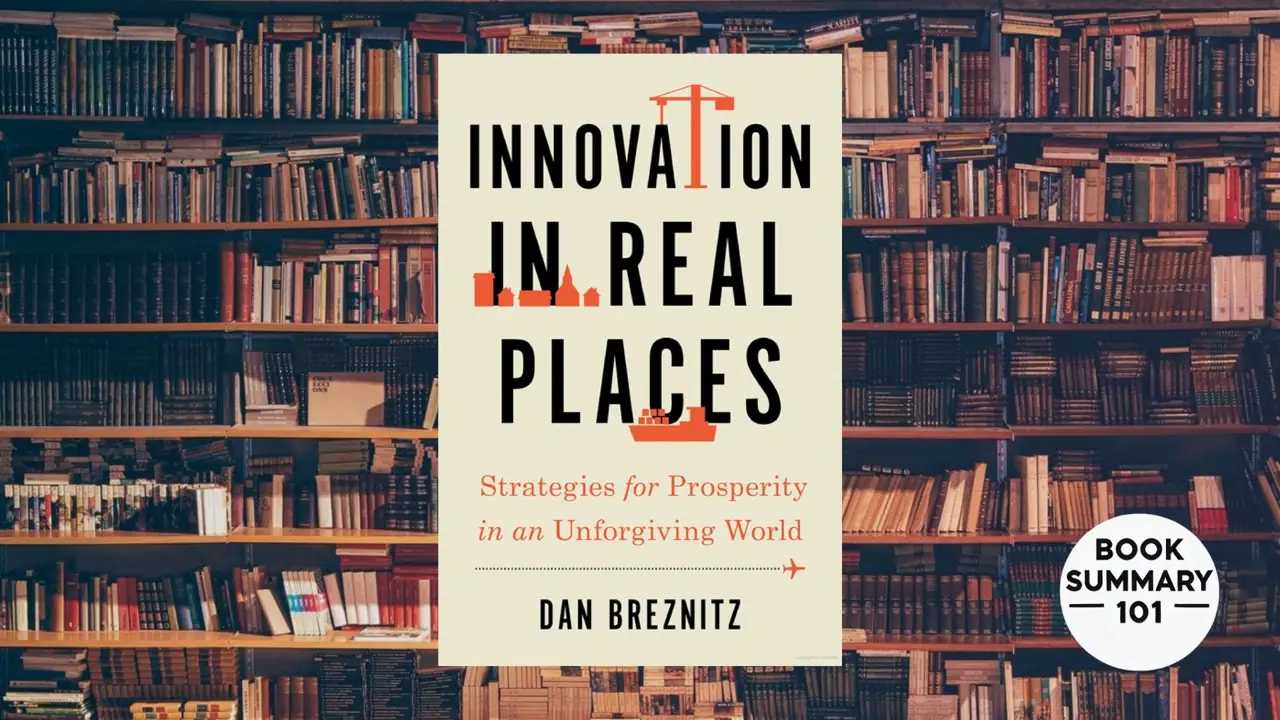
Then I read “Innovation in Real Places: Strategies for Prosperity in an Unforgiving World” by Dan Breznitz. And let me tell you, it was like a breath of fresh air. It was validation.
Breznitz, a renowned professor and economic policy advisor, basically sat me down (figuratively speaking) and said, “You’re right. Trying to clone Silicon Valley is actually the worst thing your city can do.”
This book isn’t a dry academic paper. It’s a manifesto for sanity. It explains why real prosperity comes from figuring out what your place is actually good at, rather than playing dress-up as someone else.
- Why Should You Even Bother Reading It?
- The Four Different Faces of Innovation (And Why You Only Need One)
- 1. The Great Confusion: Invention is NOT Innovation
- 2. The “Silicon Valley” Trap (The High-Tech Mirage)
- 3. Stage Two Innovation: The “Shenzhen” Model
- 4. Stage Three Innovation: The “Old Industry” Renewal
- 5. The Agents of Innovation (Fixing the Ecosystem)
- My Final Thoughts
- Join the Conversation!
- Frequently Asked Questions (The stuff you’re probably wondering)
Why Should You Even Bother Reading It?
You might be thinking, “I’m not a city planner or an economist. Why do I care?”
You should care because this book is about your job, your rent, and your community.
If you are tired of the “wealth gap” widening in your city, this book explains why. If you are a business owner wondering where you fit in a “high-tech” world, this book gives you a roadmap.
It is perfect for:
- The Skeptics: People tired of tech-bro hype.
- The Leaders: Local organizers who want real growth, not just headlines.
- The Curious: Anyone wondering why some cities boom while others bust.
It teaches us that innovation isn’t just about coding apps; it’s about how we build, improve, and sell things in the real world.
The Four Different Faces of Innovation (And Why You Only Need One)
We tend to think of “innovation” as a single, magical lightning strike. We think it only happens when a guy in a hoodie invents a new social network.
But Breznitz argues that innovation is actually a spectrum—like a relay race. There are different runners on the track, and you don’t have to run the first leg to win the gold medal.
Here are the core concepts from the book that completely reshaped how I view the economy.
1. The Great Confusion: Invention is NOT Innovation
This is the foundation of the entire book. Most people use the words “invention” and “innovation” interchangeably. Breznitz stops us right there and says, “Nope.”
Think of it like cooking.
- Invention is coming up with a brand-new, never-before-seen chemical flavor compound. It’s cool, it’s novel, and it’s done in a lab.
- Innovation is taking ingredients (whether new or old) and creating a delicious meal that millions of people actually want to eat and pay for.
The book argues that we are obsessed with the “Invention” part—the Nobel Prize stuff. But economically, the money and the jobs are usually found in the innovation stages that come after the initial idea.
Real-World Example:
Look at the iPod. Apple did not invent the MP3 player (the invention). Other companies had them years earlier. Apple worked on the design, the user interface, and the iTunes ecosystem (the innovation). The invention was the spark; the innovation was the fire. Breznitz teaches us that you can be incredibly wealthy without ever inventing the core technology.
📖 “Innovation is the implementation of new ideas, not their invention.”
Simple Terms:
Having a bright idea is worthless unless you can turn it into a product people actually use.
The Takeaway:
Stop obsessing over filing patents and start obsessing over how to make existing technology better, cheaper, or more reliable.
2. The “Silicon Valley” Trap (The High-Tech Mirage)
This section hit me hard. Breznitz describes the “Silicon Valley Model” as a specific, high-risk, high-reward type of innovation. It relies on massive venture capital and hunting for “Unicorns” (startups worth billions).
The analogy here is The Hollywood Star System.
Silicon Valley is like Hollywood. For every Brad Pitt, there are 10,000 waiting tables. It creates a massive wealth gap. You have a few billionaires and an army of service workers who can’t afford rent.
When a regular city tries to copy this, they usually end up with the bad parts (high inequality, gentrification) without the good parts (the one-in-a-million Google success story).
Real-World Example:
Think of the countless cities that built “Science Parks” or “Innovation Districts” in the early 2000s. Most of them sit half-empty today. They tried to plant palm trees in Alaska. They ignored their local strengths (like agriculture or heavy industry) to chase a software dream that didn’t fit their DNA.
Simple Terms:
Don’t try to be a movie star if your city is really good at being a carpenter.
The Takeaway:
Copying Silicon Valley usually leads to high inequality and economic failure for normal cities.
3. Stage Two Innovation: The “Shenzhen” Model
If you shouldn’t be Silicon Valley, what should you be? Breznitz introduces us to Second-Stage Innovation: The art of making things real.
Imagine a Lego set.
Silicon Valley draws the picture on the box. But someone has to figure out how to mold the plastic bricks, ensure they snap together perfectly, and produce 50 million of them without a defect.
This is what Shenzhen, China, did. They didn’t just provide “cheap labor.” They became the world’s experts in prototyping and production engineering. If you have an idea for a drone, Shenzhen can figure out how to build it in 24 hours. That is a massive, high-value innovation.
Real-World Example:
Consider DJI Drones. While the concept of drones existed, DJI (based in Shenzhen) dominated the market not just because of the software, but because they mastered the rapid iteration of hardware. They could design, build, test, and redesign a physical product faster than anyone in the US because their factories were part of the innovation lab.
Simple Terms:
There is massive wealth in being the place that figures out how to build the product better and faster than the inventor.
The Takeaway:
Manufacturing isn’t “old school”—it’s a sophisticated innovation engine if done right.
4. Stage Three Innovation: The “Old Industry” Renewal
This was my favorite section because it gives hope to “rust belt” cities. This is about innovating in established industries.
Think of this like restoring classic cars.
You take something old—a vintage Ford Mustang—and you put a modern Tesla engine and Bluetooth sound system inside it. It looks classic, but it runs on the cutting edge.
Breznitz points to Italy as the master of this. They take “old” industries—shoes, textiles, furniture—and inject them with high-tech logistics, design, and materials science. They aren’t making apps; they are making $500 sneakers using robotics.
Real-World Example:
The Riviera del Brenta in Italy. This is a cluster of shoemakers. It sounds quaint, but it’s not. They produce footwear for almost all the major global luxury brands (Dior, Chanel). They innovate in leather treatment, supply chain speed, and design adaptation. They have sustained high wages and a strong economy without a single software unicorn in sight.
📖 “There is no such thing as a ‘low-tech’ industry, only low-tech firms.”
Simple Terms:
You can be incredibly high-tech and innovative while making “boring” stuff like shoes, lamps, or tires.
The Takeaway:
Don’t abandon your city’s history; modernize it.
5. The Agents of Innovation (Fixing the Ecosystem)
Finally, Breznitz explains that you can’t just wish for these things. You need the “Agents of Innovation” to work together.
The analogy here is a Jazz Quartet.
You have the University, the Government, the Finance Sector, and the Private Industry.
- If the University is playing classical music (pure research),
- And the Banks are playing heavy metal (looking for short-term quick wins),
- And the Government is playing silence (doing nothing)…
You get noise, not music.
In successful places, these agents align. The local university teaches the specific skills the local factories need. The local banks understand the specific risks of the local industry.
Real-World Example:
Israel. Breznitz (who grew up there) details how the Israeli government didn’t just step back; they stepped in. Through the Office of the Chief Scientist, they provided grants that took the risk out of R&D for local companies. They acted as the “risk absorber” that allowed the private sector to bloom. The “band” was playing from the same sheet music.
Simple Terms:
Innovation requires the government, schools, and banks to all support the same specific strategy.
The Takeaway:
A city cannot thrive if its universities and banks are ignoring the needs of its actual local businesses.
My Final Thoughts
Reading Innovation in Real Places felt like taking off a tight pair of shoes. It was a relief.
For so long, we’ve been told there is only one way to win: The Digital Way. The App Way. The Venture Capital Way. Dan Breznitz dismantles that myth with surgical precision.
He empowers us to look at our own communities and say, “We don’t need to be San Francisco. We can be the best version of us.” Whether that means being the best at manufacturing medical devices, the best at processing food, or the best at specialized logistics.
It’s a hopeful book because it democratizes success. It tells us that prosperity isn’t locked behind the gates of Google; it’s available to any place willing to do the hard work of understanding itself.
Join the Conversation!
I’d love to hear your take on your local economy. What is one “boring” industry in your town that is actually secretly high-tech or vital to the world? Drop a comment below—let’s celebrate the real places!
Frequently Asked Questions (The stuff you’re probably wondering)
1. Is this book really technical and full of economic jargon?
Not really. While Breznitz is an academic, the book is written for a general audience. If you read the summary above and understood it, you’ll be fine with the book. He uses plenty of examples to back up his theories.
2. Do I need to be in government or tech to appreciate this?
No. It’s actually great for small business owners and investors. It helps you spot trends and understand where the real value lies in a market, beyond just the “hype” of new startups.
3. Is the author anti-technology?
definitely not. He loves technology. He is just anti-the-idea that only software technology counts as innovation. He argues for using high-tech methods in all industries.
4. Does the book offer a step-by-step guide for my city?
It doesn’t give a “10 Steps to Success” list because Breznitz’s whole point is that every city is different. However, it gives you the questions you need to ask to build your own guide.
5. Why is “Silicon Valley Envy” so dangerous?
Because the Silicon Valley model relies on a “winner-take-all” outcome. For one person to become a billionaire, thousands often fail. When a city copies this, they often get the inequality (high housing costs, gentrification) without the billionaires.