I have a confession to make.
A few months ago, I found myself standing in the middle of my kitchen, staring blankly at my phone. I had walked in there to get a glass of water, but somewhere between the living room and the sink, I felt a phantom vibration.
Ten minutes later, I was still standing there, dehydrated, scrolling through the vacation photos of a person I hadn’t spoken to since high school.
I felt gross. I felt like my brain had been hijacked. I realized that my technology wasn’t a tool anymore; it was a master.
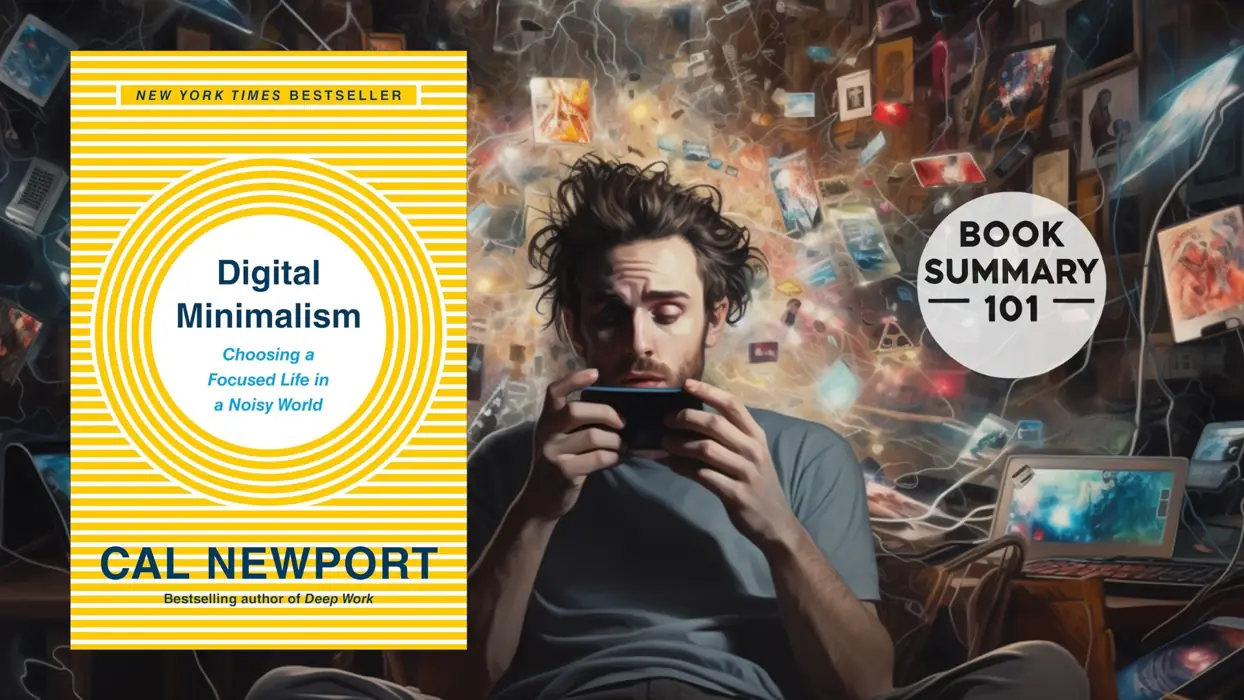
If you’ve ever felt that low-grade anxiety when your phone isn’t within arm’s reach, or if you end your day wondering where all your free time went, you aren’t alone. I was right there with you until I picked up “Digital Minimalism: Choosing a Focused Life in a Noisy World” by Cal Newport.
Reading this book felt like sitting down with a wise, non-judgmental friend who gently takes the phone out of your hand and says, “Hey, let’s get your life back.”
It changed the way I view every screen in my house. And I think it can do the same for you.
- Why Should You Even Bother Reading It?
- The Philosophy and Practices That Will Save Your Brain
- 1. The Philosophy of Digital Minimalism
- 2. The Digital Declutter (The 30-Day Reset)
- 3. Solitude Deprivation
- 4. Reclaiming Conversation
- 5. The Bennett Principle (High-Quality Leisure)
- My Final Thoughts
- Join the Conversation!
- Frequently Asked Questions (The stuff you’re probably wondering)
Why Should You Even Bother Reading It?
You might be thinking, “Great, another book telling me to throw my iPhone in a lake and go live in a yurt.”
Relax. That is not what this book is about.
Digital Minimalism is perfect for the busy professional, the exhausted parent, or anyone who loves technology but hates the way it makes them feel. It is not anti-technology; it is anti-passivity.
If you feel like your attention span has shattered into a million pieces, or if you’re tired of algorithms dictating your mood, this summary is the roadmap you’ve been looking for.
The Philosophy and Practices That Will Save Your Brain
Cal Newport doesn’t just give a list of “life hacks” or tips like turning off notifications. Instead, he offers a complete philosophy of living. He argues that we can’t simply “use less” phone time; we have to rebuild our relationship with technology from the ground up.
Here are the core concepts from the book that completely reshaped my thinking.
1. The Philosophy of Digital Minimalism
The Analogy: The Carefully Packed Suitcase
Imagine you are going on a three-week hiking trip through the mountains. You have one backpack.
You wouldn’t walk into a store and blindly sweep every item from the shelves into your bag, saying, “Well, this might be useful,” or “I don’t want to miss out on having this waffle iron.” If you did that, your pack would be too heavy to carry, and you’d be miserable.
Instead, you carefully select only the tools that serve your specific mission.
Newport argues that most of us treat our digital lives like the frantic shopper. We download every app and sign up for every service because “it might be useful” or we have FOMO (Fear Of Missing Out).
Digital Minimalism is the backpacker approach. It is a philosophy where you only use technology that supports the things you deeply value (like connection, creativity, or health) and happily miss out on everything else.
It flips the script. Instead of asking, “Is this app bad?”, you ask, “Is this app the best way to support something I value?”
Simple Terms: Don’t just clutter your life with digital tools because they exist; only pick the ones that help you be the person you want to be.
The Takeaway: Technology should be a tool you wield, not a slot machine that wields you.
2. The Digital Declutter (The 30-Day Reset)
The Analogy: Renovating a Hoarder’s House
If a house is filled to the ceiling with junk, you can’t just organize it a little bit every day. You have to strip the room down to the studs. You have to empty it completely so you can see the floor again. Only then do you bring back the furniture—but only the pieces you truly love and need.
Newport suggests that we are digital hoarders. To fix this, he proposes The Digital Declutter.
This is a 30-day period where you take a break from all optional technologies. No Facebook, no Instagram, no Netflix, no video games.
If it’s not essential for your job or safety, it goes.
During these 30 days, you will feel withdrawal. You will be bored. But you will also rediscover what you actually like to do. You might start painting, hiking, or actually talking to your neighbors.
After the 30 days, you don’t just go back to your old habits. You re-introduce apps one by one, only if they pass a strict test: Does this add massive value to my life?
📖 “To reestablish control, we need to move past tweaks and instead rebuild our relationship with technology from scratch, using our deeply held values as a foundation.”
Simple Terms: Quit all optional tech for a month to break your addiction, then only let the really good stuff back in.
The Takeaway: You can’t change your habits while you’re still in the middle of the noise. You need a hard reset.
3. Solitude Deprivation
The Analogy: Emotional Nutrition
Imagine if you ate food every single second you were awake. You’re chewing while you walk, chewing while you drive, chewing while you work. Your digestive system would eventually crash because it never had time to process anything.
Newport argues we are doing this to our brains. We are stuffing them with “input” (podcasts, music, texts, news) every waking second.
We have lost Solitude.
In this book, solitude doesn’t mean being isolated in a cabin. It means freedom from input from other minds. It means being alone with your own thoughts.
Because of smartphones, we are the first humans in history who can eliminate every single moment of solitude. The result? Solitude Deprivation. We lose the ability to clarify our problems, regulate our emotions, and come up with original ideas. We are terrified of our own thoughts, so we plug in headphones the second we step out the door.
Real-World Example:
Think about the last time you stood in line at a grocery store or waited for an elevator. Did you stare into space and think? Or did you reflexively whip out your phone? That reflex is killing your solitude.
Simple Terms: Your brain needs quiet time without phones or distractions to process your life and keep you sane.
The Takeaway: Leave the phone at home when you go for a walk. Let your brain breathe.
4. Reclaiming Conversation
The Analogy: Fast Food vs. A Home-Cooked Meal
We all know that a greasy fast-food burger provides calories, but it doesn’t provide nutrition. If you only eat fast food, you’ll survive, but you’ll be unhealthy.
Newport compares text-based communication (Likes, comments, iMessage, Slack) to digital fast food. It gives you a quick hit of “connection,” but it lacks the nutrition of face-to-face interaction.
He calls this the difference between Connection (low-bandwidth digital clicks) and Conversation (high-bandwidth, voice-or-face interaction).
We have tricked ourselves into thinking that liking a friend’s photo is the same as maintaining a friendship. It isn’t. The book argues that we should stop trading “conversation” for mere “connection.”
Newport suggests a radical tactic: Stop clicking “Like.” Don’t leave comments. If you care about someone, call them. Meet them for coffee. Use technology to set up the meeting, but don’t let the technology be the meeting.
Simple Terms: Texting is not talking. Real relationships require hearing a voice or seeing a face.
The Takeaway: Stop settling for low-quality digital clicks and start prioritizing high-quality real-world talks.
5. The Bennett Principle (High-Quality Leisure)
The Analogy: Pulling Weeds vs. Planting Flowers
If you have a garden full of weeds (bad digital habits), pulling them out is only step one. If you leave the dirt bare, the weeds will just grow back. You have to plant beautiful flowers (good analog habits) to fill the space.
Many people fail the “Digital Declutter” because they remove their phone but don’t replace it with anything. They just sit there, bored.
Newport introduces the Bennett Principle, which suggests that active leisure is much more recharging than passive consumption.
Using your hands to build a table, learning to play the guitar, or joining a running club requires energy, but it actually leaves you feeling more energized than three hours of “relaxing” on TikTok.
The book pushes you to reclaim “demanding” hobbies. When you have a rich life filled with activities you love, the phone naturally becomes less interesting. You don’t scroll because you’re too busy actually living.
📖 “The value we receive from high-quality leisure is largely independent of the specific activity… what matters is that we are using our human faculties to do something demanding and skillful.”
Simple Terms: You can’t just remove bad tech habits; you have to fill that time with active, hands-on hobbies that make you happy.
The Takeaway: Don’t just say “no” to the phone; say “yes” to painting, fixing, running, and creating.
My Final Thoughts
When I finished Digital Minimalism, I didn’t smash my smartphone with a hammer. I actually still use Instagram and Twitter.
But the dynamic has changed.
I felt a massive sense of relief. I realized that the “itch” to check my phone wasn’t a moral failing on my part; it was a result of billion-dollar companies engineering slot machines in my pocket.
By applying Newport’s 30-day reset (yes, I did it, and yes, the first week was hard), I reclaimed my brain. I now leave my phone in the kitchen when I sleep. I go for walks without headphones.
The world didn’t end. In fact, the world got a lot brighter, sharper, and more interesting. This book gave me permission to log off, and it’s the most liberating permission slip I’ve ever signed.
Join the Conversation!
I’d love to hear about your digital struggles.
What is the one app or digital habit you feel has the most control over you right now? The one you wish you could quit but feel like you can’t?
Drop a comment below. Let’s figure this out together.
Frequently Asked Questions (The stuff you’re probably wondering)
1. Do I have to quit social media entirely to be a “Digital Minimalist”?
No. Digital Minimalism isn’t about deletion; it’s about optimization. You might keep Facebook, but delete the app from your phone and only check it on your laptop for 20 minutes on Sundays. It’s about setting strict boundaries.
2. I work in tech/marketing/media. Can I still do this?
Absolutely. In fact, it’s even more important for you. Newport distinguishes between using tech for work and using it for distraction. You can be a pro at using digital tools during work hours and still be a minimalist in your personal life.
3. Is the 30-day “Digital Declutter” really necessary? Can’t I just try to use my phone less?
Newport argues that willpower isn’t enough. The apps are engineered to be addictive. The 30-day break acts as a detox to break the dopamine loop. Without the hard reset, most people slide back into old habits within days.
4. What if I miss an emergency if I don’t have my phone?
This is a common fear. The book suggests simple workarounds, like “Do Not Disturb” modes that allow calls from immediate family to break through, or telling key people, “If it’s an emergency, call me twice.” True emergencies are rare; distraction is constant.
5. Is this book too technical or academic?
Not at all. Cal Newport is a computer science professor, but he writes for a general audience. The book is filled with stories about Abraham Lincoln, Benjamin Franklin, and modern-day people. It is very readable and practical.