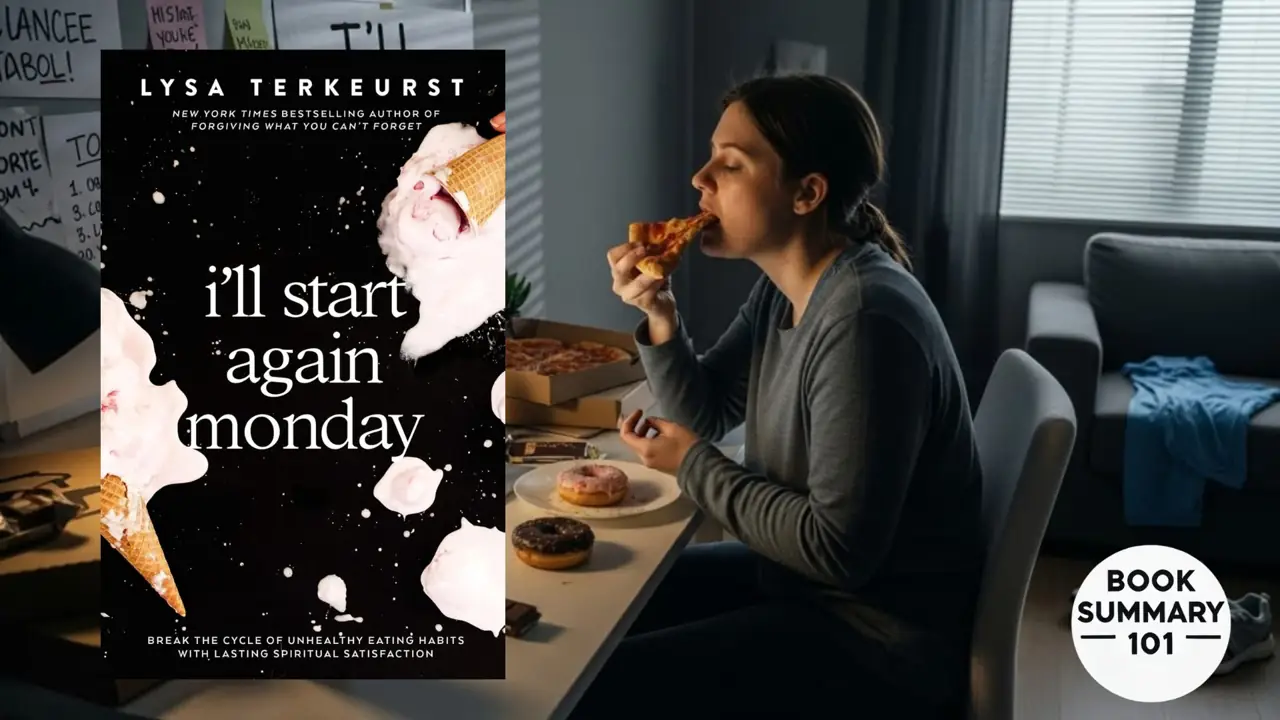
We have all been there. It’s Sunday night. You’re staring at the bottom of an empty ice cream carton or a pizza box, feeling that familiar, heavy mix of physical bloating and emotional shame.
Maybe you’ve had a stressful week. Maybe you just wanted a treat. But somewhere between the first bite and the last crumb, you lost control. Again.
So, you make a deal with yourself. You look at the calendar and declare with absolute conviction: “It’s okay. I’ll just eat whatever I want tonight, and I’ll start again Monday.”
Monday becomes the magical day where you will suddenly have the willpower of a Navy SEAL and the appetite of a bird. But then Monday comes, stress hits, and the cycle repeats.
I lived in that cycle for years. It’s exhausting, isn’t it? It feels like you are constantly fighting a war against your own cravings and losing every single time.
That is exactly why I picked up I’ll Start Again Monday: Break the Cycle of Unhealthy Eating Habits with Lasting Spiritual Satisfaction by Lysa TerKeurst.
I didn’t need another diet plan. I knew how to count calories. I needed someone to explain why I couldn’t stick to the plan. Reading this book felt less like a lecture from a nutritionist and more like a tearful, honest conversation with a best friend who actually gets it.
- Why Should You Even Bother Reading It?
- Making Peace with Your Plate and Your Soul
- 1. The “I’ll Start Again Monday” Trap (The Procrastination Loop)
- 2. Acceptance vs. Resignation (The Broken Compass)
- 3. The 2.5 Seconds of Chewing (Fleeting Pleasure)
- 4. Stop Staring at “So-and-So’s” Plate ( The Comparison Trap)
- 5. Comfort vs. Consolation (The Soul Hunger)
- 6. The “Exhausted Girl” Inside You (Decision Fatigue)
- My Final Thoughts
- Join the Conversation!
- Frequently Asked Questions (The stuff you’re probably wondering)
Why Should You Even Bother Reading It?
If you have a healthy relationship with food, where you eat when you’re hungry and stop when you’re full, you can probably skip this one.
But, if you find yourself turning to the pantry when you’re lonely, stressed, or bored, this book is essential. It is perfect for anyone—specifically those with a faith background—who feels stuck in the tug-of-war between wanting to be healthy and wanting to eat everything in sight.
It’s not for people looking for a Keto recipe or a workout routine. It’s for the person who knows what to do but can’t seem to make their brain and body cooperate to actually do it.
Making Peace with Your Plate and Your Soul
Lysa TerKeurst doesn’t throw a bunch of disconnected tips at you. Instead, she invites you on a journey to reframe how you view food, not as an enemy to be defeated, but as a resource that has taken up too much space in your heart.
Before we dive into the specific lessons, know this: The core message here is that lasting change doesn’t come from hating your body into submission. It comes from realizing that food was never designed to fix your soul.
1. The “I’ll Start Again Monday” Trap (The Procrastination Loop)
We treat “Monday” like a magical reset button. In the book, Lysa identifies this as one of the biggest lies we tell ourselves. It’s a form of procrastination that validates bad behavior in the present.
Think of it like a credit card. When you say, “I’ll start again Monday,” you are spending “calories” on credit today, assuming you’ll have the emotional wealth to pay off the debt next week. But when next week comes, you’re usually just as emotionally broke as you are today.
By putting the responsibility on “Future You,” “Present You” gets a free pass to binge. This destroys your confidence because you are essentially breaking a promise to yourself every single week.
Real-World Example:
Imagine you have a messy house. If you say, “I’ll clean the whole thing perfectly on Monday,” you might let dishes pile up all weekend because “Monday will fix it.” By the time Monday arrives, the mess is so overwhelming that you give up before you start. The book encourages handling the “dishes” (choices) right now, in the moment, rather than waiting for a perfect start date.
Simple Terms:
Stop waiting for a “perfect” start date; every meal is a chance to make a good choice.
The Takeaway:
Postponing healthy choices creates a cycle of shame; breaking the cycle requires making a good choice right now, regardless of what day of the week it is.
2. Acceptance vs. Resignation (The Broken Compass)
This was a huge “aha!” moment for me. Lysa distinguishes between acceptance and resignation. They sound similar, but they send you in completely different directions.
Imagine you are lost in the woods with a map.
- Resignation is throwing the map on the ground, sitting down, and saying, “I’m lost, I’m hopeless, I might as well eat these poisonous berries because I’m never getting out of here.”
- Acceptance is looking at the map and saying, “Okay, I am lost. I am currently at point A, and I want to be at point B. This is going to be a hard hike, and I might trip, but I acknowledge where I am so I can start walking.”
Resignation leads to despair and bingeing (“I’m already fat, so who cares?”). Acceptance deals with reality (“I struggle with sugar, so I need to be careful, but I can do this”).
📖 “Resignation feels like a weight that settles in and paralyzes us. Acceptance is a realization that propels us forward.”
Real-World Example:
Think about a budget. Resignation says, “I’m in debt, so I might as well buy this expensive purse.” Acceptance says, “I have debt. It sucks. But I acknowledge it, so I’m going to skip the purse today to help my future self.”
Simple Terms:
Admitting you have a struggle is healthy; deciding you’ve already lost the battle is toxic.
The Takeaway:
You must accept your current reality—weight, struggles, and triggers—without resigning yourself to defeat if you want to move forward.
3. The 2.5 Seconds of Chewing (Fleeting Pleasure)
This concept is the ultimate reality check. Lysa asks us to do the math on why we eat “illegal” foods (foods we are trying to avoid).
Why do we eat the donut? Because it tastes amazing.
How long does it taste amazing? Only while it is in your mouth.
Lysa estimates that the actual sensory pleasure of eating a bite of food lasts about 2.5 seconds. Once you swallow, the taste is gone. The texture is gone. The experience is over.
If you eat a whole donut, you might get 60 seconds of pleasure. But after those 60 seconds, the pleasure vanishes, and you are left with the consequences—guilt, bloating, and blood sugar spikes—that can last for hours or days.
Real-World Example:
It’s like spending your entire monthly paycheck on a firework. It is incredibly beautiful and exciting for three seconds. But once it pops, you are left in the dark with no money for rent. Was the explosion worth the eviction? Usually, no.
Simple Terms:
Don’t trade hours of feeling terrible for a few seconds of tasting something good.
The Takeaway:
When a craving hits, remind yourself that the pleasure of the taste is incredibly brief, but the result of the healthy choice lasts all day.
4. Stop Staring at “So-and-So’s” Plate ( The Comparison Trap)
We all know “So-and-So.”
She’s the friend who orders the double cheeseburger with fries, eats the whole thing, and stays a size 2. Meanwhile, you order the salad with dressing on the side and feel like you gained weight just looking at her fries.
Lysa tackles the spiritual bitterness that comes from comparing our struggles to others. When we obsess over why we have to struggle while they get to eat freely, we are questioning God’s fairness.
She uses the analogy of “assigned portions.” Just as we have different financial situations or different talents, we have different biological realities. Staring at someone else’s plate doesn’t change what’s on yours; it just makes your food taste like bitterness.
Real-World Example:
This is like being angry that your neighbor has a sports car while you have a minivan. Staring at their car won’t turn your van into a Porsche. It just makes you hate your van. You have to drive the vehicle you were given to get where you need to go.
Simple Terms:
Comparing your metabolism or diet to someone else’s only creates resentment, not results.
The Takeaway:
Accept your specific body and its specific needs as your personal assignment, and stop looking sideways at what others are eating.
5. Comfort vs. Consolation (The Soul Hunger)
This is the spiritual heart of the book. We often turn to food for comfort. And let’s be honest: mac and cheese is comforting. It physically releases chemicals in our brain that soothe us.
However, Lysa argues that while food can offer temporary comfort, it cannot offer consolation.
- Comfort is numbing the pain for a moment.
- Consolation is healing the source of the pain.
When we are lonely, rejected, or stressed, we have a “soul hole.” We try to fill that spiritual or emotional hole with a physical substance (food). But you can’t solve a spiritual problem with a physical solution. It’s a mismatch.
📖 “We can’t solve spiritual struggles with physical consumption.”
Real-World Example:
If you have a flat tire, you can’t fix it by filling the gas tank. The gas tank is fine; the tire is the problem. Pouring more gas (food) into the car (body) won’t fix the flat tire (emotional/spiritual pain). You need to address the actual issue.
Simple Terms:
Food can make you feel full, but it can’t make you feel whole.
The Takeaway:
Identify what you are actually hungry for (peace, stress relief, love) and seek a spiritual solution rather than a caloric one.
6. The “Exhausted Girl” Inside You (Decision Fatigue)
Why do we usually break our diets at 8:00 PM?
Lysa talks about the “Exhausted Girl.” This is the version of you at the end of the day. She is tired of making decisions, tired of working, and tired of caring.
If you leave your food choices up to the “Exhausted Girl,” she will choose the easiest, most comforting thing—usually junk food.
To win, you have to let the “Morning Girl” (who is fresh, motivated, and thinking clearly) make the decisions for the “Exhausted Girl.” This means prepping, planning, and removing barriers so that when you are tired, the right choice is also the easy choice.
Real-World Example:
Think of this like laying out your clothes for the gym the night before. You are doing a favor for your sleepy, grumpy morning self. In food terms, this is cutting up the watermelon at 10 AM so that at 8 PM, you can just grab a bowl instead of digging for chips.
Simple Terms:
Don’t trust your tired self to make good decisions; plan ahead when you have energy.
The Takeaway:
Anticipate your moments of weakness and prepare healthy options in advance so you don’t have to rely on willpower when you are depleted.
My Final Thoughts
Reading I’ll Start Again Monday felt like a relief. It wasn’t about trying harder; it was about thinking differently.
Lysa TerKeurst helps you realize that your struggle with food isn’t just a lack of discipline—it’s often a misplaced search for satisfaction. By shifting the focus from the number on the scale to the state of our hearts, the pressure lifts.
The most empowering part is the realization that we don’t have to wait for Monday. We can stumble at lunch and make a great choice at dinner. The cycle of “all or nothing” is broken, replaced by a grace-filled progress that actually feels sustainable.
Join the Conversation!
I’d love to hear your experience with this. What is the one “trigger time” of day (like the late-night snack attack) where you find it hardest to stick to your goals? Drop a comment below—let’s support each other!
Frequently Asked Questions (The stuff you’re probably wondering)
1. Is this a diet plan with recipes?
No. This is not a “how-to” diet book. There are no recipes or calorie counts. It is a “head and heart” book designed to help you stick to whatever healthy eating plan you have chosen for yourself.
2. Is this book religious?
Yes, very. Lysa TerKeurst is a Christian author, and the book relies heavily on scripture and biblical concepts to explain self-control and satisfaction. If you are not religious, you might find the psychological tips helpful, but the core is spiritual.
3. Do I need to read “Made to Crave” first?
Not at all. While this is a companion to her earlier book Made to Crave, it stands completely on its own. In fact, many find this one more practical and easier to digest.
4. Will this help me if I’m not overweight?
Yes. The book addresses “unhealthy eating habits.” Even if you aren’t overweight, if you feel controlled by sugar, struggle with bingeing, or use food to cope with stress, this book is relevant.
5. Is the tone judgmental?
Absolutely not. Lysa is incredibly vulnerable about her own struggles with weight and food. She writes from the trenches, not from a pedestal. You will feel understood, not judged.