I used to stand in the grocery aisle, staring at a package of cheap ground beef next to a much more expensive plant-based option (or organic grass-fed beef), and feel completely torn.
My brain knew I should buy the sustainable option. But my wallet was screaming, “Are you crazy? Look at the price difference!”
I felt guilty, confused, and frankly, a little helpless. Why is doing the right thing so expensive? Why does the system feel rigged against our health and the planet? I kept wondering if my individual choices actually mattered or if I was just throwing money into a void.
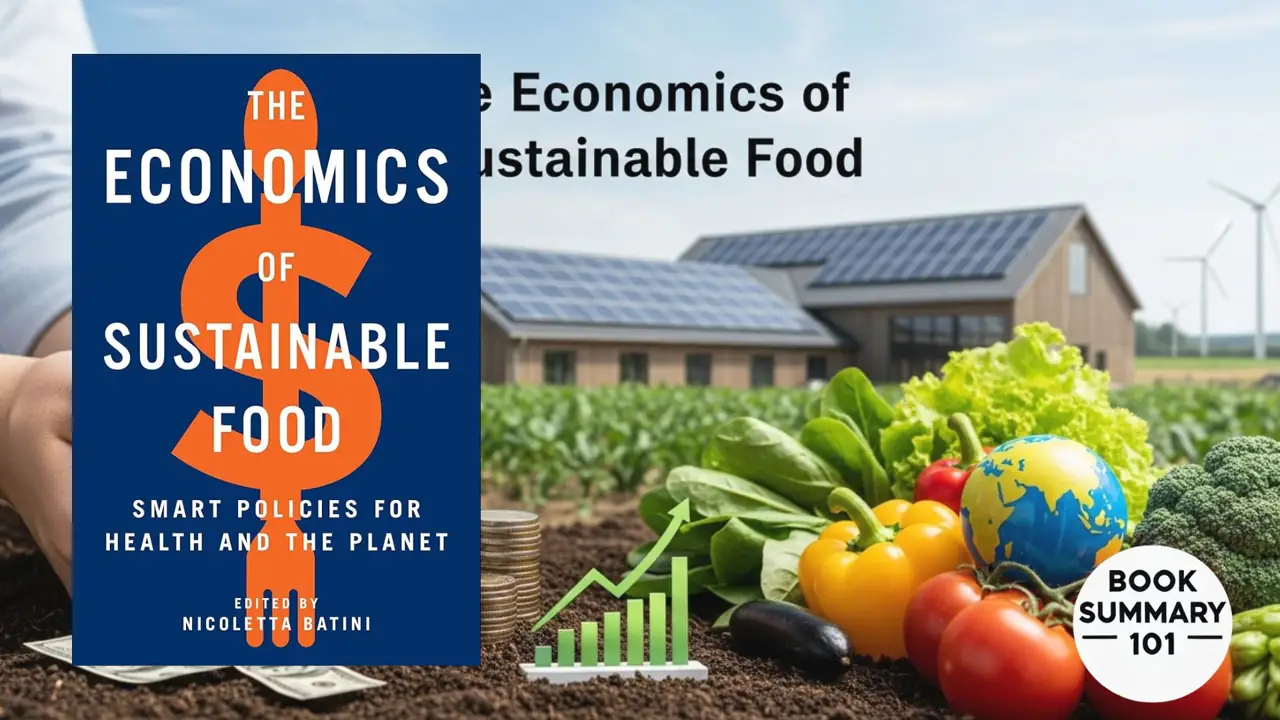
Then I picked up The Economics of Sustainable Food: Smart Policies for Health and the Planet by Nicoletta Batini.
Honestly? It felt like someone finally turned the lights on in a dark room.
This wasn’t just another preachy book telling me to eat more kale. It was a rigorous, economic explanation of why our food system is broken and, more importantly, a blueprint for how to fix it without bankrupting the world. It felt like sitting down with a brilliant friend who could finally explain the math behind the madness.
- Why Should You Even Bother Reading It?
- The Great Food Reset: Transforming How We Eat and Live
- 1. The “True Cost” Accounting: The Hidden Credit Card Bill
- 2. Flipping the Subsidy Script: Stop Paying the Arsonist
- 3. Regenerative Agriculture: Viewing Soil as a Bank Account
- 4. The Dietary Shift: The Supply and Demand Lever
- 5. Food Waste: The Leaky Bucket
- My Final Thoughts
- Join the Conversation!
- Frequently Asked Questions (The stuff you’re probably wondering)
Why Should You Even Bother Reading It?
You might be thinking, “Economics? Sounds dry.” But trust me, this is for anyone who eats—period.
If you are confused about why unhealthy food is cheap and healthy food is a luxury, this book is for you. If you are a policymaker, a business owner, or just a curious citizen worried about climate change and inflation, this is mandatory reading.
The core message is vital right now because we are hitting a wall. We are realizing that “cheap” food is actually costing us trillions in healthcare and environmental cleanup. This book bridges the gap between your dinner plate and the global economy.
The Great Food Reset: Transforming How We Eat and Live
Batini and her contributors don’t just list problems; they dismantle the entire engine of the modern food system to show us which gears need replacing. Before we dive into the specific solutions, realize that this book is ultimately an optimistic roadmap—it proves that saving the planet is actually cheaper than destroying it.
1. The “True Cost” Accounting: The Hidden Credit Card Bill
The most foundational concept in the book is understanding that the price tag on the shelf is a lie.
Imagine you go out to a fancy dinner. The menu says the steak is $5. You eat it, pay the $5, and leave thinking you got a steal. But a month later, you get a credit card bill for $45 labeled “Steak Cleanup Fees,” “healthcare costs,” and “environmental repair.”
That is our current food system.
We pay a low price at the register, but we pay the rest of the cost through our taxes (subsidies), our insurance premiums (diet-related diseases like diabetes and heart disease), and disaster relief funds (climate change caused by industrial agriculture).
Batini explains that if we factored in these “externalities”—the hidden costs—that factory-farmed burger would be the most expensive item in the store.
Specific Real-World Example:
Think about the massive “dead zone” in the Gulf of Mexico. It’s caused by fertilizer runoff from industrial corn and soy farming in the Midwest. The corn is cheap to buy, but the cost to the fishing industry and the cleanup efforts in the Gulf is astronomical. We are paying for that corn twice: once at the store, and once through environmental degradation.
Simple Terms:
We are currently buying food on a high-interest credit card, ignoring the massive bill that future generations will have to pay.
The Takeaway:
Sustainable food isn’t actually more expensive; it just has an honest price tag, whereas industrial food hides its costs in our healthcare and tax bills.
2. Flipping the Subsidy Script: Stop Paying the Arsonist
One of the most eye-opening sections of the book deals with government subsidies.
Imagine you own a beautiful house. Now, imagine you are paying your neighbor a monthly salary to come over and smash your windows and set fire to your lawn. That sounds insane, right?
But that is exactly what governments are doing with agricultural subsidies.
The book details how the vast majority of global public funds go toward industries that actively harm human health and the environment—specifically high-emission livestock and monocultures (growing only one crop, like corn, for miles). We are effectively paying the “arsonist” (industrial ag) to burn down our “house” (the planet/our health).
📖 “Reforming the current system of agricultural subsidies is not just an environmental imperative but an economic one; we are currently financing our own destruction.”
Specific Real-World Example:
Consider the US Farm Bill or the Common Agricultural Policy (CAP) in Europe. These massive policy packages often reward volume over value. They send billions to giant operations growing feed for livestock, making a fast-food hamburger artificially cheaper than a salad. Batini argues we need to flip this script: pay farmers to capture carbon, protect soil, and grow nutrient-dense food.
Simple Terms:
Governments are currently paying farmers to produce pollution and unhealthy food, when they should be paying them to protect nature and feed us well.
The Takeaway:
We don’t need to find new money to fix the food system; we just need to stop spending existing money on the wrong things.
3. Regenerative Agriculture: Viewing Soil as a Bank Account
The book moves beyond just “organic” and talks about “regenerative.”
Think of the soil like a savings account. Industrial farming is like constantly making withdrawals. You take nutrients out, you spray chemicals that kill the biology, and eventually, the account hits zero (dust bowl conditions).
Regenerative agriculture is like investing with compound interest. By using cover crops, no-till methods, and rotational grazing, you are actually adding to the account. You are putting carbon back into the ground.
Batini highlights that this isn’t just hippie philosophy; it’s hard economics. “Dead” soil requires expensive chemical fertilizers to grow anything (like a junkie needing a fix). Healthy soil grows food with fewer inputs, making it more profitable for the farmer in the long run.
Specific Real-World Example:
Look at the practice of “cover cropping.” Instead of leaving a field bare and brown in the winter (leaking carbon and eroding), a farmer plants rye or clover. This “cover” feeds the soil microbes and pulls carbon from the air. When spring comes, the farmer spends less on fertilizer because the soil is already rich.
Simple Terms:
Farming should act like a battery charger for the earth, not a drain that leaves the land empty and dead.
The Takeaway:
Healthy soil is a high-performing economic asset that sequesters carbon and produces better food for less money over time.
4. The Dietary Shift: The Supply and Demand Lever
You cannot talk about the economics of food without talking about what we choose to eat.
Imagine you have a factory that produces Widgets. These Widgets require huge amounts of energy, water, and land to make, and they create a lot of waste. Next door, there is a factory making Gadgets that uses 90% less energy and land.
Currently, the world is obsessed with Widgets (meat and dairy).
The book uses the analogy of “efficiency.” Raising an animal to eat it is incredibly inefficient. You have to grow massive amounts of crops to feed the cow, just to get a small amount of calories back in the form of beef. It’s like putting 100 gallons of gas in your car to drive one mile.
Plant-based foods (the Gadgets) cut out the middleman. You eat the crops directly. The book argues that shifting demand away from resource-intensive foods is the fastest economic lever we can pull to lower carbon emissions.
📖 “A shift toward plant-heavy diets is the single most powerful lever to optimize human health and environmental sustainability simultaneously.”
Specific Real-World Example:
Batini discusses the concept of a “carbon tax” on food. If the price of beef reflected its true carbon footprint (the water, the methane, the land use), the demand would naturally drop, and people would shift toward lentils, beans, and vegetables, which are “cheaper” for the planet to produce.
Simple Terms:
Eating plants directly is like driving a hybrid car; eating animals that ate plants is like driving a Hummer—it wastes fuel and pollutes more.
The Takeaway:
We don’t all need to be strict vegans, but reducing animal products is an economic necessity to balance the planet’s budget.
5. Food Waste: The Leaky Bucket
The final economic tragedy the book addresses is waste.
Imagine you go to the grocery store, buy three bags of groceries, walk out to the parking lot, and immediately drop one bag into the trash can. You haven’t even opened it.
That is the global food system. Roughly one-third of all food produced is lost or wasted.
From an economic standpoint, this is a disaster. We used water, labor, fuel, and land to grow that food, only to let it rot in a landfill where it releases methane (a potent greenhouse gas). It’s a “double loss”—we pay to grow it, and then we pay in climate damages when it rots.
Specific Real-World Example:
France has passed laws forbidding supermarkets from throwing away unsold food; they must donate it to charities or for animal feed. This turns a “waste cost” into a “social benefit.” The book argues for supply chain technologies (like better cold storage in developing nations) and consumer education to plug this massive leak.
Simple Terms:
Throwing away food is like printing money and then burning it before you can spend it.
The Takeaway:
Cutting food waste is the “lowest hanging fruit” of sustainability—it saves money and the planet without requiring new technology.
My Final Thoughts
Reading The Economics of Sustainable Food was a relief. It took the heavy, guilt-ridden burden of “saving the planet” and turned it into a logical, solvable math problem.
It empowered me to realize that the solutions already exist. We don’t need magic; we need policy shifts and smarter spending. It made me feel like my choices at the grocery store are part of a larger, necessary economic correction. It’s not just about being “green”; it’s about being smart.
Join the Conversation!
I’d love to hear from you. After reading this, does the idea of the “true cost” of food change how you look at the price tags in your grocery store? Drop a comment below!
Frequently Asked Questions (The stuff you’re probably wondering)
1. Is this book too technical for someone who isn’t an economist?
Not at all. While it is backed by the IMF and full of data, the concepts are explained clearly. If you understand the basic idea of a household budget, you will understand this book.
2. Is the author telling everyone to go vegan?
No. The book advocates for a “flexitarian” approach. It acknowledges that meat is part of many cultures, but argues for a significant reduction in consumption and a shift toward better quality, sustainable meat rather than industrial factory farming.
3. Is the book depressing?
Surprisingly, no. It starts with the hard truth about how bad things are, but the majority of the book is focused on solutions. It feels like a toolkit for repair, not an obituary for the planet.
4. What is the “Great Food Transition”?
This is the term used to describe the necessary shift we must make: moving from an extractive, fossil-fuel-dependent food system to a regenerative, circular, and health-focused one.
5. How can I apply this to my daily life?
Start by “voting with your wallet.” Buy less meat, but better quality. Support local farmers who use regenerative practices. And most importantly, stop wasting food in your own kitchen!