Have you ever turned on CNBC or scrolled through financial Twitter and felt your blood pressure spike?
I know I have. For the longest time, I thought “investing” meant staring at four different computer monitors, screaming “Buy!” or “Sell!” into a telephone, and understanding complex charts that looked more like seismographs than money. I felt like I was missing out on a secret language. I thought that to be wealthy, I had to be smarter, faster, and more complex than everyone else.
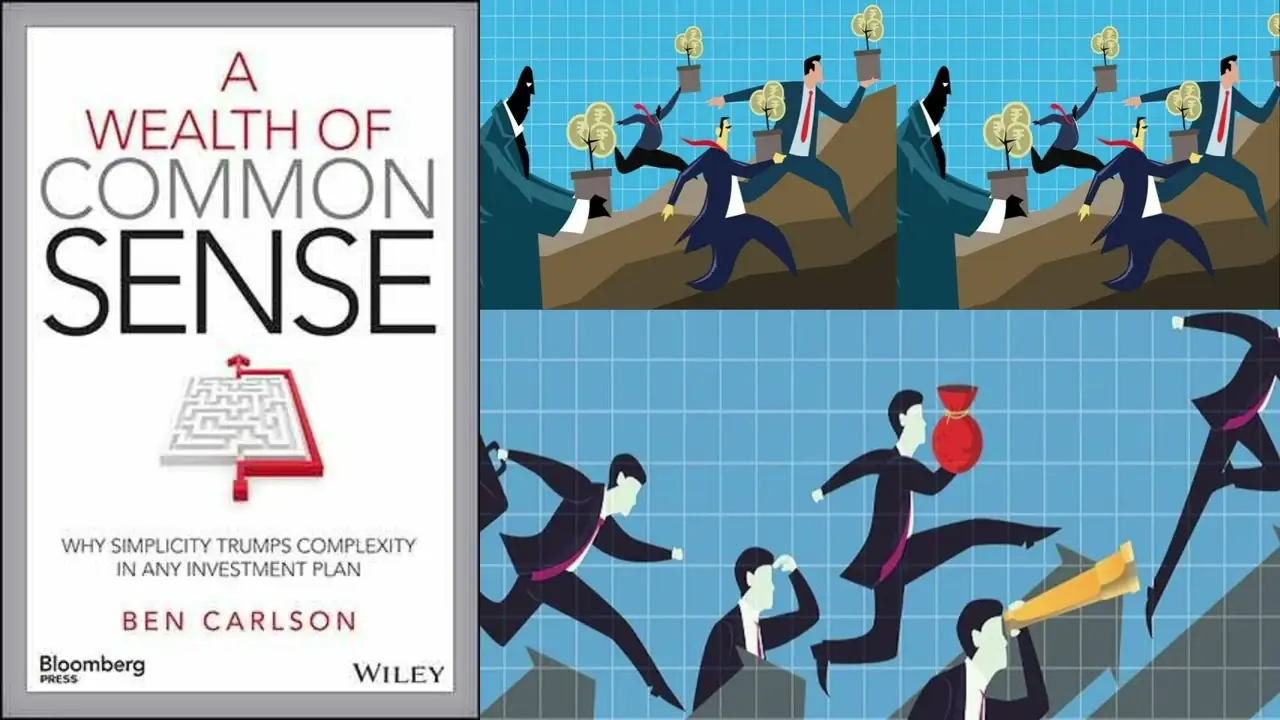
Then I picked up A Wealth of Common Sense by Ben Carlson.
It didn’t just teach me about money; it lowered my heart rate. Reading this book felt like sitting down with a remarkably calm friend who puts a hand on your shoulder and says, “Relax. You’re trying too hard, and that’s actually why you’re losing.”
Carlson, a CFA and portfolio manager, strips away the intimidation factor of Wall Street. He argues that the finance industry is designed to sell you complexity because complexity justifies high fees. But for you and me? Simplicity isn’t just easier—it’s actually more profitable.
If you are tired of chasing trends and want a strategy that lets you sleep at night, you’re in the right place.
- Why Should You Even Bother Reading It?
- The Pillars of a Stress-Free Financial Life
- 1. The Complexity Trap (Why Simple Beats Smart)
- 2. The Behavior Gap (You Are Your Own Worst Enemy)
- 3. The Myth of “This Time Is Different”
- 4. Diversification: The Only Free Lunch
- 5. Negative Knowledge (Knowing What Not To Do)
- My Final Thoughts
- Join the Conversation!
- Frequently Asked Questions (The stuff you’re probably wondering)
Why Should You Even Bother Reading It?
You might be thinking, “Great, another finance book. Is this going to be dry as toast?”
Absolutely not. This book is essential reading for anyone who has money but hates managing it. If you are a beginner terrified of the stock market, a professional who doesn’t have time to day-trade, or just someone burnt out by the crypto-hype-cycle, this book is for you.
Its core message is incredibly relevant right now. In an era where trading apps gamify investing and AI algorithms dominate the headlines, Carlson reminds us that human behavior, not computing power, is the biggest determinant of investment success. It teaches you how to ignore the noise and focus on what you can actually control.
The Pillars of a Stress-Free Financial Life
So, how do we actually build wealth without losing our minds? Carlson breaks down the investment journey into a battle between the complex narratives we are sold and the simple truths that actually work.
Before we dive into the specific strategies, understand this: successful investing is less about IQ and more about EQ (emotional intelligence). It’s about building a system that protects you from your own worst instincts. Here are the core principles that reshaped my thinking.
1. The Complexity Trap (Why Simple Beats Smart)
Imagine you want to get in shape. You walk into a gym, and a trainer tells you that you need a hyper-specific diet based on your blood type, a supplement regimen that costs $400 a month, and a workout routine that requires a degree in biomechanics to understand.
Now, compare that to a trainer who says, “Eat more vegetables, eat less junk, and move your body for 30 minutes a day.”
Which one is more likely to work long-term? The second one, of course. Yet, in finance, we flock to the first trainer. We love complexity. We assume that if an investment strategy is complicated—involving derivatives, leverage, or hedge fund tactics—it must be better.
Carlson calls this the Complexity Trap. Wall Street loves to sell complexity because it sounds sophisticated. It makes them look like wizards and us look like muggles. But here is the brutal truth: complex investment strategies rarely outperform simple ones over the long run. In fact, they usually crash and burn because they have too many moving parts and high fees that eat away at your returns.
Real-World Example:
Look at the classic bet between Warren Buffett and the hedge fund industry. Buffett bet a million dollars that a simple, boring S&P 500 index fund (a basket of America’s biggest companies) would outperform a group of hand-picked, high-fee, “sophisticated” hedge funds over ten years. The result? The boring index fund crushed the complex hedge funds. The “smart money” wasn’t so smart after all.
Simple Terms:
Don’t confuse “complex” with “effective.” Boring, simple investments usually make you more money than exciting, complicated ones.
The Takeaway:
Avoid financial products you don’t understand. If you can’t explain the investment to a 10-year-old, you probably shouldn’t own it.
2. The Behavior Gap (You Are Your Own Worst Enemy)
Let’s talk about puppies.
When you get a new puppy, the hard part isn’t teaching the puppy to sit; the hard part is training yourself to be consistent, patient, and not give in to those puppy dog eyes when they beg for table scraps.
Investing is exactly the same. The math of investing is actually solved. We know that buying a diverse portfolio and holding it for 30 years works. The problem isn’t the math; it’s the human. Ben Carlson emphasizes that the biggest threat to your portfolio isn’t the economy, the President, or inflation—it’s the person staring back at you in the mirror.
This concept is often called the “Behavior Gap.” It’s the difference between the return the market gives (say, 8%) and the return the average investor actually gets (often 4% or 5%). Why the gap? Because we panic. We sell when stocks crash because we’re scared, and we buy when stocks skyrocket because we’re greedy (FOMO). We let our emotions drive the car, and emotions are terrible drivers.
📖 “It’s not what you don’t know that gets you into trouble; it’s what you know for sure that just isn’t so. Overconfidence is a huge problem in the financial markets.”
Real-World Example:
Think back to March 2020, at the start of the pandemic. The market tanked. It was terrifying. Investors who checked their accounts every day panicked and sold everything to “stop the bleeding.” They locked in their losses. Meanwhile, the investors who did literally nothing—or better yet, kept buying automatically—caught the massive rebound that followed. The “do nothing” crowd made a fortune; the “act fast” crowd lost their shirts.
Simple Terms:
Your emotions (fear and greed) will lose you more money than a bad stock pick ever will.
The Takeaway:
Build a plan that accounts for your bad behavior. Automate your investing so you don’t have to make emotional decisions in the heat of the moment.
3. The Myth of “This Time Is Different”
History is like a catchy song that keeps getting remixed. The beat changes, the tempo might speed up, but the chorus remains the same.
In investing, every generation believes they are living through a unique era where the old rules don’t apply. In the 1990s, people said, “Profits don’t matter, it’s the internet age!” In the 2000s, it was, “Real estate never goes down!” Recently, it’s been, “Crypto changes everything!”
Carlson devotes a significant portion of the book to market history to prove one thing: Market cycles are inevitable. Markets go up, and markets go down. There will always be bubbles, and there will always be crashes.
When you understand that volatility (the market jumping up and down) is a feature, not a bug, you stop being surprised by it. It’s like living in Florida and being shocked that it rains in the summer. If you know the rain is coming, you just carry an umbrella. You don’t sell your house and move.
Real-World Example:
During the “Dot-com Bubble” of the late 90s, companies with no revenue were valued at billions. People shouted, “This time is different!” because of the internet. When the bubble burst, portfolios were decimated. Fast forward to 2021, and we saw similar behavior with “meme stocks” and NFTs. The assets changed, but the human psychology—the belief that the old rules of valuation were dead—was exactly the same.
Simple Terms:
Don’t believe the hype that the old rules of money are dead; markets always revert to the mean eventually.
The Takeaway:
Expect crashes. Plan for them. When everyone is screaming that “the world has changed forever,” check your wallet and stick to your long-term plan.
4. Diversification: The Only Free Lunch
Imagine you are at a buffet. You love shrimp, so you fill your entire plate—every square inch—with shrimp.
If the shrimp is great, you’re happy. But if that shrimp turns out to be spoiled? You’re going to have a very, very bad night.
Diversification is simply filling your plate with a little bit of everything: shrimp, steak, salad, and potatoes. If the shrimp is bad, you still have the steak. In the investment world, this is the only “free lunch”—a way to reduce your risk without necessarily reducing your expected return.
However, Carlson points out a psychological downside to diversification that no one talks about: You will always hate part of your portfolio.
If you are truly diversified (owning US stocks, international stocks, bonds, real estate), something will always be underperforming. If US stocks are booming, your bonds might look boring or be losing value. You will constantly feel a twinge of regret that you didn’t put everything into the winner. But that “regret” is the price you pay for safety.
📖 “Diversification is about accepting that you don’t know what the future holds. It’s an admission that you can’t predict which asset class will be the best performer next year.”
Real-World Example:
From 2000 to 2009 (often called the “Lost Decade” for US stocks), the S&P 500 actually lost money. If you only owned US stocks, you made zero progress for ten years. However, if you had a diversified portfolio that included Emerging Markets (like China and Brazil) or Real Estate, you actually made decent returns. Diversification saved the decade.
Simple Terms:
Don’t put all your eggs in one basket, even if that basket looks really sturdy right now.
The Takeaway:
Embrace the fact that part of your portfolio will always be losing. That means your diversification is working, not failing.
5. Negative Knowledge (Knowing What Not To Do)
We live in the Information Age, but when it comes to investing, we are suffering from information overload. We feel like we need to know everything—what the Federal Reserve is doing, what the unemployment rate is, what Apple’s earnings are.
Carlson introduces the concept of Negative Knowledge. This is the art of filtering out noise. It’s about knowing what not to pay attention to.
Think of it like wearing high-quality noise-canceling headphones in a busy coffee shop. The chatter is still there, but you choose not to hear it so you can focus on your work.
Most financial news is just entertainment disguised as advice. It is designed to trigger anxiety so you keep watching. “Negative Knowledge” is the superpower of ignoring the pundits, the predictions, and the panic. It’s understanding that checking your portfolio every day doesn’t make it grow faster—it just makes you more likely to meddle with it.
Real-World Example:
Consider the “financial experts” on TV who predict a recession every single year. If you listened to them and kept your money in cash waiting for the “big crash” that they promised in 2013, 2014, 2015, etc., you would have missed out on one of the greatest bull markets in history. By practicing Negative Knowledge and ignoring their predictions, you would be significantly richer today.
Simple Terms:
Success comes from filtering out the noise, not consuming more of it.
The Takeaway:
Stop checking your portfolio daily. Turn off the financial news. Focus on your savings rate and your time horizon, not the headlines.
My Final Thoughts
Reading A Wealth of Common Sense felt like taking a deep breath after holding it for years.
We are constantly told that money is complicated, that we need to be constantly “doing something” to grow our wealth. Ben Carlson flips that script entirely. He empowers you to realize that laziness—strategic laziness—is actually a virtue in investing.
By admitting we can’t predict the future, we free ourselves from the stress of trying. We can stop looking for the needle in the haystack and just buy the whole haystack (index funds). It’s not about being the smartest person in the room; it’s about being the most disciplined. And honestly? That’s a game I can actually win.
Join the Conversation!
I’d love to hear from you. What is the most overly complicated piece of financial advice you’ve ever received (or tried)? Did you try to day-trade crypto? Did you buy a complex insurance product? Let me know in the comments below!
Frequently Asked Questions (The stuff you’re probably wondering)
1. Is this book suitable for total beginners?
Yes, absolutely. It is one of the best starting points for beginners. Carlson avoids heavy jargon and explains concepts using clear logic and history. You don’t need a finance degree to understand it.
2. Do I need to be good at math to use the strategies in this book?
Not at all. The “wealth of common sense” approach is about behavior, not calculus. If you understand the concept of saving money and can look at a simple chart, you have all the math skills you need.
3. Does the book tell me exactly which stocks to pick?
No, and that’s a good thing. Carlson advocates for a passive investment strategy (buying the whole market via index funds/ETFs) rather than stock picking. He teaches you how to construct a portfolio, not which specific winning lottery ticket to buy.
4. Is the advice in this book still relevant in 2025?
Yes. The book focuses on human psychology and market history, which never change. While the specific hot stocks of the day change, the principles of fear, greed, and compounding remain timeless.
5. I have a financial advisor; should I still read this?
Definitely. Reading this will make you a better client. It will help you ask the right questions and understand why your advisor might be telling you to “stay the course” when the market gets rocky. It helps you distinguish between a good advisor and a salesperson.