Let’s be honest. Have you ever set a huge, ambitious goal on January 1st? You know, the “I’m going to run a marathon” or “I’m finally writing my novel” kind?
I have. My planner looked perfect. My motivation was sky-high. And by February… crickets. The running shoes were gathering dust, and the novel was still a blank page staring back at me, mocking my ambition. I felt like a failure, stuck in a cycle of starting strong and fizzling out. I figured I just didn’t have enough willpower.
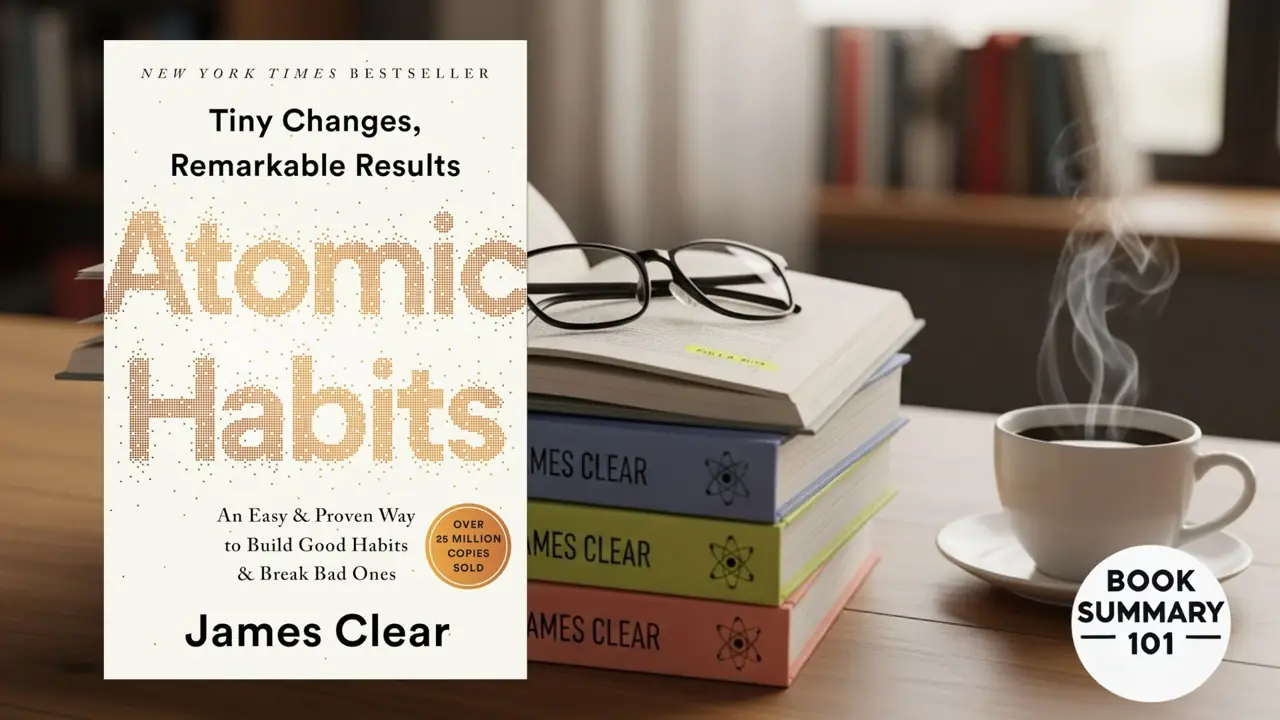
Then I picked up “Atomic Habits” by James Clear, and it felt less like a self-help book and more like a friendly, super-smart engineer was sitting across from me, explaining exactly why my approach was all wrong. It wasn’t about my lack of motivation; it was about my terrible system.
This book didn’t yell at me to “try harder.” It whispered, “Let’s make this so easy you can’t fail.” And honestly? It changed everything.
Why Should You Even Bother Reading It?
This book is for anyone who has ever tried to change but felt stuck. It’s for the chronic procrastinator, the professional wanting to be more focused, the person trying to get healthier, or the creative who can’t seem to find the time.
If you’re tired of the “go big or go home” mentality and want a practical, step-by-step guide to making small, meaningful changes that actually last, this book is your manual. In a world that’s all about massive results, this book is a refreshing reminder that real, lasting change happens one tiny step at a time.
The Big Idea – Forget Goals, Focus on Systems (The 1% Rule)
Before we dive into the “how,” we have to get our heads around the core philosophy of the book. And it’s a big one: Goals are for setting a direction, but systems are for making progress.
Imagine you have an ice cube sitting on a table in a cold room. The room is 25 degrees. Then 26. Then 27. You’re adding heat (putting in the work), but from the outside, nothing is happening. The ice cube is just… an ice cube. You keep going. 28… 29… 30… 31. Still nothing. It feels like a total waste of effort.
Then, at 32 degrees, it begins to melt. That one-degree shift unleashes a massive change, but it was all the “unseen” work from 25 to 31 that made it possible. This is what James Clear calls the “Plateau of Latent Potential.” We work and work without seeing results, get discouraged, and quit, often right before the breakthrough happens.
This is why he champions the idea of getting just 1% better every day. A 1% improvement is barely noticeable. It’s tiny. But compounded over a year, you end up 37 times better. It’s like a plane leaving LA for New York; if the pilot adjusts the nose just 3.5 degrees south, you’ll land in Washington, D.C. A small change in your trajectory can lead to a massively different destination.
📖 You do not rise to the level of your goals. You fall to the level of your systems.
This idea is the foundation for everything else. You stop chasing the finish line (the goal) and start falling in love with the process of taking small steps (the system).
Simple Terms: Small, daily improvements are more powerful than occasional, huge efforts.
The Takeaway: Don’t worry about the results right now. Just focus on building a good system and showing up, even in a small way, every single day.
The First Law – Make It Obvious
Ever tell yourself you’re going to start flossing, only to completely forget about it until your head hits the pillow? It’s not because you’re lazy; it’s because the habit is invisible.
The first law is all about designing your environment so your desired habit is the most obvious, in-your-face choice. Think of it like training a puppy. You don’t just hope the puppy goes to the bathroom outside; you put puppy pads by the door, take it out at the same time every day, and make the right path the easiest and most obvious one to follow.
We need to do the same for our brains. If you want to read more, don’t leave your book on a dusty shelf. Put it on your pillow. You’ll have to physically move it to go to sleep. Want to drink more water? Don’t leave a glass in the cupboard. Fill up a giant water bottle and put it right in the middle of your desk.
A brilliant technique Clear offers is “Habit Stacking.” You link a new habit you want to build onto a habit you already do. Your brain already has a well-worn path for your current habits, so you’re just adding a little extension. For example: “After I pour my morning cup of coffee, I will meditate for one minute.” Or “After I take my shoes off when I get home, I will immediately change into my workout clothes.” The old habit becomes the trigger for the new one.
Simple Terms: Make the cues for your good habits impossible to miss.
The Takeaway: Your environment is more powerful than your willpower. Redesign it to make good habits the default option.
The Second Law – Make It Attractive
Let’s be real. We’re not robots. We are driven by dopamine, and we’re more likely to repeat behaviors that we find enjoyable and attractive. The second law is all about hacking this reward system.
The analogy here is like getting a child to eat their vegetables by pairing them with something they love, like a little cheese sauce. You’re not changing the vegetable, but you’re making the experience of eating it more appealing. We can do this for ourselves with a strategy called “Temptation Bundling.”
You pair an action you want to do with an action you need to do.
For example, maybe you love listening to that true-crime podcast or watching the latest season of that show on Netflix. And maybe you need to do 30 minutes on the elliptical or fold that mountain of laundry. The rule becomes: “I can only listen to my favorite podcast while I’m exercising,” or “I can only watch my show while I’m folding laundry.”
You’re tying the dopamine hit of the thing you crave to the habit you’re trying to build. This transforms the feeling around the habit. It’s no longer a chore (“Ugh, I have to go for a run”). It becomes an opportunity (“Ooh, I get to catch up on my podcast!”). You start to look forward to it.
Simple Terms: Link your new habit to something you already enjoy doing.
The Takeaway: The more attractive a habit is, the more likely you are to stick with it. Make your habits things you look forward to.
The Third Law – Make It Easy
Imagine you’re sorting a giant pile of Legos. The goal, “organize all the Legos,” feels overwhelming. You wouldn’t even know where to start. But what if your goal was just to “find one red brick”? That’s easy. You could do that without even thinking.
This is the spirit of the third law. We often fail at our habits because we make them too hard. We say, “I’m going to do an hour of yoga every day,” which is a huge commitment. Instead, Clear suggests we use the “Two-Minute Rule.”
Whatever your new habit is, scale it down to something that takes less than two minutes to do.
- “Read before bed” becomes “Read one page.”
- “Do 30 minutes of yoga” becomes “Roll out my yoga mat.”
- “Study for class” becomes “Open my notes.”
The point isn’t to get results in those two minutes. The point is to master the art of showing up. Anyone can roll out a yoga mat or read one page, even on their worst day. And once you’ve started, it’s much easier to continue. You’ve overcome the biggest hurdle: inertia. You’ve found your one red brick. This law is all about reducing the friction between you and the habit.
📖 Every action you take is a vote for the type of person you wish to become.
Each time you roll out your mat, you’re casting a vote for being “a person who does yoga.” Each time you open your notes, you’re casting a vote for being “a good student.” The action itself is small, but the shift in your identity is profound.
Simple Terms: Reduce the friction of your good habits until they are too easy to say no to.
The Takeaway: A habit must be established before it can be improved. Start with the smallest possible action to build momentum.
My Final Thoughts
Reading “Atomic Habits” felt like someone finally gave me the user manual for my own brain. It’s not about grand, heroic acts of self-discipline. It’s about being a little smarter, a little more strategic, and a lot kinder to yourself.
The biggest feeling I was left with was empowerment. My failures weren’t character flaws; they were design flaws. By redesigning my environment and my approach, I could actually build habits that stick. It’s a book that’s less about inspiration and more about implementation, and that’s why it works. It gives you a toolkit, not just a pep talk.
Join the Conversation!
This book is packed with so many practical ideas. I’d love to know, which of the Four Laws resonates with you the most right now, and what’s one tiny habit you’re thinking of starting? Share it in the comments below!
Frequently Asked Questions (The stuff you’re probably wondering)
1. Do I need to be a super-disciplined person for this to work?
Absolutely not! That’s the whole point. The book teaches you to build systems that don’t rely on willpower or discipline. It’s about making good habits the path of least resistance.
2. Is this book just about productivity for work?
Not at all. While the principles can supercharge your work, they apply to everything: getting healthier, being a more present parent, learning a new skill, improving your relationships, and saving money. It’s a book about human behavior.
3. Is the book very technical or hard to read?
It’s one of the most readable and well-structured books I’ve ever picked up. James Clear uses simple language, compelling stories, and clear summaries at the end of each chapter. It’s incredibly easy to digest.
4. Who is this book NOT for?
If you’re looking for a magic bullet or a “get fit in 7 days” kind of solution, this isn’t it. The entire philosophy is built on patience, consistency, and long-term thinking. It’s for people who are ready to commit to a process.
5. What’s the single biggest takeaway from the book?
That small, seemingly insignificant daily choices are the things that shape our entire lives. Focus on getting 1% better every day, and the long-term results will take care of themselves.