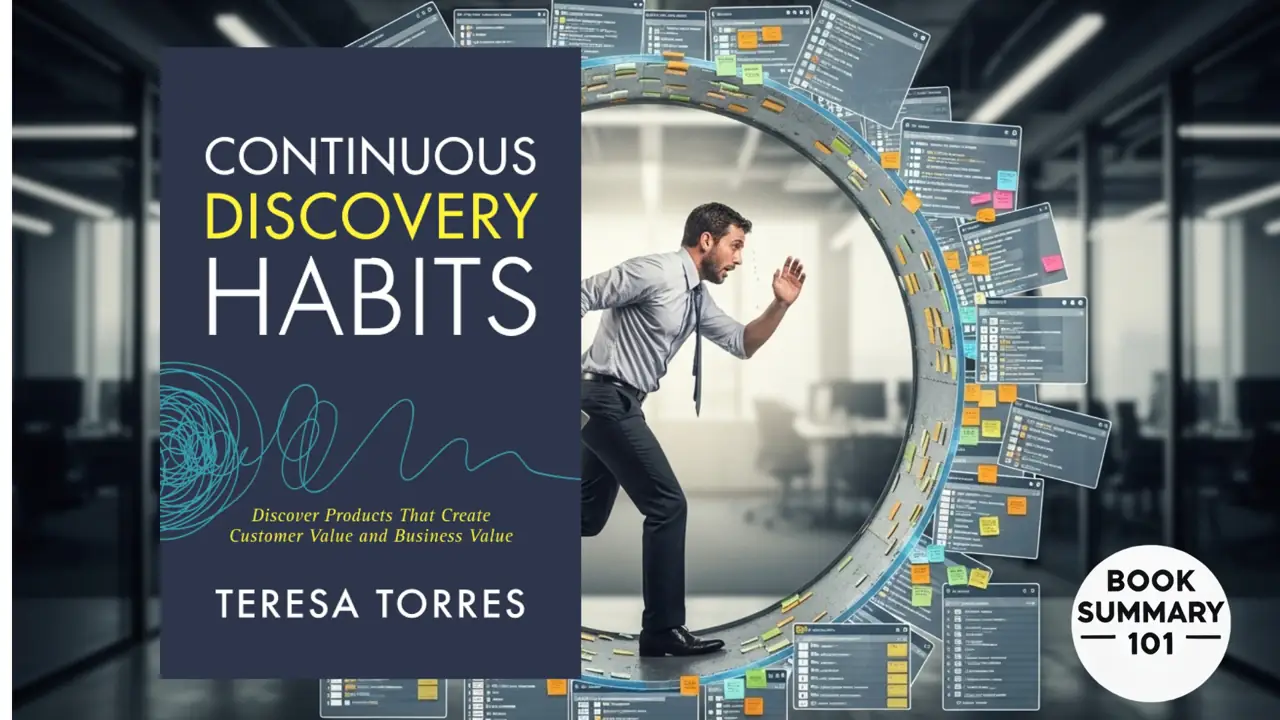
We have all been there. You spend three months pouring your heart, soul, and caffeine into a new feature. The roadmap said it was “critical.” The stakeholders were nodding aggressively in every Zoom meeting. You launch it with fanfare, wait for the analytics to roll in, and… nothing.
Crickets.
Nobody uses it. Or worse, they use it once and never come back.
For years, I felt like I was stuck on a hamster wheel of “shipping stuff” rather than actually solving problems. I thought the job was just to keep the engineers busy and the tickets moving from left to right on the Jira board. It felt risky, wasteful, and frankly, a little demoralizing.
Then I picked up Continuous Discovery Habits.
Reading this book felt like Teresa Torres was sitting across from me, gently taking the roadmap out of my hands, and saying, “There’s a better way to do this.” It wasn’t just another dry textbook on theory; it was a practical toolkit for sanity. It shifted my mindset from “Are we building the thing right?” to “Are we building the right thing?”
If you are tired of the feature factory and want to start building products that actually impact the bottom line (and make customers happy), you are in the right place.
- Why Should You Even Bother Reading It?
- The Blueprint for Building Products That Actually Matter
- The Product Trio: No More Lonely Heroes
- Outcomes Over Outputs: escaping the Feature Factory
- The Opportunity Solution Tree: Visualizing the Chaos
- Continuous Interviewing: The Weekly Habit
- Assumption Testing: Don’t Build the Whole Bridge
- My Final Thoughts
- Join the Conversation!
- Frequently Asked Questions (The stuff you’re probably wondering)
Why Should You Even Bother Reading It?
Honestly, if you work anywhere near a product—whether you are a Product Manager, a Designer, a Software Engineer, or a Founder—this book is essential survival gear.
In the old days, “discovery” was a phase that happened once a year before the “delivery” phase. Today, that moves too slow. This book is for anyone who realizes that the market changes faster than a 12-month roadmap can handle. It is particularly crucial for teams who want to move away from being order-takers (“build this feature because the CEO said so”) to becoming problem-solvers who drive real business value.
The Blueprint for Building Products That Actually Matter
Most product teams are stuck in a cycle of guessing, betting big, and often failing. Teresa Torres provides a structured framework to break that cycle, turning the chaotic process of product discovery into a reliable, repeatable engine.
The Product Trio: No More Lonely Heroes
We used to treat product development like a relay race. The Product Manager would write a massive requirements document (the baton), hand it to the Designer to make it “pretty,” who would then toss it over the wall to the Engineers to build.
This is a disaster waiting to happen. By the time the engineers see the concept, it’s too late to say, “Hey, this is technically impossible,” or “We could do this much faster if we tweaked the design.”
Torres introduces the concept of the Product Trio. Imagine you are planning a road trip. In the old model, one person picks the destination, another picks the car, and the third drives, but they never talk until the day of the trip. The Product Trio is like three friends sitting in the front seat together looking at the same map.
The Trio consists of the Product Manager, the Product Designer, and the Lead Engineer. They don’t just sync up occasionally; they do discovery together. They interview customers together. They map out solutions together.
Why does this matter? Because when an engineer hears a customer complain firsthand, they often come up with solutions the PM never would have dreamed of. When a designer understands the business constraints early, they design for viability, not just aesthetics.
It dissolves the “us vs. them” mentality. It stops being “Engineering is slow” or “Product doesn’t know what they want.” instead, it becomes a shared mission to solve a specific problem.
Simple Terms: The PM, Designer, and Lead Engineer work together from day one, rather than handing off work to each other.
The Takeaway: collaborative discovery beats siloed documentation every time; you get better ideas and faster execution when the three key perspectives are in the room together.
Outcomes Over Outputs: escaping the Feature Factory
This is the single biggest mindset shift in the book, and it’s surprisingly hard to do. Most of us are trained to measure Outputs.
- “Did we ship the dark mode?”
- “Did we launch the integration?”
- “Did we hit the release date?”
An output is just a thing you built. But building things doesn’t guarantee value. You can build a bridge that leads to nowhere; you still built a bridge (output), but you failed to solve the transportation problem.
Torres argues we must obsess over Outcomes. An outcome is a change in human behavior that drives business value.
Think of it like going to the gym.
- Output: “I spent 60 minutes at the gym.” (You could have spent that time sitting on a bench texting).
- Outcome: “I lowered my resting heart rate by 5 beats per minute.” (This is the actual value).
In a product context, Netflix doesn’t just want to measure if they shipped a “Play” button (Output). They want to measure if users are spending more hours streaming per week (Outcome). When you manage by outcomes, you give your team the freedom to find the best solution. If you tell the team “Build a mobile app,” they will build an app even if nobody wants it. If you tell them “Increase customer engagement by 20%,” they might find that an email newsletter works better and is ten times cheaper.
📖 “When we manage by outcomes, we give our teams the autonomy to find the best solution. When we manage by outputs, we tell our teams what to build, and we take away that autonomy.”
Simple Terms: Stop measuring success by what you built and start measuring it by how you changed customer behavior.
The Takeaway: Features are just guesses; true success is moving a metric that matters to the business and the customer.
The Opportunity Solution Tree: Visualizing the Chaos
If you have ever done product discovery, you know it gets messy fast. You have business goals, hundreds of customer complaints, fifty cool feature ideas, and zero idea how they all connect. It feels like trying to untangle a box of Christmas lights in the dark.
Torres introduces the Opportunity Solution Tree (OST). This is the visual backbone of the book.
Think of the OST as a literal tree structure that maps your thinking logic:
- The Root (Outcome): At the top is your clear business goal (e.g., “Increase customer retention”).
- The Branches (Opportunities): These are the customer needs, pain points, or desires that, if addressed, would achieve the outcome. (e.g., “I can’t find content I like,” or “The player crashes too much”).
- The Leaves (Solutions): These are the specific feature ideas to address the opportunities. (e.g., “A ‘For You’ recommendation algorithm”).
- The Roots of the Leaves (Assumption Tests): The experiments we run to verify the solutions.
The magic of the OST is that it forces you to link every single feature back to a customer problem and a business result. It prevents “Shiny Object Syndrome.” If an executive runs in and says, “We need to add AI Chatbots!”, you can look at the tree and ask, “Okay, which Customer Opportunity does that solve?” If it doesn’t fit on the tree, you don’t build it.
It also helps you compare apples to apples. Instead of debating “Chatbot vs. Email support,” you step back up the tree and ask, “Which customer problem is more urgent: ‘I can’t get help’ or ‘I don’t know how to use the tool’?”
Simple Terms: A visual map that connects your business goals to customer needs, and those needs to specific feature ideas.
The Takeaway: never build a solution without knowing exactly which customer pain point it solves and how that links to your business goal.
Continuous Interviewing: The Weekly Habit
When was the last time you spoke to a customer? Not a sales call, but a real research conversation? For many teams, the answer is “Last quarter” or “During that big project six months ago.”
Torres compares this project-based research to crash dieting. You starve yourself (do massive research), binge (build for six months), and then realize you’re unhealthy again.
Instead, she proposes Continuous Interviewing. The goal is simple: The Product Trio should talk to at least one customer every single week.
Imagine you are learning to play the guitar. If you practice for eight hours straight once a month, you will never get good. But if you practice for 20 minutes every day, you will improve rapidly. Continuous interviewing builds a “muscle” of customer empathy.
The key is automation. You shouldn’t be scrambling every week to find someone to talk to. You set up “drip campaigns” or in-product pop-ups that say, “Do you have 20 minutes to chat? We’ll give you a $25 gift card.” The calendar fills up automatically.
Because you are interviewing so often, the pressure is off. You don’t need a perfect script. You aren’t looking for the “Holy Grail” of insights in one call. You are just checking in. You ask specific questions about their past behavior (“Tell me about the last time you used the app”) rather than hypothetical ones (“What would you do if…?”), because humans are terrible at predicting their future behavior but great at recalling the past.
📖 “We want to interview to discover opportunities, not to validate solutions. We want to learn about our customers’ context, their needs, their pain points, and their desires.”
Simple Terms: Automate the process so you talk to at least one customer every week, keeping a constant pulse on their needs.
The Takeaway: Small, frequent doses of customer feedback are infinitely more valuable than one massive, infrequent research study.
Assumption Testing: Don’t Build the Whole Bridge
So, you have a great idea on your Opportunity Solution Tree. The team loves it. The boss loves it. Time to build the MVP (Minimum Viable Product), right?
Wrong.
Torres argues that even an MVP is usually too big of an investment. Building the whole feature to see if it works is like building a whole bridge to see if the concrete is strong enough.
Instead, you should break the idea down into its underlying Assumptions. Every idea is built on a house of cards:
- Desirability Assumption: Does anyone want this?
- Usability Assumption: Can they figure out how to use it?
- Feasibility Assumption: Can we actually build it?
- Viability Assumption: Should we build it (business-wise)?
You don’t test the idea; you test the assumptions.
For example, let’s say your idea is “A feature that automatically creates a grocery list based on your diet plan.”
Do not build the list-maker yet.
Test the desirability assumption first: Do people even stick to diet plans? You could test this by simply putting a fake button in the app that says “Generate List” and counting how many people click it (a “Painted Door” test). If nobody clicks it, you just saved yourself three months of coding.
This is science over guessing. It allows you to fail fast and cheap. You can test five different assumptions in the time it takes to build one MVP.
Simple Terms: Don’t test the whole feature; break it down into small risks and test those risks individually and cheaply.
The Takeaway: By validating the scary assumptions first, you avoid wasting months building features that are doomed to fail.
My Final Thoughts
I cannot recommend Continuous Discovery Habits enough. It is one of those rare business books that actually respects your intelligence and your time. It doesn’t just tell you what to do; it gives you the diagrams, the scripts, and the step-by-step logic to actually do it.
Reading this book gave me a profound sense of relief. It took the weight of “being a visionary genius” off my shoulders. I realized I don’t need to have all the answers. I just need a good process to find them. The confidence that comes from knowing your roadmap is based on real customer evidence—not just the loudest voice in the room—is priceless.
Join the Conversation!
I’d love to hear from you. Are you currently working in a “Feature Factory” where you just crank out tickets, or have you managed to shift to an outcome-focused mindset? Drop a comment below and let me know your biggest struggle with product discovery!
Frequently Asked Questions (The stuff you’re probably wondering)
1. Is this book only for Product Managers?
No! While it speaks directly to PMs, it is specifically designed for the “Product Trio.” Designers and Lead Engineers will get massive value from it, especially the chapters on collaborative ideation and assumption testing.
2. Do I need to be in a big tech company for this to work?
Not at all. Whether you are a seed-stage startup or a massive enterprise, the principles hold true. In fact, for startups, this habit is even more critical because you have less money to waste on building the wrong things.
3. Is the book super technical?
Nope. It is very readable and focuses on process, psychology, and logic. You don’t need to know how to code or be a data scientist to understand the concepts.
4. How much time does “Continuous Discovery” actually take?
Torres argues it should be a sustainable habit, not a full-time job. Once you get the automation set up, the goal is to fit these activities into your normal week without overwhelming the team.
5. What if my boss just wants me to build features?
This is a common struggle. The book actually offers advice on how to “manage up.” By showing your stakeholders the Opportunity Solution Tree and the data from your assumption tests, you can slowly shift the conversation from “opinions” to “evidence.”