I used to hoard self-help books like they were going out of style. I’d buy massive, 400-page tomes filled with complex psychological theories, hoping to find the magic formula for a good life. But honestly? I just ended up overwhelmed, exhausted, and stuck in the exact same bad habits.
It felt like I was trying to navigate a dense jungle without a map, hacking through thick vines of jargon and morning routines. I needed something simple. I needed someone to sit me down, hand me a cup of coffee, and give it to me straight.
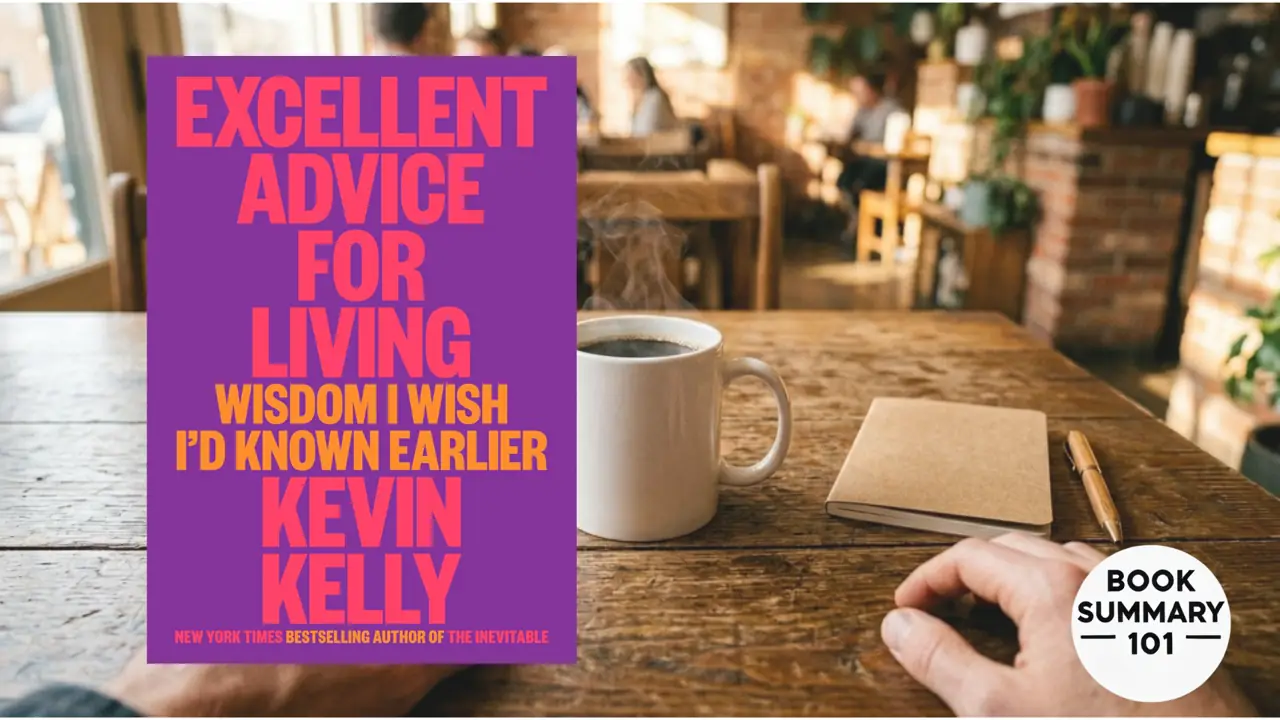
That’s exactly what happened when I picked up Excellent Advice for Living: Wisdom I Wish I’d Known Earlier by Kevin Kelly. It didn’t feel like a lecture; it felt like a warm, incredibly wise conversation with an uncle who has seen it all. Kelly, the visionary co-founder of Wired magazine, originally started writing these short pieces of advice for his kids. But it turned into a treasure trove of practical, bite-sized wisdom that completely rewired how I look at my career, my relationships, and my daily time.
Why Should You Even Bother Reading It?
Maybe you’re feeling a bit lost in your career, or perhaps you’re just overwhelmed by the sheer noise of modern life. If you are a young professional, a creative, or just a deeply curious person trying to figure things out, this book is your absolute shortcut.
You should bother with it because it bypasses the fluff. We live in an era of endless, contradictory advice from internet gurus who have barely lived life themselves. Kelly is in his 70s, has traveled the globe, built massive companies, and made plenty of mistakes, so his wisdom is entirely field-tested. It is highly relevant today because we are starving for clarity in a world of information overload, and this book delivers it by the spoonful.
- The 5 Core Principles That Reshaped My Thinking
- 1. Abandon the Rat Race: Aim to Be the Only
- 2. Embrace the “Scrap Draft”: The Art of Failing Forward
- 3. The Trampoline Effect: The Magic of Real Listening
- 4. Dropping the Backpack: The Asymmetry of Forgiveness
- 5. Your True Wealth: Managing the Currency of Attention
- My Final Thoughts
- Join the Conversation!
- Frequently Asked Questions (The stuff you’re probably wondering)
The 5 Core Principles That Reshaped My Thinking
While the book is a sprawling, wonderful list of brilliant maxims, I’ve gathered his wisdom into five central themes that completely shifted my perspective. Let’s dive into the foundational ideas that act as the ultimate operating system for a deeply fulfilling life.
1. Abandon the Rat Race: Aim to Be the Only
Imagine you are trying to open a brand-new restaurant in a bustling, food-obsessed city. If you decide to open a traditional burger joint, you are instantly competing with a hundred other burger joints, fighting tooth and nail for the title of “best burger.” But what if you open a restaurant that serves gourmet waffle-tacos out of a converted vintage school bus? You aren’t competing to be the best anymore. You are simply the only.
Kevin Kelly emphasizes this concept heavily when it comes to our careers and creative pursuits. Most of us spend our entire lives running on a crowded treadmill, trying to be a tiny bit faster or smarter than the person next to us. We try to be the “best” lawyer, the “best” graphic designer, or the “best” middle manager. But the competition for “best” is brutal, exhausting, and often leaves us feeling utterly burnt out.
Instead, Kelly advises us to find our unique intersection of skills and passions. When you combine two or three seemingly unrelated skills, you carve out a niche where you have absolutely zero competition. You stop playing everyone else’s game and start inventing your own.
Think about the comedian Bo Burnham. He wasn’t necessarily the single greatest stand-up comedian in the world, nor was he the greatest musician or the greatest filmmaker. But by combining his deeply internet-literate comedy, his musical talent, and his incredible video-editing skills, he created his Netflix special Inside. He became the only person who could have possibly made that piece of art. He bypassed the traditional comedy club route and carved out an entirely new genre.
📖 “Don’t aim to be the best. It is better to be the only.”
When you stop trying to beat others at their own game, the anxiety fades away. You start leaning into your weirdness, your unique hobbies, and your specific worldview. That is where your true, irreplaceable value lies.
Simple Terms: Stop competing in crowded spaces and instead combine your unique skills to create a niche where you are the sole player.
The Takeaway: Your quirks and unique combinations of interests aren’t distractions; they are your greatest competitive advantage in life.
2. Embrace the “Scrap Draft”: The Art of Failing Forward
Think of your life like you’re learning to ride a bicycle for the very first time. You wouldn’t sit down with a textbook about physics, memorize the aerodynamics of pedals, and then expect to effortlessly glide down the street without falling. You fully expect to wobble, scrape your knee, and look a little silly. Yet, as adults, we completely forget this when we start a new project, business, or hobby. We expect perfection on the very first try.
Kelly points out that failure isn’t a glitch in the system; it is the system itself. He encourages what I like to call a “prototyping mindset.” In the tech world, no one releases a perfect piece of software on day one. They release a messy, buggy prototype, see how it breaks in the real world, and then fix it.
We need to apply this exact same grace to our own lives. When you want to write a book, don’t try to write a masterpiece. Write a terrible, messy “scrap draft.” When you want to start a business, don’t spend a year perfecting the logo. Build a cheap, ugly version of your product and try to sell it. The feedback you get from the real world is infinitely more valuable than the perfect plan in your head.
Consider James Dyson, the inventor of the wildly successful Dyson vacuum cleaners. He didn’t just sit down and draw a perfect bagless vacuum on his first try. He built 5,127 different prototypes over the course of 15 years. Every single one of those 5,126 failures was a necessary step to figure out what didn’t work. He treated failure as data, not as a reflection of his self-worth.
If you aren’t failing occasionally, you aren’t pushing your boundaries. You are simply coasting safely within your comfort zone. By reframing failure as “gathering data,” you completely remove the sting of embarrassment and realize every misstep is just another clue pointing you toward the right answer.
Simple Terms: Treat your new endeavors like rough prototypes that are supposed to break, rather than finished masterpieces.
The Takeaway: Mistakes are not the opposite of success; they are the required raw materials needed to build it.
3. The Trampoline Effect: The Magic of Real Listening
Imagine throwing a tennis ball against a brick wall. The wall doesn’t absorb anything; it just rigidly bounces the ball right back at you with the exact same energy. Most of us listen like a brick wall. We are just waiting for our turn to speak, mentally preparing our clever comeback while the other person is still talking. But a truly great listener is like a trampoline. They absorb the impact of what you’re saying, support your weight, and then help launch your thoughts higher.
Kelly’s advice on human interaction is beautifully simple but agonizingly hard to practice. He stresses that giving someone your undivided, silent attention is one of the rarest and most precious gifts you can offer in the modern world. We are so chronically distracted by screens and notifications that true, deep listening has actually become a superpower.
When you listen like a trampoline, you aren’t just hearing words. You are asking thoughtful follow-up questions. You are letting uncomfortable silences stretch out without rushing to fill them with your own anecdotes. You are making the other person feel profoundly seen and understood.
Look at professional hostage negotiators. When they are dealing with a person in a high-stakes crisis, they don’t jump in with logical arguments or try to fix the situation immediately. They use active listening. They repeat the person’s last few words back to them, and they validate their emotions. By simply acting as a deep, empathetic sounding board, they can de-escalate incredibly dangerous situations.
You can use this in your daily life, too. The next time your partner or your coworker comes to you with a problem, bite your tongue. Don’t offer a solution right away. Just listen, nod, and ask, “Tell me more about that.” You will be shocked at how quickly your relationships deepen when people realize you are actually hearing them.
Simple Terms: Stop waiting for your turn to talk and start absorbing what others are saying with deep, curious attention.
The Takeaway: The highest compliment you can pay another human being is giving them the uninterrupted gift of your focus.
4. Dropping the Backpack: The Asymmetry of Forgiveness
Holding onto a grudge is exactly like going on a long, arduous hike while carrying a backpack full of heavy, jagged rocks. Every step is harder. Your shoulders ache, you’re exhausted, and you can’t even enjoy the beautiful scenery. The person who wronged you isn’t carrying those rocks. In fact, they might be comfortably sitting at home watching TV, completely unaware of your struggle. You are the only one suffering under the weight.
One of the most profound lessons Kelly shares is about the completely selfish nature of forgiveness. We often think that forgiving someone means letting them off the hook or saying that what they did was okay. We view it as a gift we are generously giving to the person who hurt us.
But Kelly flips this entirely on its head. Forgiveness isn’t for them; it’s exclusively for you. When you forgive, you aren’t erasing the past or excusing bad behavior. You are simply making the conscious decision to take off that heavy backpack and leave the rocks by the side of the trail.
Consider a real-world scenario where you had a toxic boss who took credit for your work and eventually fired you. You might spend years plotting revenge or rehearsing angry speeches in the shower. But that former boss isn’t losing any sleep over it. The anger is literally only raising your blood pressure and ruining your mornings.
📖 “Forgiveness is accepting the apology you will never receive.”
When you finally decide to let it go, the relief is immediate. You reclaim all that wasted mental energy and can redirect it toward building your own future. It’s a completely asymmetrical transaction where you reap 100% of the benefits of letting go.
Simple Terms: Forgiving someone is not about excusing their bad behavior; it is about freeing yourself from the mental burden of anger.
The Takeaway: Let go of grudges quickly, not because the other person deserves it, but because your peace of mind demands it.
5. Your True Wealth: Managing the Currency of Attention
Imagine walking around with a giant, leaky bucket full of hundred-dollar bills. Every few steps, a gust of wind blows a handful of cash out of the bucket, or a stranger walks by and snatches a few bills. You would panic, right? You would immediately plug the holes and guard the bucket with your life. Yet, when it comes to our attention—which is infinitely more valuable than money—we let strangers and algorithms snatch it away without a second thought.
Kelly points out that time and attention are our only truly scarce resources. You can always earn more money, buy a new car, or find a new job. But you can never, ever buy back a single hour of your attention once it has been spent.
In the modern digital economy, the biggest companies in the world are literally mining your attention for profit. Every app, newsfeed, and notification is designed by armies of behavioral psychologists to steal a few more minutes of your focus. If you don’t aggressively protect your attention, someone else will happily spend it for you.
Think about the concept of “doomscrolling” on social media. You sit down on the couch after a long day, open an app, and suddenly an hour has vanished into a blur of outrage and random videos. Now, contrast that with spending that exact same hour focused on learning a new song on the guitar or having a deep conversation with your kid. The time passes either way, but the return on investment of your attention is wildly different.
Kelly urges us to become ruthless auditors of where we look and what we consume. By consciously choosing what gets your attention, you are actively writing the script of your life rather than letting a computer algorithm write it for you.
Simple Terms: Your ability to focus is your most valuable asset, so guard it fiercely from the endless distractions of the modern world.
The Takeaway: Where you direct your attention dictates the quality of your reality; spend it as carefully as you would spend your life savings.
My Final Thoughts
Writing this out reminds me just how radically this little book changed my daily mindset. Excellent Advice for Living isn’t just a list of quotes; it is a profound permission slip to stop taking life so incredibly seriously. It empowered me to embrace my weirdest ideas, forgive faster, and fiercely protect my mental space.
I no longer feel like I’m hacking through the jungle without a map. Instead, I feel like I’m walking a clear, brightly lit path, armed with the best wisdom of a guy who has successfully navigated the terrain before me. If you apply even just one or two of these concepts, I promise you will feel a massive weight lift off your shoulders.
Join the Conversation!
I’d love to hear from you! Out of the five concepts we just talked about, which one hit closest to home for you right now? Are you struggling with being the “best” instead of the “only,” or are you carrying around a heavy backpack of grudges? Drop a comment below and let’s chat about it!
Frequently Asked Questions (The stuff you’re probably wondering)
1. Do I need to read the book cover to cover?
Not at all! The beauty of this book is that it’s structured as a collection of short, punchy aphorisms. You can pick it up, open to a random page, read for two minutes, and walk away with a brilliant idea for your day. It is perfect for reading in short bursts.
2. Is it too technical or business-focused?
Nope. Even though Kevin Kelly is a massive figure in the tech world, this book is intensely human. While there is definitely great advice for entrepreneurs, the vast majority of the book is focused on relationships, personal happiness, and emotional intelligence.
3. Who is this book actually for?
Honestly, it’s for anyone who feels overwhelmed by the complexity of modern life. It makes a fantastic gift for recent high school or college graduates, but it is equally powerful for someone in their 40s or 50s looking for a mental reset.
4. Is it just another generic self-help book?
Definitely not. Generic self-help usually gives you rigid formulas or “10-step plans.” This book acts more like a collection of mental models and guiding philosophies. It doesn’t tell you what to do; it gives you better lenses through which to view your own unique problems.
5. Do I need to know who Kevin Kelly is to appreciate it?
You don’t need to know anything about his background with Wired or his tech investments to love this book. The advice stands completely on its own as timeless, practical wisdom that anyone can instantly apply to their life.