Let’s be real for a second. How many times have you found yourself in the middle of an argument with your partner, looking around and thinking, “Wait, why am I acting like a five-year-old right now?”
I’ve been there. More times than I care to admit.
For years, my relationships followed a predictable, exhausting script. The honeymoon phase was great, but the moment things got real, I reverted to old patterns. I became needy, or distant, or weirdly controlling. I was dating different people, but I was having the same relationship over and over again.
I thought the problem was bad luck. I thought I just hadn’t found “The One.”
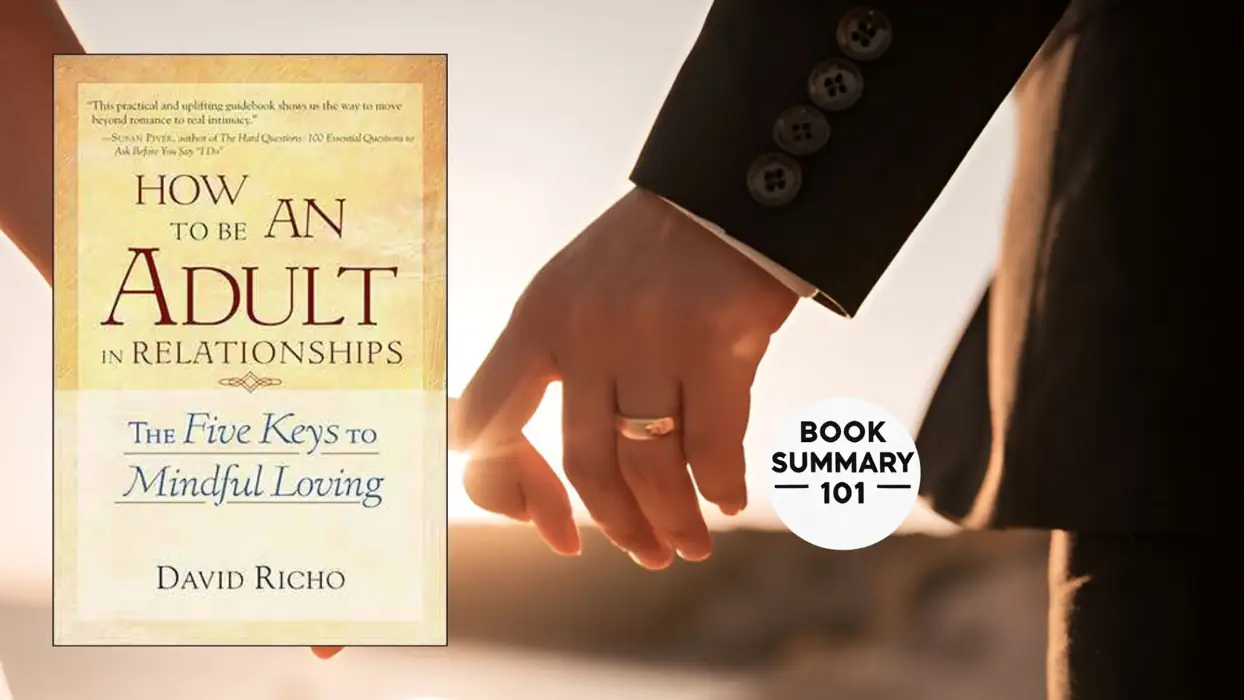
Then I picked up How to Be an Adult in Relationships by David Richo. And honestly? It felt like a gentle, loving slap in the face.
Richo didn’t offer pickup lines or manipulation tactics. He offered a mirror. He showed me that I wasn’t actually looking for a partner; I was looking for a parent to finish raising me.
Reading this book wasn’t just educational; it was like sitting down with a wise, compassionate friend who finally explained the rules of a game I’d been losing for a decade.
If you are ready to stop the drama and start building something real, pull up a chair. Let’s talk about how to finally grow up in love.
- Why Should You Even Bother Reading It?
- The Five A’s: Your Blueprint for Mindful Loving
- 1. Attention: Put Down the Smartphone
- 2. Acceptance: Buying the House “As Is”
- 3. Appreciation: The Art of the “Thank You”
- 4. Affection: The Physical Anchor
- 5. Allowing: The Open Hand
- 6. The Ghost of the Past (Transference)
- My Final Thoughts
- Join the Conversation!
- Which “A” is your stumbling block?
- Frequently Asked Questions (The stuff you’re probably wondering)
Why Should You Even Bother Reading It?
This isn’t your standard “Men are from Mars” fluff. This book is for the person who is tired of superficial connections and wants to understand the mechanics of love.
If you’re single, it explains why you keep attracting the same toxic types. If you’re married, it offers a toolkit to break out of stale resentment.
The core message is vital right now because we live in a “swipe left” culture that treats people like disposable products. Richo teaches us that love isn’t something you find; it’s a skill you practice. It’s perfect for anyone willing to do the internal work to get the external reward.
The Five A’s: Your Blueprint for Mindful Loving
David Richo builds his entire philosophy around five essential concepts. Think of these not as rules, but as the vital nutrients every relationship needs to survive—without them, love starves.
1. Attention: Put Down the Smartphone
Imagine you are a plant. If your gardener (your partner) ignores you, leaves you in the dark, and never checks your soil, you wither. It’s that simple.
In the book, Richo defines Attention as the practice of focusing on your partner’s reality. It is deep listening. It is the act of stepping out of your own head and witnessing the person in front of you.
In the modern world, our attention is fractured. We try to listen to our partner while scrolling Instagram, cooking dinner, and worrying about emails. Richo argues that this “half-attention” is perceived by the psyche as rejection.
To be an adult in a relationship, you have to master the spotlight. You have to be able to turn the spotlight off yourself and shine it fully on the other person.
Real-World Example:
Think about the last time you told a story and someone pulled out their phone. You felt your energy drop, right? Now, imagine a “Zero-Distraction Zone.” When your partner speaks, you turn your body toward them. You make eye contact. You aren’t thinking of your rebuttal; you are just taking in their data. That is Attention.
Simple Terms:
Noticing your partner and listening to them with your whole self, not just your ears.
The Takeaway:
Love requires present-moment awareness; if you aren’t paying attention, you aren’t really there.
2. Acceptance: Buying the House “As Is”
Here is where most of us trip up. We fall in love with a version of a person. We fall in love with their potential. We think, “He’s great, but he’ll be perfect once I get him to be more ambitious,” or “She’s amazing, but she needs to stop being so anxious.”
Richo uses the concept of Acceptance to challenge this control.
Imagine buying a house. You sign the papers for the house “as is.” You don’t buy the house hoping the foundation magically moves three feet to the left. Acceptance means receiving the other person exactly as they are right now, without an agenda to fix, change, or improve them.
This doesn’t mean you tolerate abuse. It means you stop fighting reality. You accept that your partner is a flawed human being, just like you.
📖 “In true love, we do not try to fix the other person; we accept them. We do not try to change the other person; we support them.”
Real-World Example:
Let’s say your partner is naturally messy. You can spend ten years screaming at them, or you can accept that they are messy and negotiate a solution (like a housekeeper or a “clutter basket”). The screaming is non-acceptance. The negotiation is adult problem-solving based on reality.
Simple Terms:
Loving the person standing in front of you, not the fantasy version you want them to be.
The Takeaway:
You cannot feel intimate with someone you are constantly trying to renovate.
3. Appreciation: The Art of the “Thank You”
We all have a deep, biological need to be recognized. Richo points out that Appreciation is about acknowledging the specific gifts and traits of your partner.
Think of it like a bank account. Every criticism is a withdrawal. Every moment of appreciation is a deposit. If you only withdraw, you go bankrupt.
Many of us think, “They know I love them, why do I have to say it?” Richo argues that unspoken gratitude is useless. Adult love requires vocalizing what you value. It’s about catching your partner doing something right and making a big deal out of it.
Real-World Example:
Instead of a generic “Thanks for dinner,” try specific appreciation: “I really appreciate how much effort you put into making this lasagna; it makes me feel so taken care of.” The first is polite; the second feeds the soul.
Simple Terms:
Actively telling your partner what you value, admire, and love about them.
The Takeaway:
Validation is a superpower; use it generously to build your partner’s sense of self-worth.
4. Affection: The Physical Anchor
Affection is the physical and emotional manifestation of warmth. It’s the glue.
Richo isn’t just talking about sex here. He’s talking about holding hands, a touch on the shoulder, a hug that lasts just a little bit longer than usual.
Imagine a campfire on a cold night. You can sit fifty feet away and see the light (intellectual love), but you need to sit close to feel the heat (affection). Without affection, a relationship becomes a business partnership or a roommate situation.
Many of us had parents who were distant, so we feel awkward showing affection. Richo encourages us to push through that awkwardness. It’s a signal of safety to the mammalian brain.
Real-World Example:
Think of the “Greeting Ritual.” When your partner comes home, do you shout “Hey” from the other room? Or do you get up, walk to the door, and give them a physical embrace? The adult choice is to make that physical connection a priority.
Simple Terms:
Making your love tangible through touch, closeness, and kindness.
The Takeaway:
Physical closeness creates emotional safety; don’t let your relationship become “touch-starved.”
5. Allowing: The Open Hand
This is the hardest one. Allowing means letting your partner be free. It is the opposite of control.
Think of holding a handful of sand. If you keep your hand open, the sand stays. If you squeeze your fist tight to try and keep it, the sand slips through your fingers.
Allowing means respecting your partner’s autonomy. It means letting them have their own hobbies, their own friends, and their own feelings—even if those feelings are negative.
We often try to control our partners because we are anxious. We think if we control them, we won’t get hurt. Richo teaches that real love respects the other person’s freedom to be themselves, even if that means they grow in a direction we didn’t expect.
📖 “We do not own our partners. We are witnessing their journey.”
Real-World Example:
Your partner wants to take a solo trip or start a new hobby that doesn’t involve you. The “child” inside you feels abandoned and tries to guilt them into staying. The “adult” in you practices Allowing: “I’ll miss you, but I support you doing this for yourself.”
Simple Terms:
Letting go of control and respecting your partner’s freedom and independence.
The Takeaway:
Love that binds and restricts isn’t love; it’s a hostage situation.
6. The Ghost of the Past (Transference)
This is the concept that ties everything together. Why is it so hard to do the 5 A’s? Because of Transference.
Richo explains that we often use our partners to work out unfinished business with our parents.
Imagine you are wearing a pair of blue-tinted glasses. Everything you see looks blue. In relationships, we wear “past-tinted” glasses. If your father was critical, you might perceive your partner’s innocent comment as an attack. You aren’t reacting to your partner; you are reacting to a ghost from your childhood.
Being an adult means realizing when you are projecting old wounds onto a new person. It means pausing and asking: “Is this reaction about what just happened, or is it about what happened to me twenty years ago?”
Simple Terms:
Confusing your partner with your parents and reacting to old childhood hurts.
The Takeaway:
You must heal your own childhood wounds so you can see your partner clearly, rather than as a replacement parent.
My Final Thoughts
Reading How to Be an Adult in Relationships was a pivotal moment for me. It moved me from a place of “needing” to a place of “loving.”
When you act like a child, you treat your partner like a vending machine—you put in coins and expect love to fall out. When you act like an adult, you realize that you are the source of the love.
Richo empowers you to stop waiting for someone to complete you. He hands you the keys to your own emotional house and says, “Time to tidy up.” It’s work, yes. But the reward is a relationship that is resilient, deep, and incredibly freeing.
Join the Conversation!
Which “A” is your stumbling block?
We all have one “A” that comes naturally and one that feels like pulling teeth. Are you great at Affection but terrible at Allowing? Let me know in the comments below—I’d love to hear your story!
Frequently Asked Questions (The stuff you’re probably wondering)
1. Is this book religious?
Not really. David Richo has a background in Catholicism and Buddhism, so there is a spiritual undertone, but it is not “preachy.” It’s more about psychology and mindfulness than dogma.
2. Is it hard to read?
It is denser than your average self-help book. It’s not a beach read. You’ll want to read a few pages, put it down, and think about it. It’s packed with wisdom, so take your time.
3. Do I need to be in a relationship to read this?
Absolutely not. In fact, it’s arguably better to read it while single. It helps you identify your own patterns so you don’t carry them into the next relationship.
4. Will this fix my toxic relationship?
It will give you clarity. It might give you the tools to fix it, or it might give you the realization that you need to leave. It promotes health, which sometimes means ending things that aren’t working.
5. What if my partner won’t read it?
That’s okay. Richo emphasizes that you can change the dynamic of a relationship just by changing your own behavior. You can’t force them to grow, but your growth will inevitably shift things.