Have you ever felt that creeping sense of anxiety that the world is moving just a little bit faster than your brain can handle?
I definitely have.
For years, I operated under a very specific, stress-inducing definition of success: “To succeed, I must know the answers.” I thought my value lay in being a walking encyclopedia, the person in the room who could recall the most facts and correct the most errors.
But then, I looked around. Algorithms were processing data faster than I ever could. Software was automating the “technical” skills I spent years honing. I felt like I was running a race against a Ferrari while wearing flip-flops.
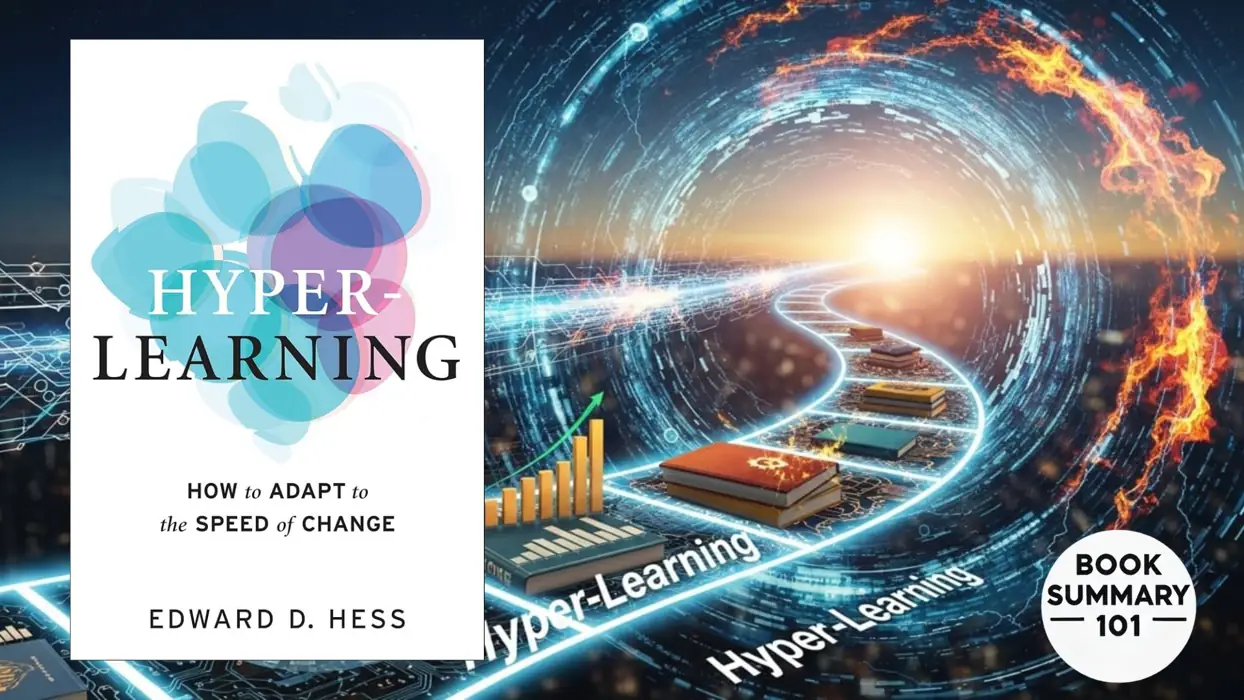
That’s when I picked up Hyper-Learning: How to Adapt to the Speed of Change by Edward D. Hess.
Reading this book didn’t just feel like learning a new skill; it felt like an intervention. Hess sat me down (metaphorically) and explained that I was playing the wrong game entirely. The goal isn’t to be a machine; the goal is to be more human.
This book is a warm, rigorous guide on how to upgrade your internal operating system to handle a world of constant change. It’s about unlearning, relearning, and finding peace in the process.
- Why Should You Even Bother Reading It?
- The Roadmap to Becoming a Hyper-Learner
- 1. Redefining “Smart” (The New Smart)
- 2. Quieting the Ego (The Bouncer at the Club)
- 3. Managing Your Inner Landscape (The Cockpit)
- 4. Other-ness (The Power of Connection)
- 5. Making It a Habit (The Daily Practice)
- My Final Thoughts
- Join the Conversation!
- Frequently Asked Questions (The stuff you’re probably wondering)
Why Should You Even Bother Reading It?
If you are a human being who plans on having a job in the next ten years, this is for you.
Seriously, though—this book isn’t written for computer scientists or tech wizards. It is written for:
- Professionals worried about automation and AI.
- Leaders trying to create teams that can actually innovate without burning out.
- Anyone who struggles with defensiveness, a big ego, or the fear of being wrong.
The core message is vital: In an age where machines do the “smart” work, your competitive advantage is your ability to learn, collaborate, and empathize—things AI (currently) sucks at.
The Roadmap to Becoming a Hyper-Learner
Hess argues that to keep up with the speed of change, we can’t just add more apps to our phones; we have to fundamentally change how we think and behave. Here are the core principles that reshaped my thinking, moving from a rigid “knower” to a flexible “learner.”
1. Redefining “Smart” (The New Smart)
We grew up in a school system that graded us on how many facts we could memorize and spit back out. Hess calls this “Old Smart.” It’s the game of “I know more than you.”
But in the Digital Age, being a storage container for facts is useless. Google knows more than you. Watson knows more than you.
Hess introduces the concept of “New Smart.”
Imagine you are packing for a trip. “Old Smart” is trying to carry everything you own in a massive backpack, just in case you need it. You’re weighed down, slow, and exhausted.
“New Smart” is knowing you can buy what you need when you get there. It’s traveling light.
“New Smart” isn’t about what you already know; it’s about the quality of your thinking, listening, and relating. It is defined not by having the answers, but by asking the right questions. It’s about admitting “I don’t know, let’s find out.” This shift is terrifying for high-achievers, but it is the only way to survive in a world where knowledge has a shelf life of about 18 months.
Simple Terms: Stop trying to be a hard drive; start trying to be a processor.
The Takeaway: Your value is no longer your knowledge base, but your ability to learn, unlearn, and relearn efficiently.
2. Quieting the Ego (The Bouncer at the Club)
This was the hardest section for me to swallow. Hess explains that the biggest enemy of learning isn’t a lack of intelligence; it’s our own ego.
Think of your mind as an exclusive VIP club. Your Ego is the Bouncer standing at the door.
When a new idea shows up that challenges what you already believe, or when someone offers you constructive criticism, the Ego Bouncer sees it as a threat. He crosses his arms and says, “You’re not on the list. Get lost.”
This is why we get defensive. This is why we double down when we are wrong.
To become a Hyper-Learner, you have to retrain that bouncer. You have to teach the Ego that being wrong isn’t a death sentence—it’s actually the VIP guest.
📖 “To become a Hyper-Learner, you must be willing to let go of your need to be right and embrace the joy of not knowing.”
We have to move from a “Fixed Mindset” (protecting our image) to a “Growth Mindset” (improving our skills). This requires “Quiet Ego”—a state where your self-worth isn’t tied to your immediate performance.
Simple Terms: You can’t learn anything new if you’re busy defending what you already think.
The Takeaway: You must consciously dial down your defensiveness to let new information in.
3. Managing Your Inner Landscape (The Cockpit)
Hess spends a lot of time discussing the biology of learning. He explains that we cannot learn effectively if we are stressed, fearful, or angry.
Imagine your brain is the cockpit of a fighter jet.
If the dashboard is flashing red lights (fear, anxiety, anger), your body goes into “fight or flight” mode. Your vision narrows. Your blood pumps to your muscles, not your brain. You literally become stupider.
To Hyper-Learn, you need to keep your dashboard green. This is what Hess calls managing your “Inner Landscape.”
He suggests specific practices to stay in this green zone, largely revolving around mindfulness and gratitude.
- Deep Breathing: It resets the nervous system.
- Positive priming: Thinking of things you are grateful for before a difficult task.
If you go into a meeting angry or terrified of your boss, you are biologically incapable of high-level collaboration. You have to be the pilot who calms the instruments before you can fly the plane.
Simple Terms: If you are freaking out, you aren’t learning.
The Takeaway: Emotional regulation isn’t just “wellness”—it’s a prerequisite for cognitive performance.
4. Other-ness (The Power of Connection)
Once you’ve sorted out your own ego and emotions, you have to look outward. Hess calls this “Other-ness.”
Here is the analogy: Think of a single computer trying to mine Bitcoin. It’s slow and might never solve the puzzle. Now, think of a massive network of computers linked together. They solve it instantly.
Humans are the same. We think better together.
But—and this is a big but—we only think well together if we feel safe. If I’m afraid you’re going to ridicule my idea, I’m going to shut up.
Hess emphasizes the need for “Caring Trusting Relationships.” This isn’t about holding hands and singing songs; it’s about creating an environment of Psychological Safety.
When you truly connect with others (empathy) and listen to understand rather than to reply, you unlock “Collective Intelligence.” You essentially upgrade your brain by plugging it into someone else’s.
Simple Terms: You are smarter when you actually listen to and care about the people around you.
The Takeaway: Hyper-learning is a team sport; you need to build high-trust relationships to access the best thinking.
5. Making It a Habit (The Daily Practice)
The final key concept is that Hyper-Learning isn’t a toggle switch; it’s a lifestyle. It’s like getting in shape. You don’t go to the gym once for 12 hours and come out with abs.
Hess suggests using Behavioral Checklists.
Imagine a surgeon scrubbing in. They have a checklist to ensure they don’t leave a sponge inside a patient. Hess suggests we need checklists for our brains.
Before a meeting, you might review a checklist that asks:
- Am I calm and in a positive emotional state?
- Is my ego quiet?
- Am I ready to listen without interrupting?
By making these behaviors explicit and checking them daily, they move from “things we know we should do” to “things we actually do.”
📖 “We become what we practice. Excellence is not an act, but a habit.”
He encourages “reflection time” at the end of the day to review how well you managed your ego and how well you connected with others.
Simple Terms: You have to practice being open-minded just like you practice a sport.
The Takeaway: Use checklists and daily reflection to turn these abstract concepts into concrete daily habits.
My Final Thoughts
Honestly, reading Hyper-Learning felt like taking a deep breath after holding it for years.
It’s easy to feel threatened by the “Rise of the Machines.” It’s easy to feel like we need to work harder, faster, and longer to stay relevant.
But Hess flips the script. He tells us that our salvation lies in slowing down, quieting our noisy egos, and leaning into our humanity. The things that make us “inefficient”—our emotions, our relationships, our curiosity—are exactly what will save us.
It’s an empowering roadmap that gives you permission to stop knowing it all, and start learning it all.
Join the Conversation!
I’d love to hear from you. What is the biggest trigger that causes your “inner bouncer” (your ego) to shut the door on new ideas? Is it being corrected? Is it feeling unprepared? Drop a comment below!
Frequently Asked Questions (The stuff you’re probably wondering)
1. Is this book highly technical or about coding?
Not at all. Despite the title, it’s about psychology, human behavior, and leadership. It’s about people, not code.
2. Do I need to be a leader or CEO to get value from it?
No. While it’s great for leaders, the concepts of “Quieting the Ego” and “New Smart” apply to parents, students, and employees at any level.
3. Is it a long read?
It’s a substantial book, but it is broken down into very manageable chapters with lots of workbook-style questions and reflections. It’s designed to be digested slowly.
4. What is the one major thing I will get out of this?
You will learn how to handle constructive criticism without falling apart, which is a superpower in itself.
5. Is the advice practical?
Yes. Hess provides specific checklists and “Daily Questions” you can literally print out and put on your desk to track your progress.