I remember the exact moment I felt like I had completely missed the boat.
I was sitting in a coffee shop, scrolling through LinkedIn, and I saw a post about a “30 Under 30” list. There they were—fresh-faced geniuses starting multimillion-dollar companies, curing diseases, and writing bestsellers, all before they could legally rent a car without a surcharge.
I looked at my own life—a patchwork of random jobs, half-finished projects, and a general sense of “what am I doing?”—and I felt a pit in my stomach. I felt like expired goods. I felt like if I hadn’t made it big by now, I never would.
Maybe you’ve felt that, too. That nagging anxiety that the clock has run out.
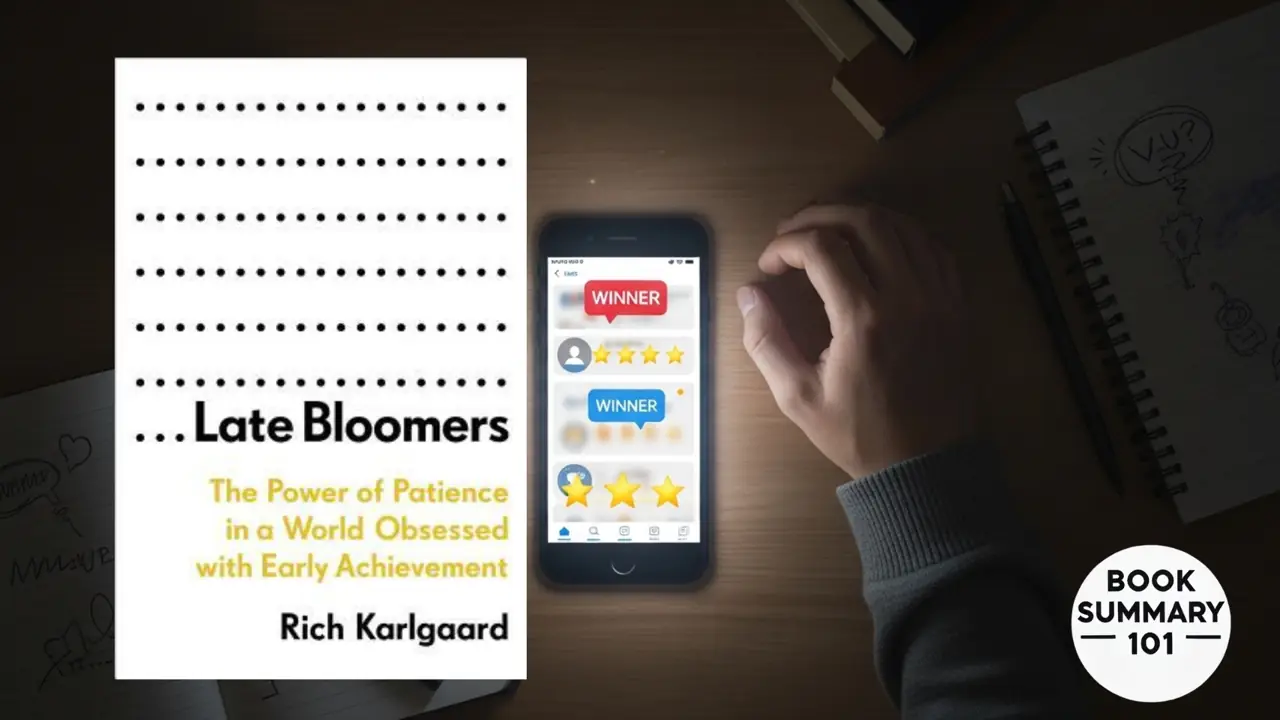
Then I picked up “Late Bloomers: The Power of Patience in a World Obsessed with Early Achievement” by Rich Karlgaard.
Reading this book didn’t just make me feel better; it completely rewired how I see success. It felt like sitting down with a wise mentor who put a hand on my shoulder and said, “Relax. You’re not failing. You’re just cooking at a different temperature.”
Karlgaard, the publisher of Forbes, uses science, sociology, and his own fascinating story (he was a security guard and a dishwasher before he found his stride!) to prove that our obsession with early achievement is not only unhealthy—it’s wrong.
Here is what I learned from this life-changing book.
Why Should You Even Bother Reading It?
Honestly, who is this for?
If you are a parent stressing out because your kid isn’t getting straight A’s or making the varsity team, you need this.
If you are a twenty-something feeling lost because your first job isn’t your “dream career,” you need this.
And if you are in your 40s, 50s, or beyond, thinking it’s too late to pivot or try something new, this book is specifically for you.
We live in a world that worships the “child prodigy”—the Zuckerberg, the Musk, the Mozart. Karlgaard argues that this obsession is causing a crisis of anxiety and burnout. This book matters because it uses hard science to prove that the majority of us are designed to bloom later, and that our later years bring specific cognitive superpowers that youth just can’t compete with.
Escaping the Conveyor Belt and Finding Your Own Pace
To understand why we feel so much pressure, we have to look at the systems we’ve built. Karlgaard breaks down the cultural trap we are in and offers a roadmap for how to step off the track and find a path that actually works for our brains and our lives.
1. The Tyranny of the Conveyor Belt
Karlgaard introduces a powerful analogy early in the book: The Conveyor Belt.
Imagine a factory line. From the moment we enter kindergarten, we are placed on this belt. It moves in one direction: towards standardized tests, elite college admissions, and high-status entry-level jobs.
The belt is designed for efficiency, not humanity. It sorts us based on very narrow criteria—mostly test-taking ability and rote memorization. If you fit the mold, the belt treats you well. You get the gold stars, the scholarships, and the applause.
But what if you don’t fit?
If you struggle with tests, or if your talents are creative, empathetic, or practical rather than academic, the Conveyor Belt labels you a “failure” or “slow.”
I loved this section because it explains why we feel so anxious. We aren’t necessarily flawed; we are just being measured by a ruler that doesn’t account for our specific dimensions. The Conveyor Belt ignores the fact that human development is messy, nonlinear, and highly individual.
📖 “We have created a society that is obsessed with early achievement. We celebrate the young and the new, the disruptive and the different. We have forgotten that most of us will not be billionaires by age thirty, or even forty or fifty. And that is okay.”
Simple Terms: Society pushes everyone down a single, narrow path of early testing and college prep, ignoring diverse talents.
The Takeaway: If you didn’t excel in school or early career, it doesn’t mean you lack potential; it just means you didn’t fit the specific, narrow sorting mechanism of the “Conveyor Belt.”
2. The Science of the Two Brains
This was the most reassuring part of the book for me. It turns out, biology is on the side of the Late Bloomer.
Karlgaard dives into neuroscience to debunk the myth that our brains decline after twenty-five. He explains that we actually have two peaks in cognitive ability.
Think of it like computer processing speeds versus a massive hard drive.
Fluid Intelligence is the processor speed. This is raw processing power, working memory, and quick calculation. This peaks early—usually in our twenties. This is why young people are often great at coding, high-speed trading, or math competitions.
Crystallized Intelligence is the hard drive. This is wisdom, vocabulary, pattern recognition, and the ability to connect unrelated dots. This doesn’t even start to peak until our 40s, 50s, and even 60s/70s!
The prefrontal cortex—the CEO of the brain, responsible for executive function and emotional regulation—doesn’t fully mature until at least age twenty-five. So, judging a person’s potential at eighteen is biologically ridiculous. It’s like judging a half-built house and saying it will never be a home.
Simple Terms: Young brains are fast, but older brains are wise and better at seeing the big picture.
The Takeaway: You aren’t getting stupider as you age; your brain is shifting from “raw speed” to “deep wisdom,” unlocking skills like leadership and complex problem-solving.
3. The Art of “Repotting”
This is my favorite analogy in the entire book.
Imagine you buy a beautiful plant. You water it, you give it light, but it starts to wither. It turns yellow and droopy. Do you blame the plant? Do you say, “This plant is a loser with no work ethic”?
No. You check the pot. Usually, the plant is root-bound. The environment is too small for its growth.
Karlgaard argues that many Late Bloomers are simply root-bound. They are stuck in environments—toxic workplaces, the wrong city, or a career field that doesn’t match their gifts—that are stifling them.
To bloom, you must be willing to “repot” yourself.
This is scary. It means leaving the comfortable (but cramping) pot you’re in. It might mean moving to a cheaper city so you can take a risk. It might mean quitting a “prestigious” job that makes you miserable to take a lower-paying one that lights you up.
Karlgaard uses his own life as an example. He was stuck in a rut, working as a security guard. He had to physically and mentally repot himself into the world of tech writing—a totally different environment—before his roots could spread and he could grow into the publisher of Forbes.
Simple Terms: Sometimes you aren’t the problem; your environment is. You need to move to a place where you can grow.
The Takeaway: Don’t be afraid to make a radical change in location or career if your current situation is making you feel stuck or small.
4. The Superpower of Resilience
Here is the irony of the “early bloomer.”
Kids who succeed at everything early on—straight A’s, captain of the team, Ivy League—often have a hidden weakness: fragility. They have never failed. So, when they hit their first real roadblock in their 30s (a divorce, a firing, a business failure), they often shatter. They don’t know how to handle not being the best.
Late Bloomers, on the other hand, have a secret weapon: Resilience.
Think of it like training a puppy. If you carry the puppy everywhere, its legs never get strong. But if the puppy runs, trips, and gets back up, it builds muscle.
Late bloomers are used to tripping. We are used to hearing “no.” We are used to taking the scenic route.
Because of this, we develop a toughness and a grit that the wunderkinds often lack. Karlgaard points out that many of the world’s most successful CEOs and leaders were late bloomers because leadership requires the ability to endure hard times—something late bloomers have been practicing their whole lives.
📖 “Late bloomers are not failures. They are simply people who have not yet found their stride. And when they do, they often soar higher and farther than the early achievers.”
Simple Terms: Because late bloomers struggle early on, they build a toughness that helps them survive and thrive later in life.
The Takeaway: Your past failures aren’t baggage; they are the training ground that made you strong enough to handle future success.
5. Constructive Quitting
We are taught that “winners never quit and quitters never win.” Karlgaard says this is total nonsense.
He introduces the concept of Constructive Quitting.
Think of playing poker. If you are dealt a terrible hand, do you keep betting money just because you’re “not a quitter”? No! You fold (quit) that hand so you can save your chips for a better opportunity.
Late bloomers are often great quitters, and that’s a compliment.
To find your true calling, you have to run experiments. You try a job, realize it hates you, and you quit. You try a hobby, realize you have no talent for it, and you quit.
Every time you quit something that isn’t working, you are buying back time to find the thing that does work. The Conveyor Belt tells us to stick to the plan at all costs. The Late Bloomer knows that quitting the wrong path is the only way to find the right one.
Simple Terms: Quitting isn’t failing; it’s pivoting away from things that don’t work to find the things that do.
The Takeaway: Give yourself permission to walk away from jobs, projects, or paths that no longer serve you so you can open up space for what will.
My Final Thoughts
Finishing Late Bloomers felt like exhaling a breath I’d been holding for ten years.
For so long, I thought the race was over. I thought that because I hadn’t sprinted out of the gate, I was destined to limp to the finish line.
Rich Karlgaard helped me see that life isn’t a 100-meter dash; it’s an ultramarathon through changing terrain. The “early achiever” model is just one way to live, and honestly, it’s a way that burns a lot of people out.
If you are feeling behind, please know this: Your brain is still evolving. Your resilience is an asset. And your best work—your deepest, most impactful work—is likely still inside you, waiting for the right time and the right pot to bloom.
Join the Conversation!
Have you ever felt “behind” in life compared to your peers? Or have you had a “repotting” moment where a big change led to a sudden burst of growth? Tell me your story in the comments below—I’d love to hear it.
Frequently Asked Questions (The stuff you’re probably wondering)
1. Is this book just for older people?
Not at all. While it’s comforting for those over 40, it’s actually crucial for people in their 20s. It helps young people stop panicking about having their entire lives figured out by graduation.
2. Does the book say early success is bad?
No. It acknowledges that early bloomers exist and that’s great for them. The book just argues against the obsession with it and the idea that it’s the only way to succeed.
3. Is this book scientific or just motivational fluff?
It’s very grounded in research. Karlgaard cites heavily from neuroscience, psychology, and sociology. The stuff about the prefrontal cortex and executive function is fascinating science, not just “feel good” advice.
4. I’m not a tech person; will I understand the examples?
Yes. Even though Karlgaard is from Silicon Valley, he uses examples from sports, cooking, aviation, and history. It’s written for a general audience, not tech insiders.
5. What is the biggest practical thing I can do after reading?
“Repotting.” The book will make you look at your current environment (job, city, friend group) and ask: Is this helping me grow, or is it keeping me small?