Let’s be honest for a second. Have you ever tried to explain what money actually is to someone?
I don’t mean pointing to a twenty-dollar bill or a credit card. I mean defining what makes that piece of paper or that digital number valuable.
A few years ago, I found myself in a heated debate about Bitcoin at a dinner party. I was trying to argue that it was “real money,” while my friend argued that “real money” was backed by the government.
We were both shouting past each other. And the embarrassing truth? Neither of us really understood how the current financial system worked. I knew I had a gap in my knowledge. I knew how to spend money, but I didn’t know how the plumbing of the financial world actually connected.
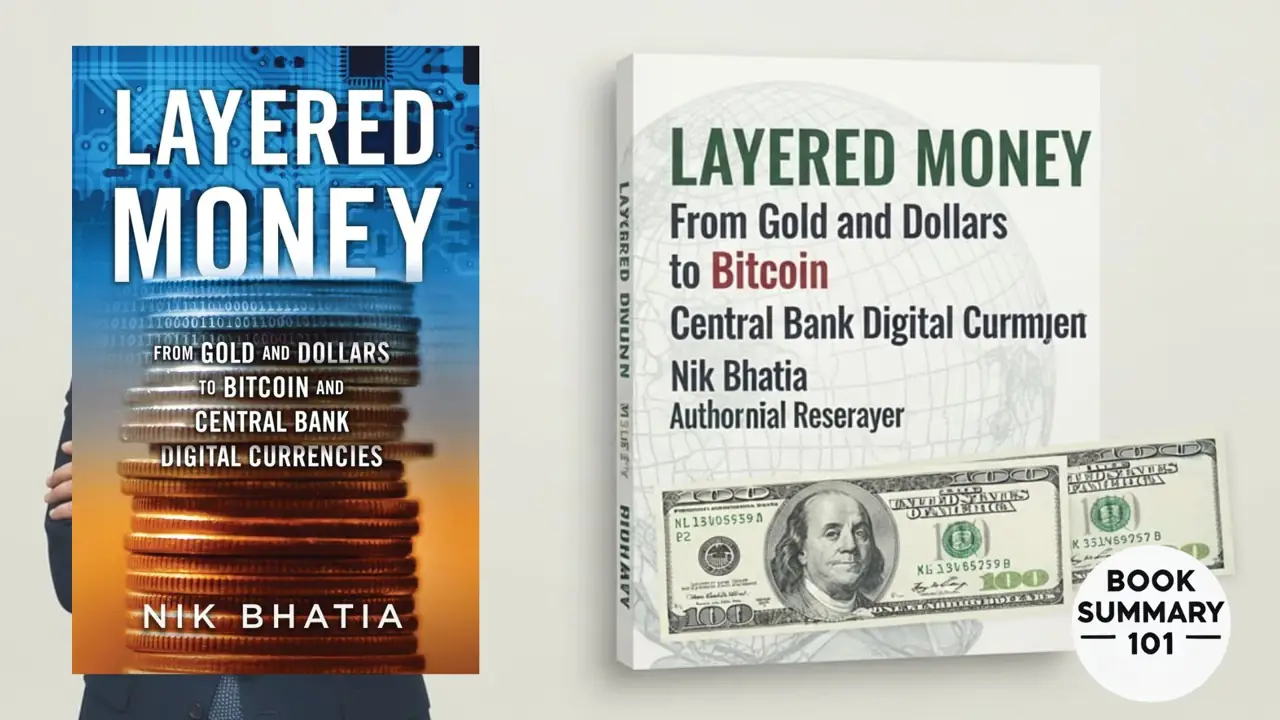
Then I picked up Layered Money: From Gold and Dollars to Bitcoin and Central Bank Digital Currencies by Nik Bhatia.
Reading this book wasn’t like reading a dry economics textbook. It felt like someone finally turned on the lights in a dark room. It was a friendly, “aha!” moment that connected the gold coins of the Roman Empire to the Bitcoin on my phone.
If you’ve ever felt stupid when finance experts talk about “The Fed,” “Liquidity,” or “Crypto,” this post is for you. Let’s break down the genius of Bhatia’s layered framework.
- Why Should You Even Bother Reading It?
- The Architecture of Value: How Money is Built in Layers
- 1. The Concept of Layered Money (The Poker Chip Analogy)
- 2. Gold: The Original Anchor
- 3. The Dollar Replaces Gold (The New Landlord)
- 4. Counterparty Risk (The House of Cards)
- 5. Bitcoin: The Return of Non-Sovereign Money
- 6. Central Bank Digital Currencies (CBDCs)
- My Final Thoughts
- Join the Conversation!
- Frequently Asked Questions (The stuff you’re probably wondering)
Why Should You Even Bother Reading It?
You might be thinking, “I’m not a day trader and I don’t work on Wall Street. Why do I need to know this?”
Here is why: We are living through a historic shift. The money in your bank account is changing fundamentally.
Whether you are a complete beginner who is terrified of inflation, a professional trying to make sense of the crypto craze, or just someone curious about why your grocery bill keeps going up, this book is essential.
It doesn’t just tell you what to think; it gives you a lens to view the world. It explains why the financial system crashes every decade and why digital currency is inevitable, not just a fad.
The Architecture of Value: How Money is Built in Layers
Nik Bhatia doesn’t just throw definitions at you. He paints a picture of a pyramid. He argues that money has never been just one thing; it has always been a hierarchy of IOUs (I Owe Yous) stacked on top of each other. Once you see the “layers,” you can’t unsee them.
1. The Concept of Layered Money (The Poker Chip Analogy)
Imagine you walk into a high-end casino. You walk up to the cage and hand over $100 in cash. In exchange, the cashier gives you a stack of chips.
Inside the casino, those chips work exactly like money. You can bet with them, tip the waitress, or even trade them with a friend. But are they real money?
Not exactly. They are a promise. They are an IOU from the casino saying, “If you bring this chip back to the cage, we promise to give you real cash.”
In Bhatia’s framework:
- Layer 1: The Cash (The final settlement).
- Layer 2: The Chips (A claim on the cash).
The book explains that our entire global economy works this way, just with more layers. Lower-layer money (like the digital dollars in your bank account) is just a promise to pay higher-layer money (reserves at the central bank).
If the casino goes bankrupt, your chips are worthless plastic. That is the risk of holding lower-layer money.
Simple Terms: Money exists in a hierarchy where lower layers are just “promises” to pay the layer above them.
The Takeaway: Not all money is created equal; some forms of money are just IOUs that carry the risk of never being paid back.
2. Gold: The Original Anchor
For thousands of years, gold was the king of the hill. It sat at the very top of the pyramid. Why? Because gold isn’t an IOU.
If you hold a gold coin, nobody else needs to do anything for that coin to have value. It just is.
Bhatia uses history to show how banks started issuing paper certificates (Layer 2) that represented the gold (Layer 1) sitting in their vaults. It was much easier to carry a piece of paper around Florence or London than a bag of heavy metal.
Think of it like a coat check ticket at a nightclub.
- The Coat (Layer 1): The actual valuable asset.
- The Ticket (Layer 2): A piece of paper that claims the asset.
The system worked beautifully—until bankers realized they could print more tickets than they had coats. This is the root of financial crises throughout history. The “layers” detach from the foundation.
📖 “Gold is not a promise to pay. It is the payment itself. It is the only financial asset that is not someone else’s liability.”
Simple Terms: Gold was the ultimate “Layer 1” money because it had no counterparty risk—you didn’t have to trust anyone to keep it valuable.
The Takeaway: Paper money began as a convenient receipt for gold, but eventually, we started trading the receipts and forgot about the gold.
3. The Dollar Replaces Gold (The New Landlord)
This is where things get really interesting—and where most people get confused.
Bhatia explains how, over the last century, the United States Dollar replaced gold at the top of the pyramid. Specifically, US Treasury bonds and Federal Reserve deposits became the new “Layer 1.”
This was a massive shift. We went from a system anchored by a neutral rock (gold) to a system anchored by the debt of a specific country (the USA).
Now, when banks need to settle debts with each other, they don’t move gold bars. They move US Treasuries or Fed reserves.
Imagine if the nightclub from our previous analogy suddenly said, “We aren’t storing coats anymore. Now, the most valuable thing in the building is a voucher signed by the manager.” The entire trust system shifts from the object (the coat) to the authority (the manager).
Simple Terms: The US government’s debt is now the foundation of the world’s money, replacing gold as the ultimate safe haven.
The Takeaway: The US Dollar isn’t just a currency; it is the structural foundation of the entire global financial system.
4. Counterparty Risk (The House of Cards)
One of the most powerful concepts in the book is “Counterparty Risk.”
This is simply the risk that the person holding your money won’t give it back.
- Layer 1 (Gold/Cash): No counterparty risk. If you hold it, you own it.
- Layer 2 (Bank Deposits): High counterparty risk. The bank is the “counterparty.”
Bhatia illustrates this with the 2008 Financial Crisis. The crisis happened because the lower layers of the pyramid (mortgage-backed securities and bank promises) turned out to be rotten. Everyone tried to run up the pyramid to safety (Layer 1) at the same time, but there wasn’t enough room.
It’s like a game of Musical Chairs. When the music plays, everyone is happy trading IOUs. But when the music stops (a crisis), everyone scrambles for the only chair that matters: Layer 1 money.
Simple Terms: The further down the money pyramid you go, the more you have to trust that someone else won’t go broke.
The Takeaway: In a crisis, liquidity dries up and everyone rushes to the top layer; if you are stuck in the bottom layers, you lose everything.
5. Bitcoin: The Return of Non-Sovereign Money
This is the climax of the book. Bhatia introduces Bitcoin not as a stock to trade, but as a technological breakthrough that creates a new Layer 1.
For the first time since gold, we have a form of money that:
- Is digital.
- Has no counterparty risk (no CEO, no central bank).
- Cannot be diluted (there will only ever be 21 million).
Bhatia argues that Bitcoin is “Digital Gold.” It is a neutral monetary network that operates outside of the government-controlled dollar pyramid.
Think of the internet. Before the internet, if you wanted to send a message, you had to use the Post Office (centralized). Now, you can send an email directly (decentralized). Bitcoin does for money what email did for mail. It allows you to hold a “Layer 1” asset on your phone without needing a bank vault.
📖 “Bitcoin is the first government-independent monetary system since the gold standard.”
Simple Terms: Bitcoin is a new monetary pyramid where the foundation is code and mathematics rather than gold or government debt.
The Takeaway: Bitcoin isn’t just a volatile speculative asset; it is a competitor to the US Treasury as a form of pristine collateral.
6. Central Bank Digital Currencies (CBDCs)
The final piece of the puzzle is the government’s response. They see the rise of digital money, and they want in.
Enter CBDCs (Central Bank Digital Currencies).
Bhatia explains that governments are currently building their own digital currencies to compete with Bitcoin and stablecoins. A CBDC would be like a digital dollar issued directly by the Fed to your smartphone wallet.
While this sounds convenient, Bhatia warns it comes with a catch: total surveillance and control. Unlike cash (which is anonymous) or Bitcoin (which is permissionless), a CBDC is programmable money that the issuer can track or even freeze.
It’s like upgrading from a physical key to your house (cash) to a smart lock controlled by your landlord (CBDC). Sure, it’s high-tech, but the landlord can now decide when you get to enter.
Simple Terms: CBDCs are the government’s version of Bitcoin, but with centralized control rather than decentralized freedom.
The Takeaway: The future of money will be a battle between decentralized money (Bitcoin) and state-controlled digital money (CBDCs).
My Final Thoughts
Reading Layered Money gave me a sense of calm in a chaotic market. Once you understand the hierarchy, the daily price swings of crypto or the confusing announcements from the Federal Reserve stop looking like random noise. You start to see them as mechanics adjusting the gears of a massive machine.
I walked away from this book feeling empowered. I finally understood that diversifying isn’t just about buying different stocks; it’s about holding assets in different layers of the pyramid.
If you want to stop guessing and start understanding the future of finance, you owe it to yourself to read this book.
Join the Conversation!
I’d love to hear your take. Do you think Bitcoin will eventually replace the US Treasury bond as the world’s main “Layer 1” asset, or will the Dollar reign supreme forever? Drop a comment below!
Frequently Asked Questions (The stuff you’re probably wondering)
1. Is this book too technical for a beginner?
Not at all. Nik Bhatia writes in plain English. If you understood the analogies in this blog post, you will handle the book just fine. He explains the jargon as he goes.
2. Is this just a book pumping Bitcoin?
No. While the author is clearly pro-Bitcoin, the first half of the book is a fascinating history lesson on gold, the Renaissance banking system, and the Federal Reserve. You learn about the history of money first, which makes the Bitcoin argument much stronger.
3. Do I need to know how to code?
Zero coding knowledge is required. This is a book about monetary theory and history, not computer programming.
4. How long does it take to read?
It is surprisingly concise. It’s not a 500-page doorstop. You can easily get through it in a weekend of casual reading.
5. Will this teach me how to trade?
No. This is not a “get rich quick” or technical analysis book. It won’t tell you when to buy, but it will help you understand what you are buying and why it matters in the long run.