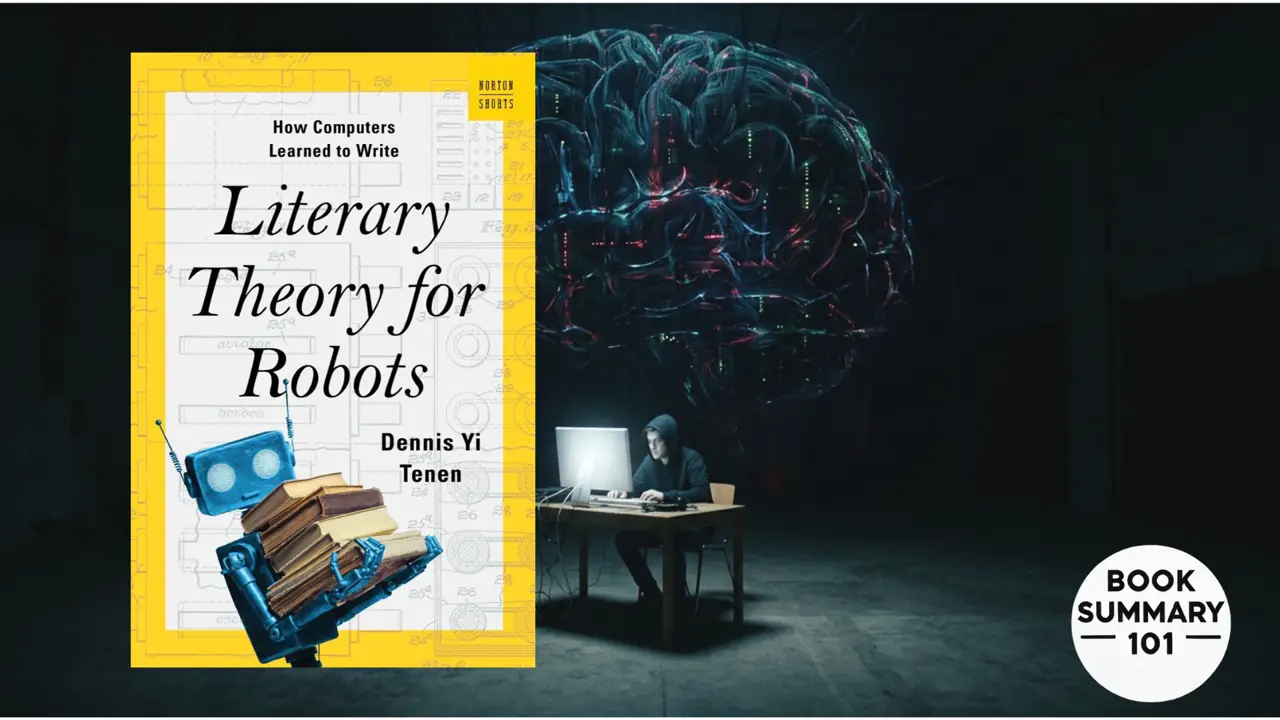
I have a confession to make. When ChatGPT first exploded onto the scene, I was terrified.
I pictured this glowing, alien brain sitting on a server rack somewhere, suddenly waking up and deciding it was Shakespeare. I thought writing – the messy, emotional, deeply human act of putting words on a page – had been stolen overnight by a bunch of microchips. It felt like magic, and honestly, a very dark kind of magic.
I spent months nervously watching the cursor blink on my screen, wondering if my own writing was about to become obsolete.
Then, a friend recommended a book that completely flipped my perspective. The book is called Literary Theory for Robots: How Computers Learned to Write (A Norton Short) by Dennis Yi Tenen.
Reading it felt like sitting down for coffee with a brilliant, incredibly patient history professor who just wanted to show me that there is no monster under the bed. Tenen took away the scary “alien magic” of AI and replaced it with a fascinating, surprisingly human history.
Why Should You Even Bother Reading It?
If you have ever felt intimidated by Artificial Intelligence (a completely normal reaction we explore in our summary of Demystifying Artificial Intelligence), or if you’re a writer, creator, or just a curious human wondering how a computer can write a poem, this book is for you.
You don’t need a degree in computer science to understand it. Tenen argues that AI isn’t a sci-fi invention from the future; it’s actually the result of centuries of human history, literature, and collaborative work. Understanding this gives you your power back. It transforms AI from a terrifying replacement into a deeply familiar tool.
- Why Should You Even Bother Reading It?
- The Hidden Gears of the AI Writing Machine
- The Myth of the Lone Genius
- Paper Machines and Analog Algorithms
- Markov Chains and the Art of the Guess
- The Ghost in the Machine (Human Labor)
- Intelligence as Architecture, Not an Entity
- My Final Thoughts
- Join the Conversation!
- Frequently Asked Questions (The stuff you’re probably wondering)
The Hidden Gears of the AI Writing Machine
To truly understand how a machine writes, we have to look past the glowing screens and uncover the centuries-old, incredibly human concepts that make it all possible.
The Myth of the Lone Genius
Have you ever pictured the “great human author”? Usually, we imagine a solitary genius, maybe Ernest Hemingway type, locked away in a snowy cabin, pulling brilliant, original words out of thin air.
Dennis Yi Tenen wants us to completely shatter that image. The truth is, writing has never been a solo act.
Think about building a modern house. You don’t go into the forest, chop down the trees, smelt the iron for the nails, and bake the glass for the windows yourself. You go to Home Depot. You buy prefabricated lumber, pre-made drywall, and standard-sized screws. You are the architect, but you are relying on the labor, standardization, and materials created by thousands of other people.
Writing works the exact same way. When you write an email, you are using a dictionary you didn’t invent, grammar rules you didn’t establish, and cliches that have been passed down for generations.
Historically, writers used templates, massive encyclopedias, and even teams of assistants to craft their stories. Shakespeare heavily borrowed plots from older historical texts. We have always relied on a massive, shared toolbox of human language to express ourselves.
When we look at AI text generators today, they aren’t doing anything fundamentally new. They are just using the ultimate, digitized version of that shared Home Depot. They are pulling from a vast warehouse of human language. Realizing this takes the “magic” out of the machine. It shows us that computers aren’t inventing new thoughts; they are just really fast at walking down the aisles of our collective human vocabulary and picking out the right materials.
Simple Terms: Human writing has always been a team sport relying on shared tools, and AI is just the newest, fastest tool in the shed.
The Takeaway: Stop viewing AI as an independent genius that rivals human creativity; instead, view it as a massive, high-speed library of prefabricated human thoughts.
Paper Machines and Analog Algorithms
When we hear the word “algorithm,” we immediately think of Silicon Valley, massive server farms, and complex computer code. But Tenen reveals a shocking truth: algorithms existed centuries before electricity.
Imagine you have a massive, chaotic bucket of mixed-up Legos. If you want to build a specific castle, you first need to sort them – all the red bricks here, all the roof pieces there. To do this, you might create a physical sorting tray with different labeled compartments. That tray is a physical tool that makes complex work simple.
Historically, humans built “paper machines” to sort information in a very similar way. Hundreds of years ago, medieval monks and Islamic scholars created physical paper wheels – circular charts that you could spin to combine different words, concepts, and ideas to generate new philosophical statements. It was literally a “machine” made of paper that generated text.
Later, we saw the invention of the dictionary, index cards, and massive filing cabinets. These were the original computers!
📖 “The history of artificial intelligence is not a sudden rupture, but a gradual accumulation of tools that humans built to externalize their own memories and thoughts.”
If you look at a children’s Mad Libs book – where you fill in the blanks with nouns and verbs to create a funny story – you are looking at a basic algorithm. The template dictates the structure, and the variables change the output.
Modern AI doesn’t rely on magic; it relies on these exact same principles, just scaled up to an unimaginable size. A program like Grammarly, which corrects your sentence structure, is essentially the modern, digital descendant of a 19th-century grammar textbook and a filing cabinet. The technology has evolved, but the underlying concept of organizing information is deeply rooted in our paper past.
Simple Terms: Long before computers existed, humans used physical tools like paper wheels, index cards, and templates to organize information and generate ideas.
The Takeaway: The foundation of AI text generation isn’t modern computer code; it is based on centuries-old human methods of sorting and combining information.
Markov Chains and the Art of the Guess
How does a machine actually know what word to type next? This is where the concept of “Markov Chains” comes in, and it’s far less complicated than it sounds.
Imagine you are singing along to your favorite song on the radio. Even if the radio suddenly cuts out to static, your brain automatically knows the next lyric. Or, think about having a conversation with your spouse or best friend. Because you know them so well, you can often finish their sentences before they even get the words out.
Your brain is doing this based on probability. You have heard the song so many times, or spoken to your friend so often, that you can mathematically guess what comes next with near-perfect accuracy.
In the early 20th century, a Russian mathematician named Andrey Markov started looking at literature this way. He took the poetry of Alexander Pushkin and spent hours manually counting vowels and consonants. He realized that if you know the current letter or word, you can calculate the mathematical probability of what the next letter or word will be.
This is exactly what AI does today. When you start typing an email and Gmail’s “Smart Compose” suddenly suggests the end of your sentence in gray text, it isn’t reading your mind. It isn’t “thinking.” It is using a Markov Chain on steroids.
The AI has digested billions of human emails. It knows that if you type, “I hope this email finds you,” there is a 99% probability the next word is “well.” It is an incredibly advanced guessing game. It doesn’t understand the meaning of the words, any more than a highly trained puppy understands the complex grammar of “sit.” The puppy just knows the sound leads to a treat. The AI just knows that certain words statistically follow others.
Simple Terms: AI writes by looking at millions of examples to mathematically guess which word has the highest probability of coming next.
The Takeaway: AI doesn’t “understand” the language it produces; it is simply playing a highly advanced, mathematically precise game of fill-in-the-blank.
The Ghost in the Machine (Human Labor)
There is a very dangerous myth that AI is totally autonomous – that it sits in a void, teaching itself how to be smart without any human help. Tenen’s book acts as a massive reality check, pulling back the curtain on the artificial intelligence industry.
Have you ever heard the story of the “Mechanical Turk”? Back in the 18th century, there was a famous machine that amazed audiences across Europe. It was a life-sized mechanical man dressed in robes that sat at a desk and played chess against human opponents – and it won, constantly. People thought it was a miracle of engineering. But it was a hoax. Hidden inside the cramped desk beneath the chessboard was a real, human chess master, pulling levers and moving the pieces.
AI today is a modern Mechanical Turk. We see a sleek, futuristic chat interface, but we don’t see the massive army of humans hidden “inside the desk.”
📖 “Intelligence does not reside in the machine, but in the vast, unseen network of human labor that feeds, corrects, and sustains it.”
For an AI like ChatGPT to know how to answer your questions politely and safely, it has to undergo a process called RLHF (Reinforcement Learning from Human Feedback). Tech companies hire thousands of human workers – often vastly underpaid workers in developing countries – to read the AI’s messy outputs, label toxic content, and manually score the responses.
Furthermore, the data the AI trained on in the first place is our data. Every blog post you’ve written, every Reddit comment, every digitized book. The machine is not a self-made genius. It is a mosaic built from the uncredited, often uncompensated labor of millions of human beings. (If you want to understand just how crucial human workers are to the future of this technology, you might also appreciate our summary of AI Needs You.)
Simple Terms: Artificial intelligence only functions because thousands of invisible human workers are constantly feeding it data and correcting its mistakes.
The Takeaway: We must stop treating AI as an independent, alien entity and start recognizing it as an extraction of massive amounts of collective human labor.
Intelligence as Architecture, Not an Entity
Because of movies like The Terminator or The Matrix, we have a very specific idea of what artificial intelligence is. We imagine it as a single, glowing entity – a brain floating in a digital jar. We think of intelligence as a spark of consciousness. (For a mind-bending look at how human intelligence actually works compared to machines, I highly recommend checking out our summary of A Thousand Brains.)
Tenen flips this entirely on its head. He argues that intelligence isn’t a “thing” inside the machine. Intelligence is the structure of the network.
Think about a vibrant, bustling city like New York or Tokyo. The “intelligence” of the city doesn’t live in the mayor’s office, and it doesn’t live in a single skyscraper. The intelligence of the city is the architecture itself: the way the subway lines connect neighborhoods, the way the traffic lights synchronize to let cars flow, the way supply chains bring food to the grocery stores every morning. The city functions brilliantly because of its structural connections.
AI is exactly the same. An AI doesn’t have a “brain.” Instead, it has a map.
When you use a tool like Wikipedia, you are interacting with structural intelligence. The power of Wikipedia isn’t just the text on the page; it’s the millions of blue hyperlinks connecting a historical event to a biography, and a biography to a geographic location.
AI text generators map the relationships between words and concepts in a vast, multi-dimensional web. When you ask it a question, it isn’t “thinking” of an answer; it is driving a car down the superhighways of information that humans have paved for it. The brilliance you see in an AI’s response isn’t coming from the machine’s soul; it’s coming from the beautifully complex architecture of human knowledge that the machine is navigating.
Simple Terms: The “smarts” of AI do not come from a conscious brain, but from the highly organized, interconnected map of human data it navigates.
The Takeaway: AI is not a living entity to be feared; it is an architectural map of human knowledge, much like a highly efficient city grid or the links on Wikipedia.
My Final Thoughts
Before I picked up Literary Theory for Robots: How Computers Learned to Write (A Norton Short), I viewed AI with a sense of helpless dread. It felt like an unstoppable force of nature that was going to wash away human creativity.
But Dennis Yi Tenen gave me a profound gift: context.
By taking me back through the history of Islamic scholars, medieval monks spinning paper wheels, and Russian mathematicians counting vowels, he showed me that AI isn’t alien at all. It is deeply, fundamentally human. It is the reflection of our own collective intelligence, built on the backs of human labor, sorting human words using human-designed templates.
This book didn’t just teach me how computers write; it reminded me why human writing is so special in the first place. AI can guess the next probable word, but it takes a human to break the rules, to feel the emotion, and to actually mean what is being said. I no longer look at the blinking cursor with fear. I look at it with the confidence of knowing exactly how the machine works.
Join the Conversation!
I’m curious to hear your thoughts! Before reading this, did you view AI text generators like ChatGPT as an “alien brain” or just a fancy autocomplete tool? Has learning about the history of “paper machines” changed how you feel about using AI in your daily life? Drop a comment below and let me know – I’d love to chat with you about it!
Frequently Asked Questions (The stuff you’re probably wondering)
1. Do I need to know how to code to understand this book?
Absolutely not! That is the best part about this book. Tenen uses literature, history, and real-world analogies to explain how computers work. There is zero complicated math or coding jargon. It is written specifically for everyday people.
2. Is the book too technical or dry?
Not at all. It reads much more like a fascinating history book than a computer science manual. It’s relatively short, incredibly engaging, and focuses on the human stories behind the technology.
3. Will this teach me how to write better prompts for ChatGPT?
Not directly. This isn’t a “how-to” manual for using AI tools. Instead, it’s a “how-it-works” book. However, by understanding how the machine thinks (like guessing probabilities and relying on templates), you will naturally become much better at interacting with it.
4. Who is Dennis Yi Tenen?
He is an associate professor of English at Columbia University, but he actually started his career as a software engineer at Microsoft! This makes him the perfect guide because he deeply understands both the computer code and the literary history.
5. How long does it take to read?
Because it is a “Norton Short,” it is incredibly concise. Most readers can get through it comfortably in a weekend. It’s designed to be a punchy, thought-provoking read that respects your time.