I have a confession to make. A few years ago, I hit a career wall.
I looked at the rapidly changing tech landscape—AI writing code, algorithms predicting consumer behavior—and I felt a cold knot of anxiety in my stomach. I felt obsolete.
My first instinct was panic. Do I need to go back to university for four years? Who has the time or money for that? Am I just… done?
I felt like I was running a marathon where the finish line kept moving further away.
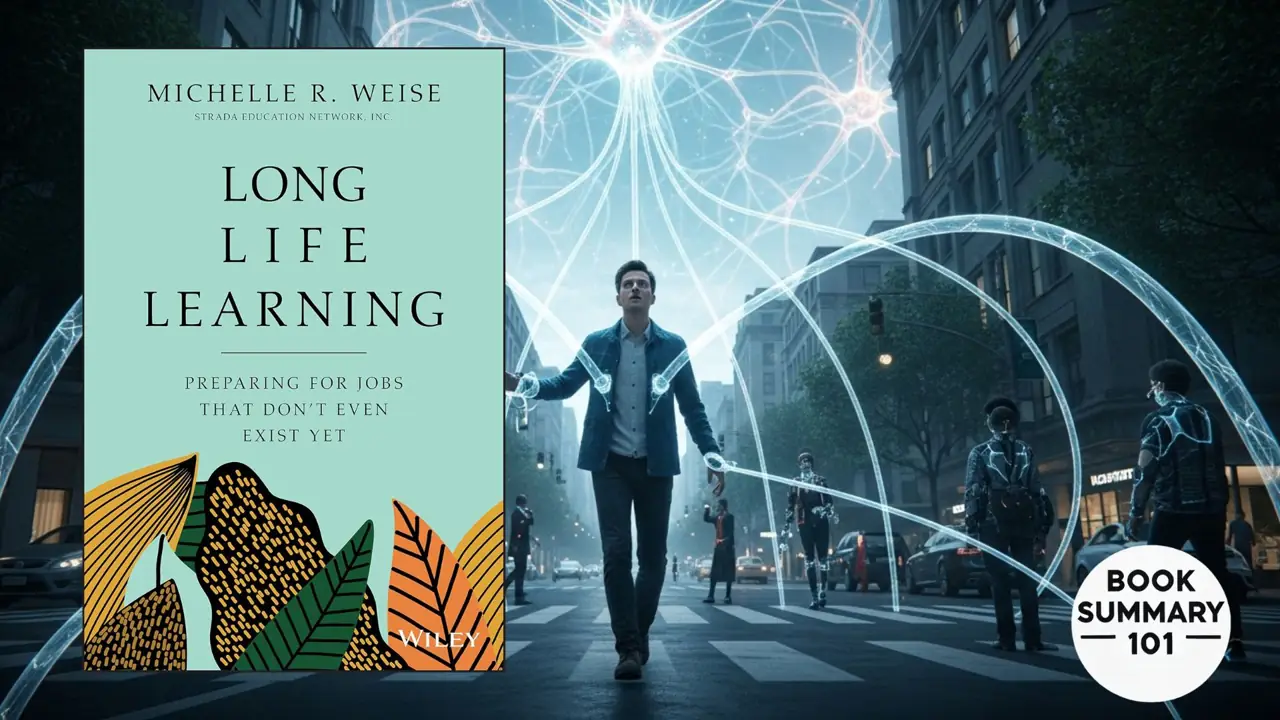
That’s when I stumbled upon Michelle R. Weise’s Long Life Learning: Preparing for Jobs that Don’t Even Exist Yet. I expected a dry, academic textbook about policy. Instead, what I found felt like a reassuring conversation with a brilliant mentor over coffee.
Weise didn’t tell me to “hustle harder.” She explained that the system I was stressed about was built for a world that no longer exists—and she laid out exactly how we can fix it.
If you’ve ever worried about your skills expiring, this post is for you.
Why Should You Even Bother Reading It?
Honestly? Because you’re probably going to live a long time.
This book isn’t just for educators or policy wonks. It is for anyone who plans on working for a living in the next 20 years. Whether you are a mid-career professional terrified of automation, a student wondering if college is worth the debt, or a manager trying to hire the right people, this book is your survival guide.
The core message is simple but urgent: The old “learn once, work forever” model is broken. We need a new map for a much longer journey.
- Why Should You Even Bother Reading It?
- The Blueprints for a New Working World
- 1. The End of the “Three-Stage Life”
- 2. Serving the “Non-Consumers”
- 3. Human Skills: The Robot-Proof Shield
- 4. The “Rosetta Stone” of Hiring
- 5. Wraparound Support: The “Pit Crew” Approach
- My Final Thoughts
- Join the Conversation!
- Frequently Asked Questions (The stuff you’re probably wondering)
The Blueprints for a New Working World
We tend to think that if we can’t keep up with the job market, it’s a personal failure. We think we’re just not smart enough or disciplined enough.
But Weise flips the script. She argues that the infrastructure for “lifelong learning” is missing. It’s like trying to drive across the country without gas stations. Here are the core principles from the book that completely reshaped how I view my career and the future of education.
1. The End of the “Three-Stage Life”
Imagine your life is a standardized three-course meal.
- Appetizer: Education (Ages 5–22)
- Main Course: Work (Ages 23–65)
- Dessert: Retirement (Ages 65+)
For decades, this was the standard menu. But thanks to advances in healthcare and technology, we are moving toward a 100-year life.
If you live to 100, you can’t retire at 65 with enough money. You might need to work for 60 or 70 years. The problem? That “Appetizer” of education you ate when you were 20 isn’t enough fuel to power you through a 60-year Main Course. You’re going to starve.
Weise explains that we need to move from a “one-and-done” education model to a continuous buffet. We need to be able to dip in and out of the workforce to recharge our skills.
Real-World Example:
Think about your grandfather. He likely learned a trade or got a degree, joined a company, and stayed there until he got a gold watch. Now, look at a modern graphic designer. The software they used five years ago is already obsolete. They can’t rely on their college degree from 2005; they need “snacks” of learning every few months just to stay employed.
Simple Terms: You can’t run a 60-year career on a 4-year degree.
The Takeaway: We must normalize taking breaks from work to learn, treating education as a recurring subscription, not a one-time purchase.
2. Serving the “Non-Consumers”
Weise uses a brilliant concept here borrowed from business theory: Non-Consumers.
Imagine a luxury car dealership. They only sell Ferraris. Most people can’t afford one, so they walk (or take the bus). In the world of education, universities are often the Ferrari dealerships. They offer expensive, time-consuming, four-year packages that many adult learners (parents, full-time workers) simply cannot “buy.”
These people aren’t unwilling to learn; they are just non-consumers of the current product because it doesn’t fit their lives.
Weise argues we need to create the “Toyota Camrys” or “Uber rides” of education—short, affordable, targeted learning experiences that fit into a busy adult’s life.
📖 Quote: “We need to build a new learning ecosystem that is navigable, supportive, targeted, integrated, and transparent.”
Real-World Example:
Consider Guild Education (a company Weise discusses). They partner with massive employers like Walmart or Disney to offer employees education as a benefit. But they don’t just throw a catalog at them; they offer short, flexible courses that a cashier working 40 hours a week can actually finish. They are turning non-consumers into learners.
Simple Terms: Traditional college is too expensive and rigid for working adults.
The Takeaway: The future belongs to educational programs that are short, flexible, and designed for people who have bills to pay.
3. Human Skills: The Robot-Proof Shield
Whenever we talk about the future of work, everyone screams, “Learn to code!”
Weise says: Not so fast.
Think of skills like a computer system. Technical skills (coding, operating machinery, accounting) are the Software. Software requires constant updates and patches. It goes obsolete fast.
However, Human Skills (empathy, ethics, communication, critical thinking) are the Operating System.
Weise points out that while AI is getting great at the “Software” tasks, it is terrible at the “Operating System” tasks. As technology handles the repetitive stuff, the ability to listen to a client, understand their emotional needs, and make an ethical judgment call becomes more valuable, not less.
Real-World Example:
Zillow can give you a “Zestimate” (an automated home value) in seconds. That’s the software. But Zillow cannot hold your hand when you’re selling your childhood home and feeling emotional about leaving the memories behind. A real estate agent who has high emotional intelligence (the OS) provides value that the algorithm simply cannot touch.
Simple Terms: Tech skills expire; people skills are forever.
The Takeaway: Don’t just chase technical trends; double down on your ability to communicate, empathize, and solve complex human problems.
4. The “Rosetta Stone” of Hiring
Have you ever looked at a job description that asked for a “Ninja Rock Star with 10 years experience in a tool that was invented 3 years ago”?
Weise highlights a massive “translation” problem.
- Schools speak: “Credit hours,” “Liberal Arts,” “GPA.”
- Employers speak: “Python,” “Project Management,” “Salesforce.”
They are speaking two different languages. This is why you might be perfectly qualified for a job but get rejected because your resume didn’t have the right keywords for the automated bot to find.
We need a Rosetta Stone—a translation layer. Weise advocates for a shift to Skills-Based Hiring. Instead of showing a diploma (which is a black box), we should have a “digital wallet” of verified skills.
Real-World Example:
Imagine if, instead of sending a PDF resume that says “B.A. in English,” you sent a digital link showing verified badges: Critical Writing (Level 5), SEO Optimization (Level 3), and Team Leadership (verified by former boss). Companies like Credly are trying to do this. It helps employers see what you can actually do, not just where you sat for four years.
Simple Terms: We need to stop hiring based on pedigrees and start hiring based on proven skills.
The Takeaway: The future resume won’t be a list of job titles; it will be a verified portfolio of specific capabilities.
5. Wraparound Support: The “Pit Crew” Approach
This is my favorite concept in the book because it’s so humane.
Weise argues that when adult learners drop out of a course, it’s usually not because the math was too hard. It’s because life got in the way. The car broke down, the babysitter quit, or the work shift changed.
If we want lifelong learning to work, we can’t just offer the “course.” We need to offer the Pit Crew.
Think of a Formula 1 driver. They don’t win the race alone. They have a team changing tires, fueling the car, and checking the engine. Adult learners need a pit crew that provides childcare, transportation assistance, career coaching, and mental health support.
📖 Quote: “It’s not the content that stops people from learning; it’s the chaos of life.”
Real-World Example:
Some coding bootcamps now offer “income share agreements” (you don’t pay until you get a job) and include living stipends or free laptops. They aren’t just selling information; they are removing the friction that stops people from succeeding.
Simple Terms: You can’t learn if you’re worried about how to feed your kids.
The Takeaway: Successful educational programs of the future must support the whole person, not just their brain.
My Final Thoughts
Reading Long Life Learning didn’t just make me smarter; it made me feel calmer.
It made me realize that feeling “behind” isn’t a personal flaw—it’s a symptom of a system in transition. The book is empowering because it tells us that it is never too late to pivot. In a 100-year life, you have time to be three, four, or five different versions of yourself.
Weise gives us permission to let go of the linear path and embrace a messy, cyclical, exciting journey of constant growth.
Join the Conversation!
I’d love to hear your take on the “100-Year Life.”
If you had the time, money, and “pit crew” support to learn absolutely anything right now—without worrying about the cost—what skill would you start learning tomorrow?
Drop a comment below!
Frequently Asked Questions (The stuff you’re probably wondering)
1. Do I need to be in the tech industry to appreciate this book?
Absolutely not. While it discusses technology, the principles apply to nurses, teachers, tradespeople, and artists. It’s about the structure of work, not just the tech sector.
2. Is this book depressing? Does it say robots are taking all our jobs?
No! It’s actually very optimistic. Weise believes that while tasks will be automated, human judgment is irreplaceable. She focuses on how to prepare, rather than doom-scrolling about the apocalypse.
3. Is it very academic and hard to read?
It is well-researched and contains data, but Weise writes clearly. However, it is more of a “big picture” systemic book than a breezy self-help guide. It challenges you to think about society, not just yourself.
4. Does the book say college is a waste of time?
No. It argues that college is great, but it’s not enough. It suggests that universities need to evolve to support people throughout their lives, not just for four years after high school.
5. Who is the ideal reader for this?
If you are a hiring manager, an educator, or someone feeling “stuck” in your career mid-life, this book is essential reading. It helps you see the playing field clearly.