Have you ever looked at a twenty-dollar bill and wondered, “Why is this actually worth anything?”
I mean, really thought about it. It’s just a piece of cotton-blend paper with some green ink and a dead president on it. You can’t eat it. You can’t build a house with it.
For a long time, I treated the economy like the weather—something that just “happens” to us. Inflation goes up, interest rates go down, and I just nodded along, pretending I understood why. But deep down, I had this nagging feeling that the system was more fragile than the news anchors made it sound. It felt like we were all playing a game where the rules kept changing, but nobody told the players.
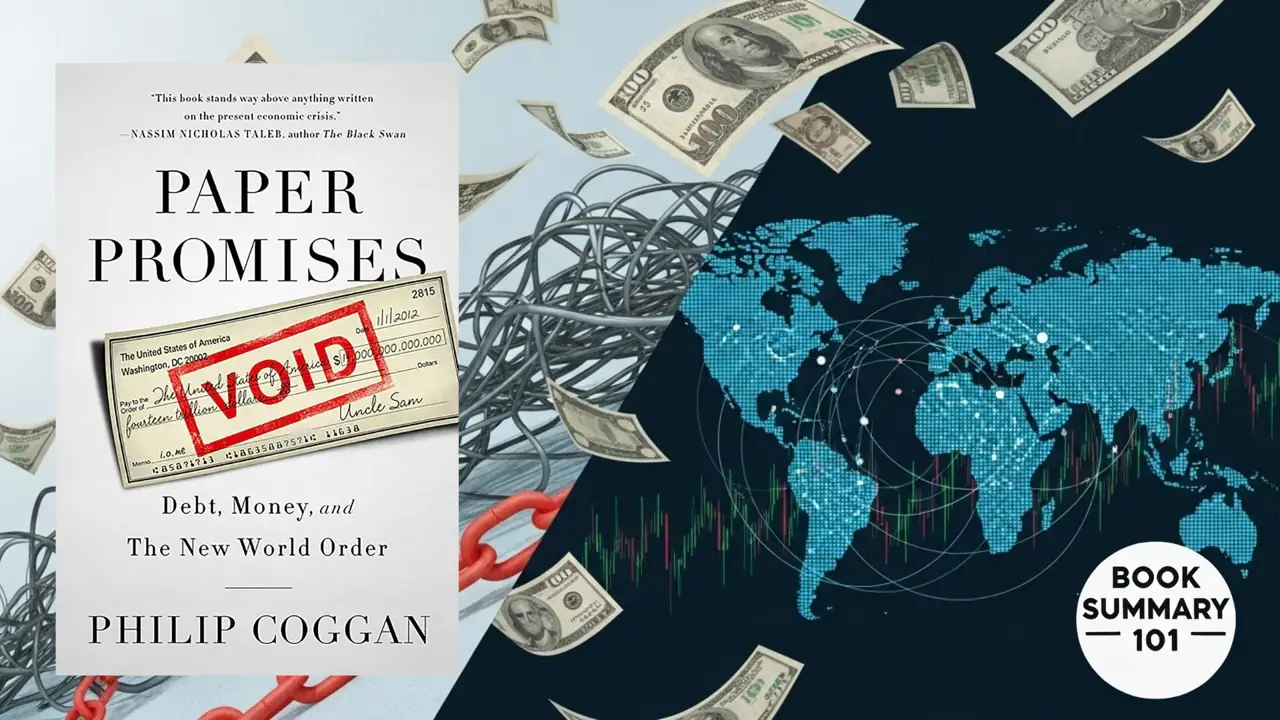
Then I picked up Paper Promises: Debt, Money, and the New World Order by Philip Coggan.
It wasn’t like reading a dry textbook. It felt like sitting down with a wise, slightly cynical historian who bought me a beer and said, “Let me tell you how the world actually works.”
Coggan pulls back the curtain on the history of money, revealing that our entire financial lives are built on a very delicate foundation of trust—or as he calls them, “promises.” And the scary part? We might have made more promises than we can keep.
- Why Should You Even Bother Reading It?
- The Cycles That Define Our Economic Reality
- 1. Money is Just a “IOU” (The Concept of Deferred Payment)
- 2. The Eternal Battle: Creditors vs. Debtors
- 3. Breaking the Golden Handcuffs (The Nixon Shock)
- 4. The Illusion of the “Great Moderation”
- 5. The Three Ways Out (And None Are Painless)
- 6. The Shift from West to East
- My Final Thoughts
- Join the Conversation!
- Frequently Asked Questions (The stuff you’re probably wondering)
Why Should You Even Bother Reading It?
You might be thinking, “I’m not an economist, and I don’t work on Wall Street. Why do I need to know the history of debt?”
Here is the honest answer: Because it affects the price of your groceries, the value of your house, and the safety of your retirement fund.
This book is perfect for:
- The Curiously Confused: If you’ve heard terms like “Quantitative Easing” or “Fiat Currency” and felt lost.
- The History Buff: If you want to see how debt has toppled empires from Rome to the British Empire.
- The Future-Proofer: Anyone who wants to understand why the 2008 financial crisis happened and why many experts think “Part 2” is inevitable.
It’s not about stock tips; it’s about understanding the ground beneath your feet.
The Cycles That Define Our Economic Reality
Coggan doesn’t just throw charts at you; he weaves a narrative about human behavior. Before we dive into the specific mechanisms, it’s crucial to understand that financial history isn’t a straight line of progress—it is a repetitive cycle of building up confidence and then shattering it.
1. Money is Just a “IOU” (The Concept of Deferred Payment)
To understand the book, you have to change how you view money.
Imagine you are at a bar with your friends. You buy a round of drinks, but you don’t have cash. The bartender knows you, so he writes your name on a tab.
That tab isn’t the beer. It’s a promise to pay for the beer later.
Coggan explains that money operates the exact same way. It is a claim on the future. When you work for a week and get paid, you are holding a “claim check” that society promises to honor later when you want to buy food or clothes.
Throughout history, money has evolved from things with intrinsic value (like gold coins, which are valuable in themselves) to “fiat” money (paper that is valuable only because the government says so).
When money is backed by nothing but a promise, it allows governments to print as many “claim checks” as they want. The problem arises when there are more claim checks circulating than there are actual goods and services to buy. That’s when the promise starts to look a little shaky.
Simple Terms: Money isn’t wealth; it is a voucher you hold today to get actual stuff tomorrow.
The Takeaway: Our entire modern economy is based on the trust that the “voucher” (dollar, euro, yen) will still be worth something when we try to spend it.
2. The Eternal Battle: Creditors vs. Debtors
Coggan frames the entire history of economics as a wrestling match between two groups of people:
- Creditors: The people who have money and lend it out (savers, retirees, bankers).
- Debtors: The people who owe money (students, homeowners, governments).
Think of this like a Tug-of-War.
Creditors want “Sound Money.” They want money to be scarce and hold its value so that when they get paid back, the money buys just as much as it did when they lent it. They love Gold Standards.
Debtors, on the other hand, secretly love inflation. Imagine you owe someone $100, but suddenly inflation hits and $100 is only the price of a candy bar. It becomes incredibly easy to pay off your debt.
📖 “Inflation is a way of reneging on debts; it is a tax on the creditor in favor of the debtor.”
Coggan argues that democracy naturally favors the debtor. Why? Because there are usually more people with debt (voters) than there are wealthy bankers. Therefore, in the long run, the system tends to drift toward inflation to help the majority ease their burdens.
Simple Terms: Savers want money to keep its value; borrowers want money to lose value so their loans are cheaper to pay back.
The Takeaway: History swings back and forth between favoring savers and borrowers, and right now, we are in a massive struggle over who is going to take the hit.
3. Breaking the Golden Handcuffs (The Nixon Shock)
One of the most pivotal moments in the book is 1971.
Before this, the US dollar was tied to gold. This acted like a strict parent. If the government wanted to spend more money, they needed more gold. It limited how much debt they could get into. It was a pair of “Golden Handcuffs.”
In 1971, President Nixon took the US off the gold standard. He unlocked the handcuffs.
Suddenly, money was untethered. Governments could create credit out of thin air. Coggan compares this to giving a teenager a credit card with no spending limit. At first, it feels amazing! You can buy everything! The economy boomed, credit cards became common, and mortgages became easy to get.
But without the discipline of gold, the West went on a 40-year borrowing binge. We promised to pay for pensions, healthcare, and wars, all funded by debt that wasn’t backed by anything tangible.
Simple Terms: In 1971, we removed the physical limit on how much money could be created, leading to an explosion of debt.
The Takeaway: The modern financial world is an experiment that is only about 50 years old, and we are just now seeing the long-term consequences of “unlimited” money.
4. The Illusion of the “Great Moderation”
From the 1980s up to 2008, everything looked great. Inflation was low, growth was steady, and economists patted themselves on the back, calling it the “Great Moderation.”
Coggan argues this was an illusion. It was like a homeowner who thinks they are rich because they keep taking out home equity loans to buy fancy cars. They look wealthy, but they are just eating their future equity.
During this time, central banks (like the Federal Reserve) acted like alchemists. Every time the economy stumbled (the dot-com crash, 9/11), they slashed interest rates and printed money to prop it back up.
This taught investors a bad lesson: “Don’t worry about risk; the government will save you.”
This behavior encouraged reckless gambling, leading directly to the 2008 housing crash. We weren’t actually getting richer through productivity; we were just inflating asset prices (houses and stocks) with cheap debt.
Simple Terms: We mistook a “debt-fueled spending spree” for a “healthy, growing economy.”
The Takeaway: You cannot solve a problem caused by too much debt by issuing even more debt, yet that has been the strategy for decades.
5. The Three Ways Out (And None Are Painless)
So, we have piled up historic levels of debt. Governments owe trillions. Individuals owe trillions. How does the story end?
Coggan uses a stark analogy: The Check is on the Table.
Imagine a group of friends eats a massive, expensive dinner. The bill arrives, and it’s way more than anyone can pay. There are only three ways to handle this situation:
- Default (Hard Default): You simply stand up and say, “I’m not paying.” This causes chaos, bankruptcy, and ruins your reputation (credit score).
- Inflation (Soft Default): This is the magician’s trick. You pay the bill, but you print fake money to do it. The restaurant gets paid, but the money is worthless.
- Financial Repression: You force the people at the table to hand over their wallets. Governments do this by keeping interest rates below inflation, slowly draining value from savers to pay off government debts.
📖 “History suggests that there is no painless way to deleverage an economy. Someone has to take the loss.”
Coggan argues we are currently in the phase of Financial Repression. By keeping interest rates at rock bottom (or near zero), savers are being slowly bled dry to keep the government and the debtors afloat.
Simple Terms: The debt is too big to be paid back honestly, so we will likely see it eroded through inflation or currency devaluation.
The Takeaway: If you are holding cash or low-interest bonds, you are the one paying for the dinner, whether you realize it or not.
6. The Shift from West to East
The final major concept is the geopolitical shift.
For the last century, the West (US and Europe) were the creditors—the rich bankers of the world. But now, the roles have flipped.
Think of the US as the “Aging Aristocrat” living in a crumbling mansion, still spending money to keep up appearances.
Think of China and emerging markets as the “Hardworking Shopkeeper” who has been saving every penny.
The US consumes more than it produces, and it borrows the difference from China. China holds massive amounts of US debt. This creates a fragile balance of power. If the “Shopkeeper” decides to stop lending money to the “Aristocrat,” the Aristocrat’s lifestyle collapses overnight.
Coggan suggests that the “New World Order” will inevitably involve the decline of the US dollar’s dominance and the rise of Asian currencies, simply because he who holds the gold (or the savings) makes the rules.
Simple Terms: The West is broke and living on credit from the East; eventually, the bill comes due, and power shifts to the lender.
The Takeaway: We are witnessing the slow end of Western financial dominance and the rise of a multi-polar economic world.
My Final Thoughts
Reading Paper Promises: Debt, Money, and the New World Order was a bit like taking the red pill in The Matrix. It didn’t make me an expert day trader, but it stopped me from being a naive observer.
It’s easy to feel angry when you realize that money is a game where the rules are bent to help the debtors at the expense of the savers. But knowledge is empowering. Instead of just hoping my savings account will be safe, I now understand why interest rates are low and why inflation feels sticky.
The book isn’t necessarily pessimistic, but it is realistic. Promises have been made that cannot be kept in real terms. Understanding that allows you to stop expecting the government to fix everything and start thinking about how to protect your own “claims on the future.”
Join the Conversation!
I’d love to hear your take on this. If you had to choose between a “Hard Default” (a sudden crash where debts are wiped out but banks fail) or “High Inflation” (prices double but the system keeps running), which poison would you pick? Drop a comment below!
Frequently Asked Questions (The stuff you’re probably wondering)
1. Is this book too technical for someone who hates math?
Not at all. Philip Coggan is a journalist (he wrote for The Economist), not a dry academic. He uses history, stories, and clear logic. There is very little math; it’s mostly about history and human psychology.
2. Is the book outdated since it was published a few years ago?
Surprisingly, no. In fact, it’s almost more relevant now. The cycles he describes (money printing, rising debt) have accelerated since the book came out. He predicted the struggles we are facing right now.
3. Does the book tell me where to invest my money?
No. This is not an investment guide. It won’t tell you to buy Bitcoin or Gold. It provides the historical context so you can decide what makes sense. It teaches you how to think, not what to buy.
4. Is it a “doom and gloom” book?
It can feel a little heavy because it exposes the flaws in our system. However, it’s not written by a conspiracy theorist shouting about the end of the world. It’s a rational look at how economic cycles naturally rise and fall.
5. How long does it take to read?
It’s a dense read in terms of ideas, but the writing flows well. You could probably get through it in a week of dedicated evening reading. It’s about 300 pages of actual text.