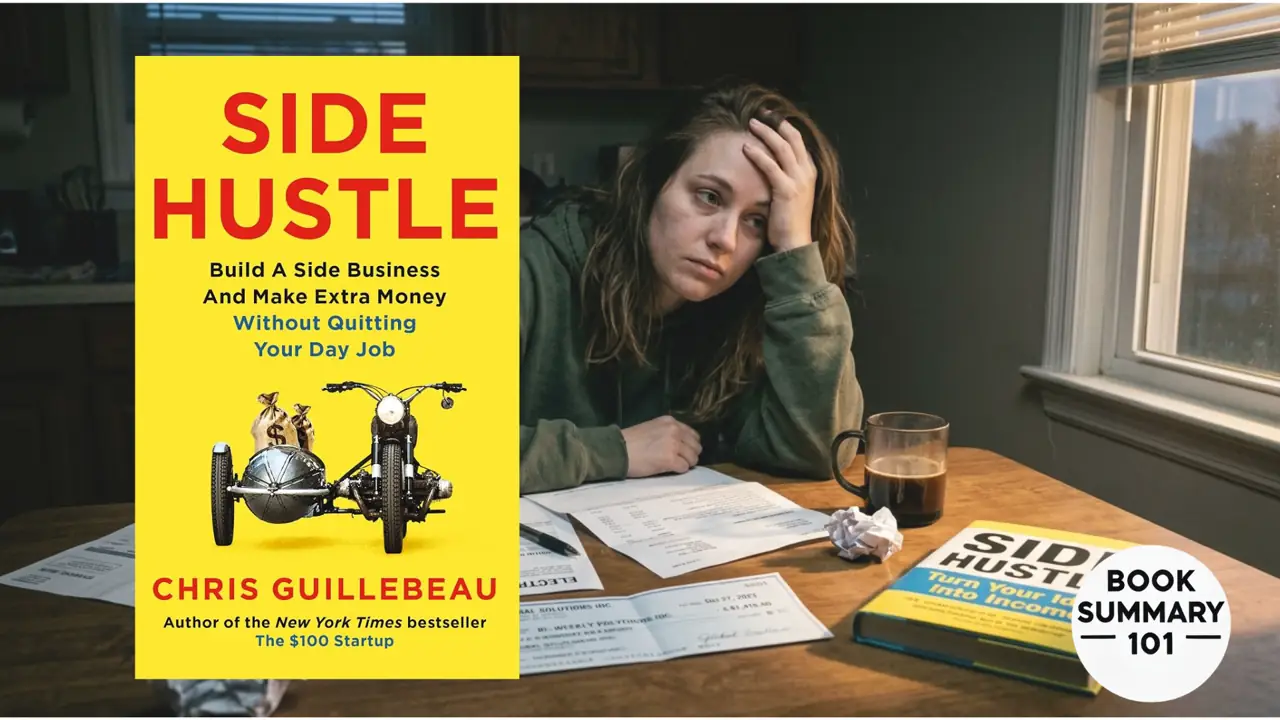
I used to stare at my bi-weekly paycheck with a pit in my stomach. No matter how carefully I budgeted, there was always too much month at the end of the money. I honestly thought my only options were to beg my boss for a pathetic 3% raise, or sacrifice my weekends to a grueling, soul-crushing retail job.
The idea of starting a “business” terrified me. I pictured maxed-out credit cards, complicated tax forms, and terrifying meetings with venture capitalists. But then, a friend handed me a copy of Side Hustle.
Reading this book felt like sitting down for coffee with an insanely smart, encouraging mentor who just wanted to see me win. It completely shattered my illusion that making extra money had to be risky or complicated. Instead, it handed me a step-by-step roadmap to creating my own security.
Why Should You Even Bother Reading It?
If you are a 9-to-5 professional, a busy parent, or someone who breaks into a cold sweat at the word “entrepreneur,” this book is written specifically for you. You don’t need a business degree, and you certainly don’t need a trust fund.
This book is vital today because relying on a single source of income is actually the riskiest thing you can do. A side hustle isn’t just about paying for a nice vacation; it’s about buying back your freedom and building an asset that belongs entirely to you.
- Why Should You Even Bother Reading It?
- The 27-Day Blueprint to Financial Freedom
- Generating an Arsenal of Ideas
- The “Tinder” Approach to Idea Selection
- Transforming an Idea into an “Offer”
- The Power of the 27-Day Launch
- Regroup, Refine, and Steer the Ship
- My Final Thoughts
- Join the Conversation!
- Frequently Asked Questions (The stuff you’re probably wondering)
The 27-Day Blueprint to Financial Freedom
Guillebeau breaks down the journey from zero to profitable side hustle into five distinct phases, making the entire process feel like a fun, step-by-step game rather than a stressful business venture.
Generating an Arsenal of Ideas
Imagine you are walking down a crowded beach with a high-powered metal detector. Most people are just mindlessly staring at the sand, walking right over valuable items. But with your metal detector turned on, every beep is a hidden treasure waiting to be dug up.
In the world of side hustles, your “metal detector” is your power of observation. You have to train your brain to look for everyday problems, annoyances, and inefficiencies. When someone complains, your metal detector should beep. A side hustle isn’t usually born from a groundbreaking, Steve Jobs-level invention. It is usually born from a very simple, boring problem that someone is willing to pay to solve.
For instance, you don’t need to invent a new breed of dog to make money in the pet industry. You just need to listen to your neighbors complaining about how expensive traditional kennels are. You hear the complaint, your metal detector beeps, and suddenly you realize you could offer an exclusive, in-home pet sitting service for anxious dogs.
The key during this initial phase is volume. You want to dig up as many “beeps” as possible without judging them yet. Keep a running note on your phone. Write down every service you wish existed, every skill you have that people ask you for help with, and every frustration you encounter in your daily routine. By the end of your first week, you should have a massive treasure chest of raw, unpolished ideas to choose from.
Simple Terms: Train your brain to notice everyday problems and turn those complaints into a giant list of potential money-making solutions.
The Takeaway: The best business ideas are already all around you, hiding in plain sight as ordinary frustrations.
The “Tinder” Approach to Idea Selection
Now that you have a massive list of ideas, you have to realize that not all of them are winners. Think of this process like using a dating app. You are going to ruthlessly swipe left on the bad matches, and only swipe right on the ones that have serious, immediate potential.
You cannot fall in love with an idea just because it sounds cool. You have to evaluate it ruthlessly. Guillebeau suggests putting your ideas through a very specific filter. Does this idea have a high potential for profit? Can it be started with the skills and resources you already have right now? Will it cost little to no money to get off the ground?
Let’s look at a real-world example. Say you have two ideas: starting a gourmet food truck, and offering freelance resume writing for recent college grads. The food truck sounds incredibly fun and glamorous. But wait—it requires a $50,000 loan, health department permits, and months of preparation. Swipe left.
📖 “A side hustle is not a part-time job. A side hustle is not the gig economy. It is an asset that works for you.”
Now look at the resume writing idea. You already have a laptop, you know how to format a Word document, and college kids are desperate for jobs right now. You can start tonight for zero dollars. Swipe right! You want to select the idea that offers the path of least resistance to your first dollar. It’s about feasibility and profitability, not necessarily following your deepest, grandest life passion.
Simple Terms: Ruthlessly filter your brainstormed list to find the one idea that is highly profitable, low-cost, and easy to start immediately.
The Takeaway: Don’t pursue an idea that requires debt or months of prep; choose the simplest path to making your first sale.
Transforming an Idea into an “Offer”
There is a massive difference between having an idea and having an offer. Imagine you walk into a fancy restaurant, starving for dinner. The chef doesn’t just hand you a raw chicken, a handful of flour, and a stick of butter. They hand you a beautifully plated, perfectly seasoned meal.
An idea is just the raw ingredients. An “offer” is the fully cooked meal that someone is actually excited to buy. To turn your idea into an offer, you need three specific ingredients: a promise, a pitch, and a price.
The promise is how your side hustle will change the customer’s life. The pitch is the simple, compelling way you explain it. And the price is what it costs. If you just say, “I am good at Excel,” that is a raw ingredient. Nobody buys raw ingredients.
But what if you say, “I sell a custom Excel template that tracks every penny of your wedding budget, preventing you from overspending, and it costs $29.” Boom. You have just cooked the meal. You are no longer selling “Excel skills”—you are selling peace of mind to stressed-out brides.
This shift in mindset is incredibly powerful. People don’t open their wallets for vague concepts. They open their wallets when they understand exactly what they are getting, how it solves their specific pain point, and how much it costs. Crafting an irresistible offer is the bridge between a daydream and a deposit in your bank account.
Simple Terms: Package your skills into a clear, specific product or service with a direct promise, a simple pitch, and a set price.
The Takeaway: Customers don’t buy your vague skills or ideas; they buy concrete solutions to their specific problems.
The Power of the 27-Day Launch
Imagine you are directing a high school play. Your actors have been rehearsing for weeks. The costumes aren’t totally perfect, someone occasionally forgets a line, and the lighting is a bit finicky. But the calendar says it’s opening night. Ready or not, you have to pull the curtain up.
When starting a side hustle, perfectionism is your absolute worst enemy. It is so easy to spend six months tweaking a logo, agonizing over a website design, or waiting for the “perfect” time to start. Guillebeau imposes a strict 27-day deadline for a reason: it forces you to open the curtain.
📖 “Action is better than inaction. If you’re not sure what to do, do something.”
You do not need a slick, expensive website to launch. You don’t need business cards. You just need a way for people to give you money. If your side hustle is selling custom-painted sneakers, your “launch” might literally just be an Instagram post with a picture of your shoes and a link to your PayPal account.
The goal isn’t to be flawless; the goal is to exist in the real world. Once you launch, the market will tell you what works and what doesn’t. You will learn more in your first week of actually trying to sell something than you would in a year of reading business books. Push the bird out of the nest. Pull the curtain up. Launch before you feel fully ready.
Simple Terms: Stop obsessing over tiny, perfect details and force yourself to put your product out into the world within a strict timeframe.
The Takeaway: A messy, imperfect launch that makes money is infinitely better than a perfect idea that never sees the light of day.
Regroup, Refine, and Steer the Ship
Launching your side hustle is a huge victory, but the work doesn’t stop once you make your first sale. Think of your new business like a massive sailboat leaving the harbor. Once you are out on the open ocean, the wind will change. The currents will shift. If you just tie down the steering wheel and go to sleep, you are going to crash into a reef.
You have to actively steer the ship. In the world of side hustles, this means tracking your metrics and adjusting your strategy based on reality, not assumptions. After your launch, you enter the phase of regrouping and refining.
Let’s say you started a weekend hustle baking artisan cookies. You notice that your double-chocolate cookies sell out in an hour, but your oatmeal raisin cookies sit there gathering flies. Steering the ship means you stop making the oatmeal altogether. You double your production of chocolate. You ask your best customers why they love the chocolate so much, and you use their exact words in your future marketing.
This phase is all about doing more of what works and ruthlessly cutting what doesn’t. You tweak your pricing, test new marketing channels, and find ways to automate the boring parts of the job. You aren’t guessing anymore; you are using real-world data to make your hustle more efficient and more profitable. By continuously adjusting the sails, you can turn a tiny trickle of extra income into a roaring, reliable river.
Simple Terms: Once your business is live, analyze what is actually making money, do more of that, and cut out the things that aren’t working.
The Takeaway: Success isn’t a set-it-and-forget-it event; it requires constant, small adjustments based on real customer feedback.
My Final Thoughts
Reading Side Hustle felt like finally being handed the instruction manual for the modern economy. For years, I believed that making extra money meant sacrificing all my free time to an employer who didn’t care about me.
Chris Guillebeau completely shifted my mindset. He taught me that I already have the skills and resources to create my own security. This book is a masterclass in taking control of your financial destiny. It empowers you to stop asking for permission, stop waiting for a raise, and start building an asset that you actually own. It’s not just about cash; it’s about confidence.
Join the Conversation!
I would absolutely love to hear from you. Have you ever tried to start a side hustle? What is the weirdest, most unique idea you’ve ever considered trying to make money from? Drop your thoughts in the comments below, and let’s brainstorm together!
Frequently Asked Questions (The stuff you’re probably wondering)
Do I need a ton of money to start?
Absolutely not! In fact, the book heavily discourages going into debt. The best side hustles leverage the skills and tools you already possess. Many successful hustles can be launched for under $50.
Is this just about driving for Uber or delivering groceries?
No. Those are part-time jobs in the “gig economy,” where you trade time for a fixed amount of money. A true side hustle is an asset you create, own, and control, which has the potential to scale and grow in value.
I work 50 hours a week. Do I have time for this?
Yes. The 27-day plan is designed for busy people. It requires you to dedicate just a small, focused amount of time each day (maybe 30-60 minutes) to accomplish one specific task, rather than burning yourself out.
What if my 27-day hustle completely fails?
Then you celebrate! Because you built it quickly and cheaply, a failure isn’t a disaster. You simply take the lessons you learned, toss out the bad idea, and move on to the next one in your arsenal without losing your life savings.
Do I need to be a tech genius to do this?
Not at all. While some hustles involve websites or apps, many are strictly service-based (like consulting, tutoring, or crafting). You only need to be willing to solve a problem for someone else.