Let me tell you about the worst job I ever had. On paper, it looked like an absolute dream. We had a gorgeous office, a fridge stocked with endless sparkling water, and yes, the cliché ping-pong table right in the middle of the breakroom.
But behind the scenes? It was a nightmare of micromanagement, burnout, and silent resentment. I used to sit in my ergonomically perfect chair, staring at the ping-pong table, wondering why I felt so utterly drained every single day.
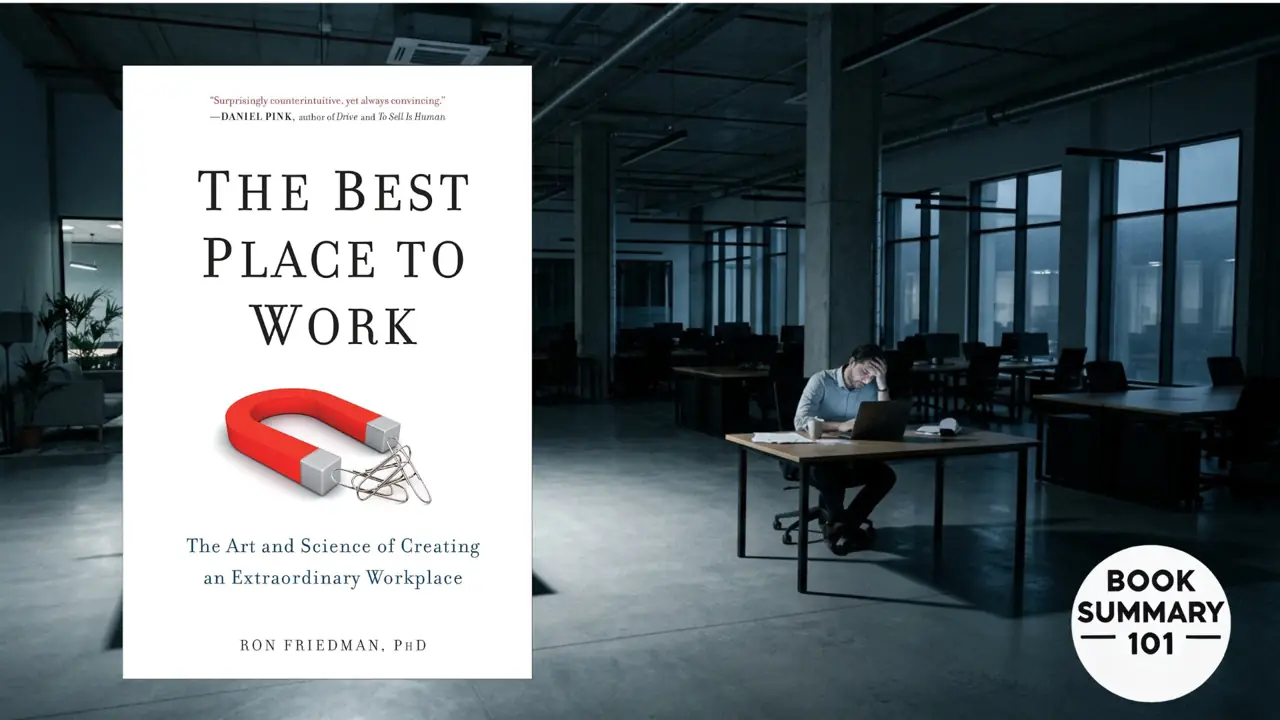
I thought maybe I was just broken. I thought maybe I just wasn’t cut out for the corporate world. Then, a mentor handed me a copy of The Best Place to Work by Ron Friedman.
Reading it felt like sitting down for coffee with a brilliant psychologist who finally explained exactly why I was so miserable. It turns out, human beings aren’t motivated by superficial perks. We are motivated by deep, fundamental psychological needs. This book completely flipped my understanding of what makes a job great, and I’m so excited to share its secrets with you.
Why Should You Even Bother Reading It?
If you’ve ever felt utterly exhausted by 3:00 PM despite doing nothing but sitting at a desk, this book is for you. Whether you are a CEO trying to stop your best talent from quitting, a middle manager trying to boost team morale, or just a regular employee wondering why your workplace feels so toxic, this book holds the answers.
It cuts through the corporate jargon and HR buzzwords to reveal the actual science of human motivation. We spend half our waking lives at work. You owe it to yourself to understand how to make those hours energizing, rather than soul-crushing.
- Why Should You Even Bother Reading It?
- The Core Principles That Reshaped My View of the Office
- 1. The Three Ingredients of Motivation (The Psychological Garden)
- 2. The Myth of the Open Office (The Rock Concert Dilemma)
- 3. Embracing “Smart” Failure (The Toddler Walking Analogy)
- 4. Work-Life Integration, Not Balance (The Symphony vs. The Seesaw)
- 5. The Power of Genuine Connection (The Bundle of Twigs)
- My Final Thoughts
- Join the Conversation!
- Frequently Asked Questions (The stuff you’re probably wondering)
The Core Principles That Reshaped My View of the Office
Before we dive into the specific ideas, let’s get one thing straight: creating an amazing workplace is actually more about psychology than it is about real estate. Here are the five foundational shifts that took me from a frustrated clock-watcher to someone who actually understands how great teams are built.
1. The Three Ingredients of Motivation (The Psychological Garden)
Imagine you are trying to grow a thriving, beautiful tomato plant. You can’t just yell at the plant to grow faster, and you certainly can’t bribe it by painting its pot a pretty color. To thrive, that plant absolutely requires three fundamental things: rich soil, sunlight, and water. If you deprive it of any of those three, the plant will wither, no matter how much you paid for it.
According to Friedman, human beings at work are exactly the same. We have three basic psychological needs that must be met for us to thrive: Autonomy (the feeling of being in control of our choices), Competence (the feeling that we are good at what we do and getting better), and Relatedness (the feeling of genuine connection to others).
When workplaces try to fix morale with free pizza while simultaneously micromanaging employees, they are essentially painting the plant pot while withholding water. It’s useless.
A perfect real-world example of this is the outdoor clothing company, Patagonia. They have a legendary “Let My People Go Surfing” policy. When the surf is up, employees are allowed to drop what they’re doing and hit the beach, as long as their work gets done. Patagonia isn’t just being nice; they are aggressively watering the “Autonomy” need. They are telling their employees, “We trust you to manage your own time.” The result? Fierce loyalty, incredibly low turnover, and a team of highly motivated adults.
Simple Terms: People don’t want perks; they want to feel trusted, capable, and connected.
The Takeaway: Stop trying to bribe your team with snacks and start looking for ways to give them more control over their daily tasks.
2. The Myth of the Open Office (The Rock Concert Dilemma)
Picture yourself trying to study for the most important exam of your life. Now, picture trying to study for that exam while sitting in the front row of a heavy metal rock concert. The music is blaring, people are bumping into you, and bright lights are flashing in your eyes.
How much studying do you think you’d actually get done? Probably zero. Yet, this is exactly what we do to knowledge workers when we force them into completely open-plan offices.
For years, the trend was to tear down all the walls to encourage “collaboration.” But Friedman’s research shows that open offices actually destroy our ability to focus. Constant interruptions, ringing phones, and visual distractions flood our brains with stress hormones. We need quiet spaces to do deep, meaningful work.
Look at how a modern university library is structured. It doesn’t just have one massive, noisy room. It has a loud cafe area for group work, quiet whispering zones, and entirely silent individual carrels for intense studying.
Great workplaces treat their offices like libraries. They provide a variety of spaces tailored to different types of tasks. They offer “caves” for deep, focused isolation, and “campfires” for loud, creative collaboration.
📖 “The secret to happy workplaces isn’t spending more money. It’s about creating the conditions that allow employees to do their best work.”
Simple Terms: Open offices are terrible for concentration; people need quiet spaces to think.
The Takeaway: If you want your team to produce brilliant work, you have to protect their attention by giving them spaces free from constant interruption.
3. Embracing “Smart” Failure (The Toddler Walking Analogy)
Think about a toddler who is just learning how to walk. They pull themselves up on the coffee table, take one wobbly step, and immediately fall flat on their diaper. What do we do? We cheer! We clap our hands and encourage them to try again.
Imagine if, instead, we screamed at the toddler, wrote them up for a performance violation, and told them they were a terrible walker. That toddler would probably never try to walk again. They’d just crawl forever to stay safe.
In the corporate world, we often treat employees exactly like that punished toddler. We claim we want “innovation” and “risk-taking,” but the moment someone tries a new idea and fails, we penalize them. This creates a culture of fear where people only do the bare minimum to avoid getting in trouble.
Friedman argues that extraordinary workplaces actively embrace failure as a learning tool. They create psychological safety. Consider the famous product WD-40. The name literally stands for “Water Displacement, 40th formula.”
The scientists who invented it failed 39 times before they got it right. If their bosses had fired them after the 10th failure, one of the most successful household products in history would never exist. Great companies don’t punish failure; they punish the failure to learn from mistakes.
Simple Terms: If people are terrified of making mistakes, they will never try anything new or innovative.
The Takeaway: Build a culture where well-intentioned failures are analyzed and celebrated as stepping stones, not punished as career-ending disasters.
4. Work-Life Integration, Not Balance (The Symphony vs. The Seesaw)
When we talk about our careers and our personal lives, we almost always use the phrase “work-life balance.” This creates a terrible mental image of a playground seesaw.
On a seesaw, if one side goes up, the other side must go down. It implies a strict, unavoidable conflict. It suggests that every hour you spend succeeding at work is an hour stolen from your family, and vice versa. It’s a guilt-inducing way to live.
Friedman suggests a different analogy: a symphony. In a symphony, the violins and the trumpets aren’t competing against each other. Sometimes the strings are loud, sometimes the brass takes over, but they blend together to create a beautiful piece of music.
This is the concept of work-life integration. Instead of trying to build massive, rigid walls between 9-to-5 work and evening home life, extraordinary workplaces offer immense flexibility. They recognize that life is messy.
Take a look at companies like Netflix, which pioneered the concept of unlimited Paid Time Off (PTO). They stopped tracking how many hours people sat in their chairs and started tracking the actual results they produced. If you need to leave at 2:00 PM on a Tuesday to go to your kid’s school play, you go. You just make up the work when it makes sense for you. Treating adults like adults creates a symphony, not a seesaw.
Simple Terms: Stop obsessing over rigid working hours and start focusing on flexibility and actual results.
The Takeaway: Allowing employees the freedom to blend their personal and professional lives naturally leads to lower burnout and higher productivity.
5. The Power of Genuine Connection (The Bundle of Twigs)
If you take a single, isolated twig from a tree, you can easily snap it in half with two fingers. It’s fragile and vulnerable. But if you take twenty of those exact same twigs, bundle them tightly together, and try to break them? It’s nearly impossible. The strength of the bundle comes entirely from the connection between the individual pieces.
Workplaces operate on the exact same physical principle. When employees feel isolated, lonely, and disconnected from their peers, they snap easily under the pressure of tight deadlines or stressful projects.
Friedman points out that having just one close friend at work drastically increases employee retention, engagement, and overall happiness. Yet, many managers actually discourage socializing, viewing it as “time theft.”
📖 “We are social creatures. When we feel connected to the people around us, our brains release oxytocin, which naturally lowers stress and increases our willingness to collaborate.”
Consider the online shoe retailer Zappos. They place such a high premium on cultural fit and team connection that they actually offer new hires thousands of dollars to quit after their first few weeks of training.
Why? Because they only want people who genuinely want to be there and be part of the community. They know that a tight-knit bundle of employees will weather any storm, while a group of disconnected individuals will splinter at the first sign of trouble.
Simple Terms: Having friends at work isn’t a distraction; it’s a critical shield against stress and burnout.
The Takeaway: Encourage your team to socialize, eat together, and build real friendships—it’s the strongest glue your company can buy.
My Final Thoughts
Reading The Best Place to Work was a total lightbulb moment for me. It validated everything I had felt in my gut about terrible jobs, but it gave me the scientific vocabulary to actually explain why they were terrible.
More importantly, it left me feeling incredibly empowered. You don’t need a million-dollar budget to make your workplace better. You don’t need to install a slide in your lobby.
You just need to treat people like human beings. Give them a little more autonomy, forgive their honest mistakes, and help them connect with each other. Whether you are the CEO or the newest intern, you can start applying these psychological principles today to make your corner of the working world just a little bit brighter.
Join the Conversation!
I would love to hear from you! What is the absolute weirdest, most useless office “perk” you’ve ever experienced that totally missed the mark? Drop your stories in the comments below—let’s swap some corporate horror stories!
Frequently Asked Questions (The stuff you’re probably wondering)
1. Do I need to be a CEO or HR director to use the advice in this book?
Not at all! While leaders can implement company-wide changes, individual employees can use these concepts to “manage up,” redesign their own daily routines, or advocate for better working conditions within their specific teams.
2. Is this just another boring, academic management textbook?
Nope! That’s the beauty of it. Friedman is a psychologist, but he writes like a storyteller. The book is packed with fascinating studies, real-world examples, and surprising facts that keep the pages turning.
3. What if I work entirely from home? Does this still apply?
Absolutely. The fundamental human needs (Autonomy, Competence, Relatedness) don’t disappear just because you are wearing sweatpants in your living room. In fact, finding ways to fulfill the “Relatedness” (connection) need is even more critical for remote workers.
4. Will this book teach me how to manipulate my employees into working 80-hour weeks?
Definitely not. This book is the exact opposite of toxic hustle culture. It’s about working smarter and aligning the workplace with human biology and psychology so that people naturally want to do great work without burning out.
5. If I can only fix one thing in my office right now, what should it be?
Start with Autonomy. Look at your team (or your own workflow) and ask: “Where am I micromanaging?” Give people more control over how and when they complete their tasks, and watch their energy levels transform.