Let me tell you a slightly embarrassing secret about my twenties. I used to think keeping all my money in a standard savings account was the ultimate financial flex.
I would log in, look at my little pile of cash, and pat myself on the back for being so “responsible.” The stock market terrified me. I thought of it like a giant, chaotic casino where guys in suits yelled at screens and regular people lost their life savings overnight.
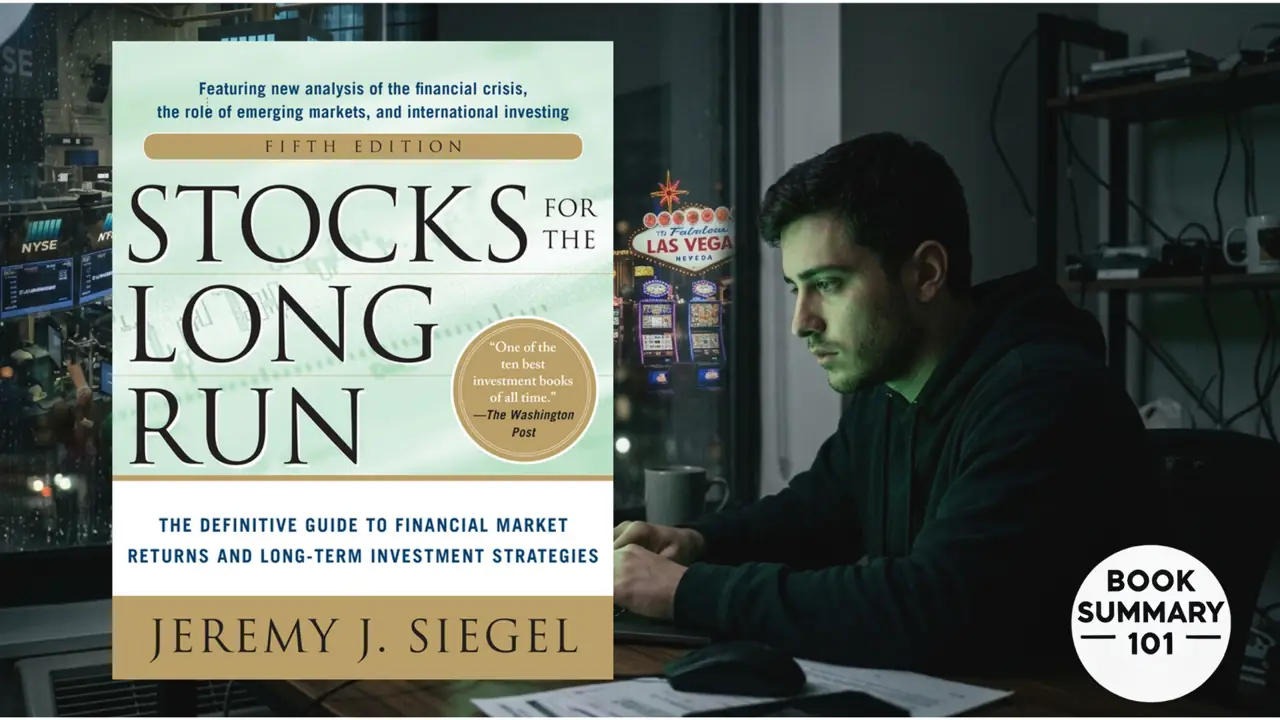
Whenever the news reported a “market crash,” I felt a smug sense of relief that my money was safely tucked away under a digital mattress. But then, a mentor of mine noticed my extreme risk aversion and handed me a copy of Stocks for the Long Run by Jeremy Siegel.
I’ll be honest, the title sounded like a dry, dusty economics textbook. I expected pages of incomprehensible math. Instead, reading it felt like sitting down for coffee with a brilliant, patient grandfather who gently dismantled every single fear I had about money.
This book didn’t just teach me about investing; it completely shattered my illusion of what “safe” actually means. It showed me that playing it safe was actually the riskiest thing I could possibly do.
Why Should You Even Bother Reading It?
If you have ever felt paralyzed by the ups and downs of the stock market, this book is your cure. It’s perfect for beginners who want to understand why people invest, but it’s just as vital for seasoned professionals who need to be talked off the ledge during a market panic.
Siegel uses two centuries of hard data to prove one beautifully simple point: human progress is an unstoppable force, and owning a piece of that progress is the surest way to build wealth. In today’s world of crypto hype, meme stocks, and constant financial anxiety, this book offers something incredibly rare. It offers peace of mind.
- Why Should You Even Bother Reading It?
- The Core Principles That Turn Market Chaos Into Predictable Wealth
- The 200-Year Time Capsule: Why Stocks Always Win
- The Melting Ice Cube: Understanding the Silent Thief
- The Dog on the Beach: Why Volatility is NOT Risk
- The Golden Geese: The Magic of Reinvested Dividends
- The Traffic Jam Trap: Why Market Timing Fails
- My Final Thoughts
- Join the Conversation!
- Frequently Asked Questions (The stuff you’re probably wondering)
The Core Principles That Turn Market Chaos Into Predictable Wealth
Let’s break down Jeremy Siegel’s masterclass into the foundational truths that will completely rewire how you view your money. These aren’t get-rich-quick schemes; they are the undeniable laws of financial gravity that can set you free.
The 200-Year Time Capsule: Why Stocks Always Win
Imagine you have a magical, indestructible time capsule. You are standing in the year 1802, and you have to decide what to put inside it to leave for your great-great-great-grandchildren. You have three choices: one dollar in gold, one dollar in paper cash, or one dollar invested in a broad basket of American businesses (stocks).
If you put the dollar in paper cash, your descendants would open the capsule today to find that their dollar can barely buy a pack of gum. If you put in gold, they might have enough to buy a nice suit. But if you put in that one dollar of stock? They would open the capsule to find millions of dollars.
This is the ultimate premise of Siegel’s research. He looked at a staggering 200 years of financial history. Through world wars, the Great Depression, pandemics, and political upheavals, stocks have consistently produced an average “real” return of about 6.5% to 7% per year, after inflation.
Think about what that means. We constantly worry about what the market will do next month or next year. But when you zoom out and look at the big picture, the stock market is a relentless wealth-generating machine.
Take the S&P 500, for example. Despite every catastrophe of the 20th and 21st centuries, the world’s biggest companies just keep finding ways to innovate, sell products, and grow. When you buy a stock, you aren’t buying a lottery ticket. You are buying a tiny slice of human ingenuity and economic progress.
Simple Terms: Over long periods of time, owning a piece of global businesses (stocks) vastly outperforms holding cash, gold, or bonds.
The Takeaway: Stop worrying about tomorrow’s news headlines; history proves that betting on human progress is the ultimate winning strategy.
The Melting Ice Cube: Understanding the Silent Thief
Let’s talk about that supposedly “safe” cash sitting in your bank account. I want you to imagine taking a big, solid block of ice out of your freezer and setting it on your kitchen counter.
When you first put it down, it looks substantial. It feels heavy and solid. But as the hours pass, it slowly starts to weep water onto the counter. You don’t see it shrinking second by second, but if you leave it there all day, you’ll eventually come back to nothing but a puddle.
This is exactly what inflation does to your cash. Inflation is the silent thief that breaks into your bank account every single night, not to steal your money, but to steal what your money can buy.
Think about the real-world cost of a movie ticket. Back in the late 1990s, you could easily see a blockbuster for about five bucks. Today? You’re lucky if you can get in the door for fifteen dollars, and let’s not even talk about the cost of popcorn.
Your five-dollar bill hasn’t changed its appearance, but its power has completely evaporated. Siegel brilliantly points out that avoiding the stock market because you are afraid of losing money is a massive logical error.
By hiding in cash, you are guaranteeing a loss of purchasing power over time. Stocks are the ultimate hedge against this melting ice cube. Because businesses can raise their prices to keep up with inflation, their stock values and dividends naturally rise over time, acting like a freezer that keeps your wealth solid and intact.
📖 “The purchasing power of currency has historically been far more volatile than the purchasing power of a diversified portfolio of common stocks.”
Simple Terms: Inflation destroys the value of cash over time, making “safe” savings accounts inherently risky.
The Takeaway: To protect your money from slowly disappearing, you must invest it in assets like stocks that grow faster than the cost of living.
The Dog on the Beach: Why Volatility is NOT Risk
One of the biggest reasons people run screaming from the stock market is that the prices bounce around like crazy. It’s terrifying to see your portfolio drop 10% in a week. But Siegel makes a crucial distinction that completely changed my life: volatility is not the same thing as risk.
To understand this, imagine a man walking his energetic dog along the beach. The man represents the long-term trend of the stock market. He is walking steadily forward, in a relatively straight line, heading straight down the coastline.
The dog represents short-term market volatility. The dog runs wildly into the ocean, chases a seagull up the dunes, runs behind the man, and darts ahead. If you only watch the dog, you’d think it was complete chaos, and you’d have no idea where they were going.
But no matter how crazy the dog acts, he is tethered to the man. Eventually, both the man and the dog end up at the exact same destination down the beach.
In the short term (days, months, or even a few years), the stock market is the crazy dog. It reacts to news, fears, and rumors. But in the long term (10, 20, or 30 years), the market is the man walking steadily forward, driven by the actual profits and growth of companies.
Think of the 2008 financial crisis or the 2020 pandemic crash. In the moment, the dog was sprinting wildly in the wrong direction. But investors who held on tight and simply waited for the man to keep walking ended up wealthier a decade later. Time is the magical ingredient that turns wild volatility into steady, predictable growth.
Simple Terms: Short-term price swings (volatility) are scary, but over a period of decades, the risk of losing money in a diversified stock portfolio drops to nearly zero.
The Takeaway: Stop watching the crazy dog; focus on the man walking down the beach by keeping your money invested for the long haul.
The Golden Geese: The Magic of Reinvested Dividends
If you’ve ever wondered what the true “secret sauce” of stock market wealth is, look no further than dividends. Siegel’s data reveals something shocking: the vast majority of historical stock market returns don’t actually come from stock prices going up.
Instead, they come from reinvesting dividends. To picture how this works, imagine you are given a magical golden goose. Every month, this goose lays a small golden egg.
Now, you have a choice. You can take that golden egg, sell it, and buy a fancy dinner. Or, you can incubate that egg. If you incubate it, it eventually hatches into a baby golden goose.
Now you have two geese laying eggs. If you keep incubating all the eggs, eventually you will have an entire farm of golden geese, churning out wealth faster than you can keep track of.
Dividends are the golden eggs of the stock market. When a company makes a profit, they often distribute a portion of that cash directly to their shareholders. If you take that cash and use it to buy more shares of the stock, you are incubating your eggs.
Let’s look at a real-world example like Coca-Cola. For decades, they have steadily paid and increased their dividends. If you bought Coca-Cola stock 40 years ago and spent the dividends, you’d have made a decent profit.
But if you used those dividends to automatically buy more Coca-Cola shares, your wealth would be exponentially higher. You’d be earning dividends on top of dividends. Siegel proves that this simple act of reinvestment is the true engine of compounding, turning ordinary savers into millionaires over time.
Simple Terms: Reinvesting the cash payouts (dividends) you receive from companies is the most powerful way to accelerate your wealth creation.
The Takeaway: Don’t just buy stocks; ensure your account is set to automatically reinvest all dividends to unleash the full power of compound interest.
The Traffic Jam Trap: Why Market Timing Fails
We’ve all had this fantasy: What if I just sell all my stocks right before the market crashes, wait for things to hit rock bottom, and then buy them all back at a massive discount? It sounds brilliant in theory.
In practice, it is a spectacular way to destroy your financial future. Trying to time the market is exactly like being stuck in a massive, frustrating traffic jam on the highway.
You are sitting in the middle lane, not moving. Suddenly, you see the left lane inch forward. So, you aggressively swerve into the left lane.
The moment you do, the left lane stops completely, and the lane you just left starts speeding away. You swerve back, only to get stuck again. By constantly trying to outsmart the traffic, you end up arriving at your destination far later than if you had just patiently stayed in your lane.
Siegel’s research shows that the stock market moves in sudden, unpredictable bursts. The absolute best days in the market—the days that generate almost all of your long-term returns—often happen immediately after the absolute worst days.
If you get scared and pull your money out during a crash, you almost certainly miss the rapid recovery that follows. For example, if you missed just the 10 best trading days in the S&P 500 over a 20-year period, your overall returns would be cut in half.
You have to be right twice to time the market: you have to know exactly when to sell, and exactly when to buy back in. No one can do that consistently.
📖 “The urge to time the market is strong, but the data is clear: missing just a few of the market’s best days drastically reduces your overall return. Time in the market is always superior to timing the market.”
Simple Terms: Trying to guess when the stock market will go up or down usually results in missing out on the biggest periods of growth.
The Takeaway: Pick a solid investment strategy, stay in your lane, and refuse the temptation to jump in and out of the market based on fear or greed.
My Final Thoughts
Reading Stocks for the Long Run was a profound turning point for me. It took a subject that felt dark, mysterious, and threatening, and dragged it out into the bright light of historical data.
Jeremy Siegel doesn’t just ask you to have blind faith in the stock market. He provides absolute, undeniable proof that optimism is a winning financial strategy.
It taught me that I don’t need to be a Wall Street insider or a math genius to build a secure future. I just need to be patient, stay disciplined, and trust in the long-term march of human progress.
When you truly internalize the lessons of Stocks for the Long Run, financial news stops being scary. You start seeing market drops not as disasters, but as temporary blips on a 200-year timeline of upward growth. It is a deeply empowering feeling, and I truly hope these concepts give you the same peace of mind they gave me.
Join the Conversation!
Now I want to hear from you! What is your biggest fear when it comes to investing your money? Are you still holding onto a “melting ice cube” of cash under the mattress? Drop a comment below and let’s talk about how to take that first step toward long-term wealth!
Frequently Asked Questions (The stuff you’re probably wondering)
Do I need to be a math genius to understand this book?
Not at all! While Siegel is a professor and uses data, he explains the concepts incredibly clearly. You don’t need to know how to calculate complex formulas; you just need to grasp the big-picture ideas like inflation, compounding, and time horizons.
Is this book outdated since it was written a while ago?
Siegel has updated the book over the years (it’s in its 6th edition now), but honestly, the core principles never age. Whether it’s 1994, 2008, or today, the fundamental truth that stocks outperform cash over long periods remains a mathematical reality.
Does the book say I should put 100% of my money in stocks?
Not exactly. While stocks are the best long-term builders of wealth, Siegel acknowledges that if you need money in the short term (like for a house down payment next year), it shouldn’t be in the stock market. The “long run” really means money you won’t touch for 10 to 20 years.
What about crypto or individual meme stocks?
Siegel’s philosophy is built on buying broad, diversified index funds (like the entire S&P 500) that generate real profits and dividends. Speculative assets that don’t produce cash flow rely purely on finding someone else to buy them for a higher price, which goes against the core “buy and hold” investing principles of this book.
How much money do I need to start investing for the long run?
Literally a few dollars! With modern brokerage apps, you can buy fractional shares of index funds. The amount you start with matters far less than the habit of consistently investing and leaving it alone for decades to let compound interest work its magic.