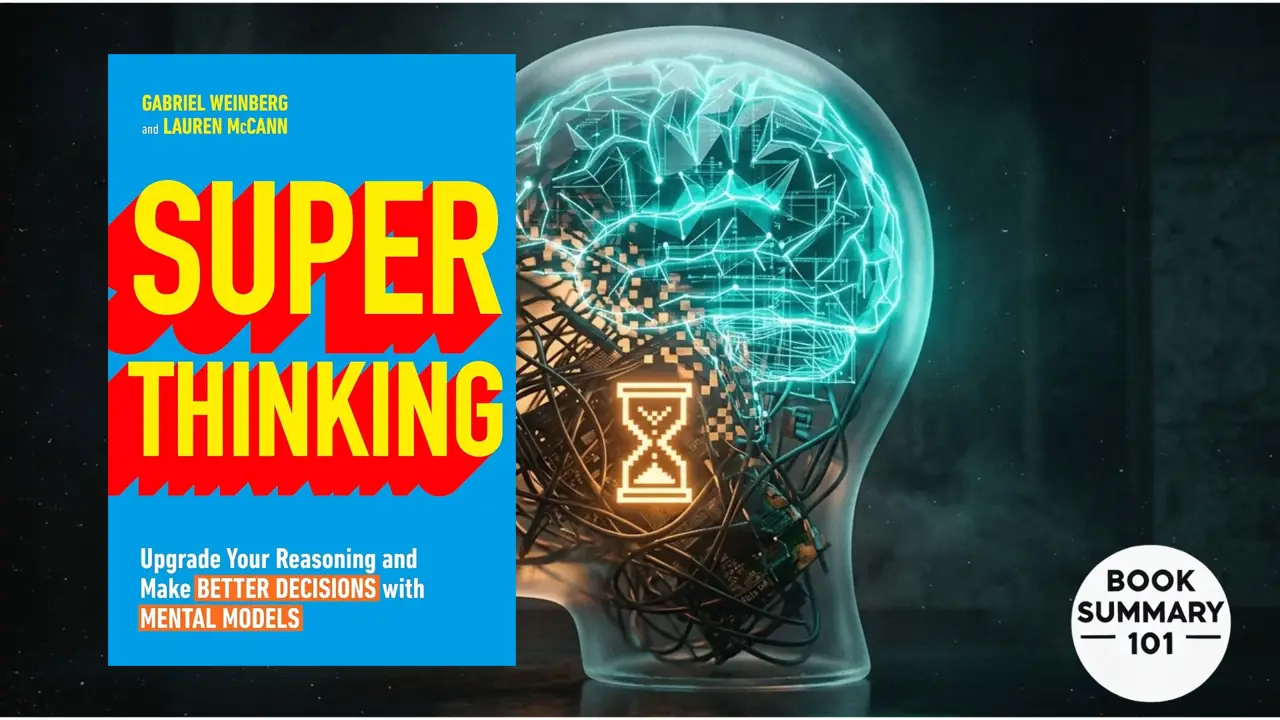
For a long time, I felt like my brain was running on an outdated operating system. I’m talking about the mental equivalent of Windows 95, where every time a complex decision popped up, my mind would just freeze.
I would overthink simple choices, misread other people’s intentions, and constantly feel like I was taking two steps forward and three steps back. I’d watch highly successful people effortlessly navigate chaotic situations and wonder, What do they know that I don’t?
It turns out, they don’t necessarily have higher IQs. They just have better frameworks for viewing the world. That was the massive “aha!” moment I had when I picked up Super Thinking by Gabriel Weinberg and Lauren McCann.
Reading it felt like sitting down over coffee with a brilliantly practical friend who was quietly handing me the cheat codes to reality. It wasn’t about memorizing facts; it was about adopting “mental models”—cognitive shortcuts that untangle the messy world around us.
Why Should You Even Bother Reading It?
If you are a chronic overthinker, an ambitious professional, or just someone curious about why we make the silly mistakes we do, this book is for you. You don’t need a background in tech, finance, or psychology to grasp these concepts.
We live in an incredibly noisy, complicated world where we are forced to make hundreds of decisions a day. This book gives you a specific toolkit to cut through that noise. It protects you from your own biases, saves you from unnecessary drama, and helps you make choices that your future self will thank you for.
- Why Should You Even Bother Reading It?
- The Core Mental Models That Upgraded My Mind
- 1. First Principles Thinking
- 2. Hanlon’s Razor
- 3. The Pareto Principle (The 80/20 Rule)
- 4. Opportunity Cost
- 5. Inversion
- My Final Thoughts
- Join the Conversation!
- Frequently Asked Questions (The stuff you’re probably wondering)
The Core Mental Models That Upgraded My Mind
Instead of relying on gut feelings, these specific frameworks act like Swiss Army knives for your brain, allowing you to slice through confusion and solve problems faster than ever before.
1. First Principles Thinking
Imagine you want to build a house, so you buy a massive bucket of mixed Lego bricks. Most people will look at the pictures on the box, try to find the exact pieces, and copy the design someone else already created.
That is “thinking by analogy.” It’s doing things because that’s how they’ve always been done. But First Principles Thinking is completely dumping the bucket onto the floor, ignoring the box entirely, and looking at the fundamental, unchangeable properties of the individual bricks themselves. You ask yourself, What are the absolute, undeniable facts here? From there, you build your own unique solution from the ground up.
When you think by analogy, you are limited by the flaws of the past. When you think from first principles, you unlock pure innovation. It forces you to strip away assumptions, traditions, and “best practices” until you are left with only the raw truth.
The most famous real-world example of this is Elon Musk and the creation of SpaceX. When Musk wanted to send a rocket to Mars, he found that purchasing a finished rocket was insanely expensive—upwards of $65 million. Most people would have given up right there.
Instead, Musk used First Principles. He asked, What is a rocket actually made of? Aerospace-grade aluminum alloys, titanium, copper, and carbon fiber. Then he asked, What is the value of those materials on the commodity market? It turned out, the raw materials were only about 2% of a typical rocket’s price. So, he decided to buy the cheap raw materials and build the rockets himself, revolutionizing the space industry.
You can apply this to anything. Struggling to get fit? Strip away the fad diets and look at the first principles: calories in versus calories out, and progressive muscle overload.
Simple Terms: Breaking a complex problem down into its most basic, undeniable truths and building your solution from there.
The Takeaway: Stop copying how everyone else does things, question your deepest assumptions, and find the raw facts hidden underneath the noise.
2. Hanlon’s Razor
Think about training a brand new puppy. You leave for work, and when you come home, you find that your favorite pair of expensive sneakers has been chewed to shreds.
Your initial, emotional reaction is anger. You might even think, This dog is out to get me! He did this to punish me for leaving him alone! But when you take a breath, you realize that’s ridiculous. The puppy doesn’t hate you. The puppy is just bored, clumsy, and doesn’t know any better.
Hanlon’s Razor asks us to apply this exact same grace to human beings. It is a mental model designed to save you from endless amounts of unnecessary stress and paranoia.
📖 “Never attribute to malice that which is adequately explained by carelessness.”
We are naturally wired to take things personally. When someone cuts us off in traffic, we assume they are a selfish jerk intentionally trying to run us off the road. When a coworker ignores an important email, we assume they are quietly sabotaging our career.
But Hanlon’s Razor gently reminds us that most of the time, people aren’t plotting against us. They are just distracted, overwhelmed, tired, or frankly, a little bit clumsy with their lives. The person cutting you off in traffic is probably just running late for a stressful doctor’s appointment and didn’t check their blind spot.
By adopting this model, you instantly become less angry and more empathetic. It stops you from creating villains in your head.
Simple Terms: Don’t assume someone did something to hurt you on purpose when it’s much more likely they just made a careless mistake.
The Takeaway: Give people the benefit of the doubt; it will save your sanity and preserve your relationships.
3. The Pareto Principle (The 80/20 Rule)
Imagine you are tending to a massive vegetable garden. You spend hours every single day watering every single plant equally, weeding every row, and stressing over the soil.
But at the end of the season, when you harvest your crops, you realize something shocking. Just a tiny handful of your tomato plants produced almost all the food, while the vast majority of the garden barely yielded a thing.
This is the Pareto Principle in action. It states that roughly 80% of your results come from just 20% of your efforts. The universe, it turns out, is rarely distributed evenly.
Once you understand this mental model, you stop trying to do everything and start focusing only on the right things. It is the ultimate antidote to burnout. You realize that being busy is not the same thing as being productive.
Consider a classic real-world example from the tech industry. In the early 2000s, Microsoft noted that 80% of the crashes in their Windows operating system were caused by just 20% of the reported bugs. Instead of trying to fix every single tiny glitch, they focused all their engineering power on that top 20%. By fixing just a fraction of the issues, they dramatically improved the entire system.
Look at your own life. You probably wear 20% of the clothes in your closet 80% of the time. Around 80% of your stress probably comes from just 20% of the people you know.
If you want to drastically improve your life, audit where your results are coming from. Double down on the 20% that brings you joy, wealth, or health, and relentlessly cut out the 80% that is just draining your energy.
Simple Terms: A tiny fraction of what you do produces the vast majority of your meaningful results.
The Takeaway: Stop trying to give 100% effort to everything; find the vital few things that actually move the needle and ignore the rest.
4. Opportunity Cost
Imagine you walk into an incredible, premium all-you-can-eat buffet. You paid a flat $50 to get in, and you are starving.
Right at the entrance, there is a giant bowl of cheap, heavy macaroni and cheese. It looks good, so you fill your entire plate with it and eat it all. But then, you walk around the corner and see the carving station with prime rib, fresh lobster tails, and gourmet sushi.
Tragically, you are completely full. You can’t eat another bite. That macaroni and cheese wasn’t just “free” because you paid the entrance fee. It cost you the ability to eat the prime rib.
That is Opportunity Cost. It is the realization that every time you choose to do something, you are simultaneously choosing not to do a million other things. There is no such thing as a free choice, because time is our most limited and precious currency.
We often forget this when making daily decisions. We think, I’ll just binge-watch this Netflix show for three hours; it doesn’t cost me anything. But the hidden price tag is massive.
The real-world opportunity cost of those three hours is the sleep you desperately need, the workout you skipped, or the time you could have spent building a side hustle. You paid for that television show with your future health and wealth.
When you start viewing the world through the lens of Opportunity Cost, your entire perspective shifts. You stop saying “yes” to every minor request, every mediocre hangout, and every mindless distraction. You realize that your “yes” is incredibly expensive.
Simple Terms: The true cost of any decision is the value of the next best alternative you had to give up to make it.
The Takeaway: Every time you say yes to something trivial, you are actively saying no to something truly important.
5. Inversion
Think about trying to be the world’s best, most flawless race car driver. You have to memorize tracks, perfect your cornering, calculate tire wear, and master incredibly complex maneuvers. It is incredibly difficult to figure out how to be perfect.
Now, flip the problem upside down. Instead of asking, How do I become the best driver? ask yourself, What are the guaranteed ways to crash the car and die?
Well, that’s easy to answer! Driving blindfolded, driving drunk, texting while going 100 mph, and never using your brakes. If you simply focus on avoiding those stupid, catastrophic mistakes, you will naturally become a highly successful driver.
This is the power of Inversion. It is the practice of thinking backward. Instead of trying to brilliantly solve a problem, you figure out how you would guarantee failure, and then you just avoid doing those things.
📖 “Thinking backward, or inverting a problem, can often help you see it from a new, highly revealing perspective.”
Human beings are remarkably bad at predicting what will make us happy or successful. But we are absolute experts at knowing what brings misery and ruin. Inversion uses this pessimistic superpower to our advantage.
Take a real-world example like improving a marriage. If you ask, “How do I create the perfect relationship?” you might get lost in complex ideas about grand romantic gestures or expensive vacations.
But if you invert it and ask, “How do I guarantee a terrible divorce?” the answers are obvious: lie constantly, refuse to communicate, hold grudges, and disrespect your partner. If you simply avoid those negative behaviors, you will inevitably build a strong, healthy relationship. It’s success by subtraction.
Simple Terms: Solving a difficult problem by figuring out what would cause massive failure, and then carefully avoiding those actions.
The Takeaway: You don’t always need to be brilliant to succeed; most of the time, you just need to consistently avoid being stupid.
My Final Thoughts
Reading Super Thinking was a paradigm shift for me. It took the messy, confusing reality of daily life and gave me a clean set of lenses to view it through.
I no longer feel like a victim of my own bad decisions or unpredictable circumstances. Instead, I feel equipped. When a problem arises, I don’t panic. I just open my mental toolbox, pull out First Principles or Hanlon’s Razor, and calmly get to work.
If you want to feel more in control of your career, your relationships, and your own mind, learning these models is the ultimate unfair advantage.
Join the Conversation!
Which of these mental models resonated with you the most? Are you going to start applying the 80/20 rule to your closet, or use Hanlon’s Razor on your grumpy coworker? Let me know in the comments below!
Frequently Asked Questions (The stuff you’re probably wondering)
Do I need to be a math or science genius to get this?
Not at all! While the book draws heavily from fields like physics, economics, and computer science, the authors explain everything in plain English. If you can understand the analogy of a clumsy puppy or a vegetable garden, you can easily grasp every concept in this book.
Is it just another boring business book?
Definitely not. While professionals and entrepreneurs love mental models, the examples used range from historical events and pop culture to everyday life situations. It feels more like a guide to “how the world actually works” rather than a dry corporate manual.
Who is this book actually for?
It’s for anyone who feels overwhelmed by decision-making. Whether you are a student trying to plan your future, a parent trying to manage a chaotic household, or a manager trying to lead a team, these tools will make your life significantly easier.
Can I use these models in my personal life, or just at work?
You will use them everywhere. Concepts like Opportunity Cost will change how you spend your weekends, and Inversion will completely transform how you approach your personal relationships and fitness goals. They are universal truths.
Will it take me forever to read?
The beauty of this book is its modular structure. You don’t have to read it front-to-back in one sitting. You can read one chapter, digest a specific mental model, and immediately start applying it to your life that very same day.