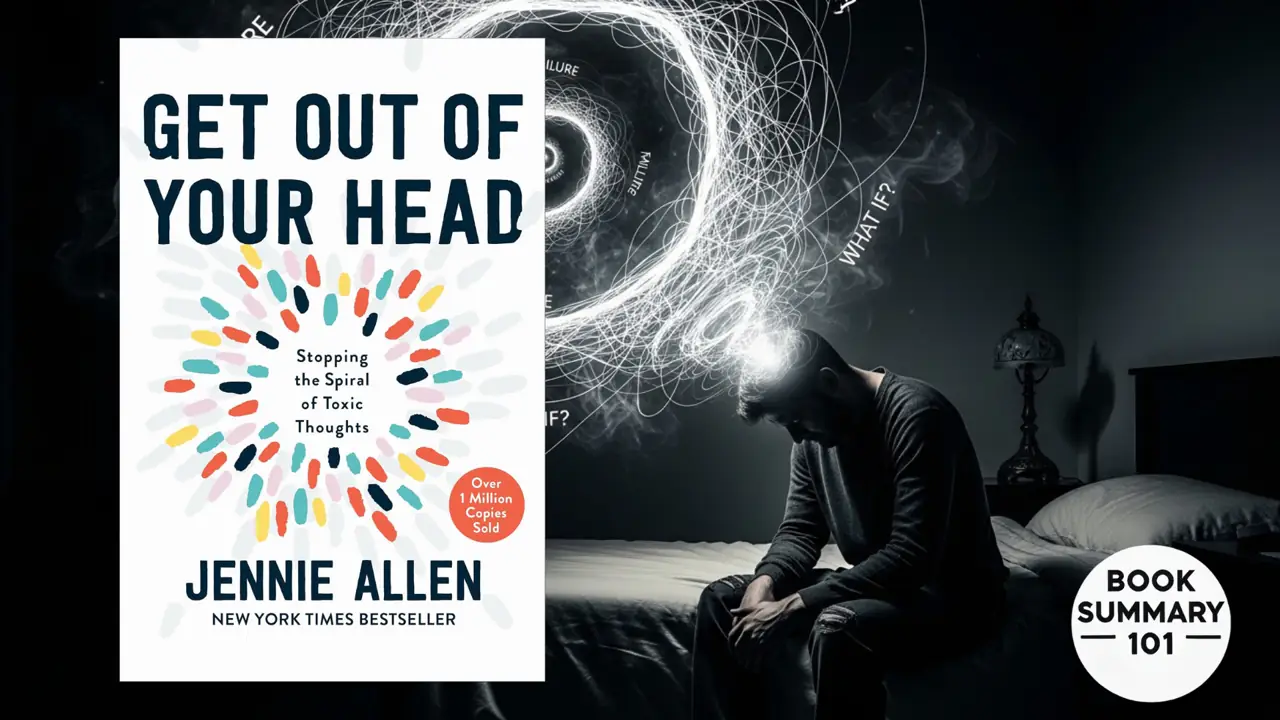
We need to talk about 3:00 AM.
You know the feeling, right? You wake up, the house is silent, but your brain is screaming. It starts with one small thought—maybe a mistake you made at work, or a weird look your friend gave you.
Suddenly, you’re off to the races. That one thought spirals into “I’m going to get fired,” which spirals into “I’m a failure,” which crashes into “Nobody actually likes me.” By the time the sun comes up, you’re exhausted, anxious, and defeated before your feet even hit the floor.
I used to live there. Honestly, sometimes I still visit.
For the longest time, I thought I was just a victim of my own brain. I thought, “Well, this is just how I’m wired. I’m an anxious person.” It felt like my thoughts were happening to me, like a hailstorm I just had to endure.
Then I picked up Get Out of Your Head: Stopping the Spiral of Toxic Thoughts by Jennie Allen.
It wasn’t just a book; it felt like a lifeline thrown to a drowning swimmer. It wasn’t a dry medical text or a vague “just think positive” pamphlet. It was a gritty, honest, and incredibly hopeful conversation about how to actually take back control of the real estate between our ears.
If you feel like you’re losing the battle for your mind, grab a coffee and settle in. We’re going to walk through this together.
- Why Should You Even Bother Reading It?
- The Core Principles That Reshaped My Thinking
- 1. The Spiral (The Trap We All Fall Into)
- 2. Taking Thoughts Captive (Playing the Bouncer)
- 3. Neuroplasticity (Rewiring the Dirt Road)
- 4. The Shift: Community (Breaking Isolation)
- 5. The Shift: Awe (Looking Up)
- My Final Thoughts
- Join the Conversation!
- Frequently Asked Questions (The stuff you’re probably wondering)
Why Should You Even Bother Reading It?
Look, life is loud right now. Between social media, the news, and the pressure to be perfect, our brains are overloaded.
If you are someone who constantly overthinks, struggles with anxiety, or feels like you’re trapped in negative patterns you can’t break, this book is for you.
It’s also fantastic if you are skeptical about “self-help.” Jennie Allen bridges the gap between theology (what we believe about God) and neuroscience (how our physical brains work). She argues that we don’t have to surrender to chaos.
It is relevant because it hands you a weapon. It tells you that you are not helpless. You have a choice. And realizing that is half the battle.
The Core Principles That Reshaped My Thinking
Jennie Allen doesn’t just diagnose the problem; she gives us a map to get out of the wilderness. She breaks down how our thoughts dictate our lives and offers specific “interruptions” to stop the spiral. Here are the most transformative concepts from the book.
1. The Spiral (The Trap We All Fall Into)
Imagine you are walking down a path and you trip. You start sliding down a muddy hill. You grab at roots and rocks, but you keep sliding faster and faster until you hit the bottom.
That is the Spiral.
Jennie explains that a spiral starts with a trigger—usually an emotion or a circumstance. Maybe you feel lonely. That trigger launches a thought: “I am all alone.”
If you don’t catch that thought, it gains momentum. It becomes a belief: “No one cares about me.” That belief dictates your action: You isolate yourself and stop answering texts. That action confirms your original thought, and the spiral deepens.
Most of us live our lives sliding down this hill, thinking gravity is the only law that exists. We think the spiral is inevitable. But the book’s central premise is that we can grab a branch. We can stop the slide.
Simple Terms: A bad feeling leads to a bad thought, which leads to bad behavior, which makes the feeling worse.
The Takeaway: You have to identify the “trigger” thought before it gains enough speed to ruin your day.
2. Taking Thoughts Captive (Playing the Bouncer)
This is the most proactive concept in the book. Jennie uses the analogy of warfare, specifically referencing the idea of “taking every thought captive.”
Think of your mind like an exclusive VIP club. Right now, you might have the back door propped open, letting anyone walk in—fear, insecurity, jealousy, bitterness. They are trashing the place, drinking your champagne, and starting fights.
Jennie argues that you need to be the Bouncer.
When a thought approaches the door—for example, “You aren’t good enough to lead this project”—you don’t just let it in. You stop it at the velvet rope. You check its ID.
You ask: Is this true? Is this helpful? Does this align with who I want to be? If the answer is no, you kick it to the curb. You have the authority to say “No” to a thought.
📖 “We can choose to spiral out, or we can choose to take our thoughts captive.”
Simple Terms: You don’t have to believe everything your brain tells you; you can choose which thoughts get to stay.
The Takeaway: Treat your mind like valuable property and stop letting toxic thoughts squat there rent-free.
3. Neuroplasticity (Rewiring the Dirt Road)
This is where the science gets really cool. Jennie talks about how our brains are physically shaped by our thinking.
Imagine a dirt road in the country. If a truck drives down that road every single day for ten years, what happens? It creates deep, hardened ruts. If you try to drive a car down that road, the wheels will naturally slide into those ruts. It takes a massive amount of effort to steer out of them.
Our toxic thoughts are those ruts. If you have thought “I’m ugly” every time you look in the mirror for ten years, your brain has physically built a superhighway for that thought. It’s automatic.
But here is the good news: Neuroplasticity.
Science shows we can fill in the old ruts and carve new paths. It takes time and repetition, but we can physically alter our brains. By choosing a different thought—like “I am made with purpose”—over and over again, we are clearing a new trail through the forest. Eventually, that becomes the easy path.
Simple Terms: Your brain gets good at what you practice; if you practice worry, you get better at worrying.
The Takeaway: You aren’t “stuck” this way forever; you can physically retrain your brain to think positively through repetition.
4. The Shift: Community (Breaking Isolation)
One of the biggest lies our spirals tell us is, “Don’t tell anyone. They’ll think you’re crazy.”
Jennie uses the analogy of the dark. When you are a kid, the pile of laundry in the corner looks like a monster in the dark. It’s terrifying. But the second you flip the light switch, you see it’s just a pile of dirty socks. The fear vanishes.
Toxic thoughts thrive in the dark. They grow mold in the damp, dark corners of our secrets.
The disruption for this is Community. When we speak our fears out loud to a safe friend, we turn the light on. We say, “I’m feeling like a total failure today.”
Usually, the friend says, “Me too,” or “That’s not true at all.” Suddenly, the monster becomes a pile of socks. The thought loses its power the moment it leaves your mouth.
Simple Terms: Secrets make us sick; talking about your fears takes away their power.
The Takeaway: Find one “safe” person you can be 100% honest with, because isolation is the playground of toxic thoughts.
5. The Shift: Awe (Looking Up)
We spend so much time looking down—at our phones, at our problems, at our navels. This leads to a spiral of self-obsession and cynicism.
Jennie suggests the antidote is Awe (or Delight).
Think about standing at the edge of the Grand Canyon or staring up at a sky full of stars. In that moment, do you feel big or small? You feel small—but in a really good way. You realize the universe is massive and your problems are relatively tiny.
When we fill our minds with things that are beautiful and bigger than us (God, nature, art, serving others), our brain doesn’t have room for the petty spirals of self-pity. You can’t be overwhelmed by the beauty of a sunset and overwhelmed by your messy kitchen at the same time.
📖 “What we think about comes out in how we live.”
Simple Terms: Stop obsessing over yourself and go find something beautiful that makes you feel small.
The Takeaway: Intentionally seeking moments of wonder and beauty pushes the “reset” button on a stressed-out brain.
My Final Thoughts
Reading Get Out of Your Head: Stopping the Spiral of Toxic Thoughts didn’t fix me overnight. I still wake up with worry sometimes. But the difference is, I now know I have a weapon.
I used to think my mind was a runaway train that I was locked inside of. Now I know I’m the conductor. I can hit the brakes. I can switch tracks.
It is empowering to realize that while we can’t control everything that happens to us, we have absolute agency over how we think about it. And because our thoughts determine our emotions and our actions, changing our minds literally changes our reality.
If you feel stuck in a loop, please know: you don’t have to stay there. The exit ramp is closer than you think.
Join the Conversation!
I’d love to hear from you. What is the one “rut” or repeating negative thought that you struggle with the most? Let’s support each other in the comments below.
Frequently Asked Questions (The stuff you’re probably wondering)
1. Is this a religious book?
Yes. Jennie Allen is a Christian author, and the book is deeply rooted in biblical theology (specifically the book of Philippians). However, even if you aren’t religious, the neuroscience and practical tools regarding cognitive behavioral patterns are highly effective and applicable.
2. Is it hard to read?
Not at all. Jennie writes like she’s talking to a friend. It’s very conversational, full of personal stories, and uses simple diagrams. You can easily get through it in a weekend.
3. Do I need to be in a mental health crisis to read this?
No! In fact, it’s better if you aren’t. Think of this as preventative maintenance for your car. It gives you the tools to handle the crisis before it happens.
4. Does she say I can just “pray away” mental illness?
No. Jennie is very clear that she respects therapy, medicine, and science. She views this book as a complement to professional help, focusing on the spiritual and habit-based side of our thought life.
5. Is the audiobook good?
Yes! Jennie reads it herself. She is a very dynamic speaker (she runs a massive conference called IF:Gathering), so the audio version feels very passionate and engaging.