Let’s be entirely honest with each other for a second. How many times have you started a new week, a new month, or a new year completely fired up, only to lose all momentum by Wednesday?
I used to be the ultimate victim of the “boom and bust” cycle. I would set a massive goal, go into full-blown drill-sergeant mode, and brutally force myself to grind it out.
I thought discipline meant depriving myself of joy, gritting my teeth, and treating my brain like an enemy that needed to be conquered. Predictably, my willpower would always snap like a brittle rubber band, leaving me exhausted, guilty, and right back where I started.
I was completely burnt out on “hustle culture.” I needed a way to achieve my goals that didn’t feel like a daily prison sentence.
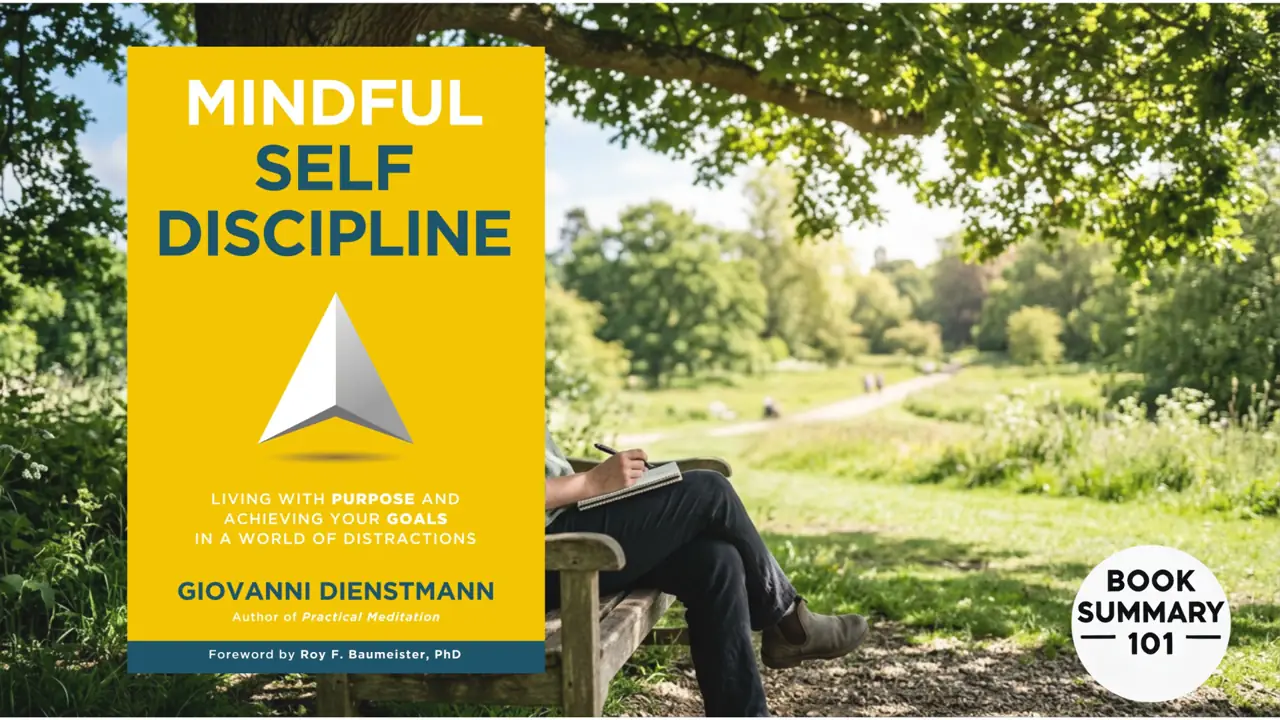
That’s when I stumbled upon Mindful Self-Discipline – Living with Purpose and Achieving Your Goals in a World of Distractions by Giovanni Dienstmann. Reading this felt like sitting down with a wise, compassionate friend who gently took the whip out of my hand. It completely flipped my understanding of willpower, showing me how to blend Eastern mindfulness with Western goal-setting. It turns out, you don’t have to hate yourself to get things done.
Why Should You Even Bother Reading It?
If you are a chronic procrastinator, a burnt-out high achiever, or simply someone who struggles to put down your smartphone and do the things you know you should do, this book is your blueprint.
It is specifically designed for our modern, hyper-distracted era. We live in an attention economy where algorithms are constantly hijacking our brains. (If you want to dive deeper into reclaiming your focus from technology, you might also appreciate the practical advice in our summary of Digital Minimalism.)
This book teaches you how to reclaim your focus, not through sheer, agonizing force, but through deep self-awareness and self-compassion. It’s for anyone who wants to build lasting habits while actually enjoying the journey.
- Why Should You Even Bother Reading It?
- The 5 Core Shifts to Master Your Mind and Your Goals
- The Marriage of Mindfulness and Discipline
- The Three Pillars of Success (Aspiration, Awareness, Action)
- The Power of the Pause
- Taming the “Lower Self”
- Shifting from Motivation to Devotion
- My Final Thoughts
- Join the Conversation!
- Frequently Asked Questions (The stuff you’re probably wondering)
The 5 Core Shifts to Master Your Mind and Your Goals
To truly transform how you approach your daily tasks and lifelong dreams, we need to unpack the beautiful, practical systems Dienstmann lays out in his work. These are the five foundational concepts that will completely rewire how you view the act of getting things done.
The Marriage of Mindfulness and Discipline
Think of traditional discipline as riding a wild horse by constantly yanking on the reins, digging your spurs in, and screaming at the animal. Eventually, the horse is going to buck you off.
Mindful self-discipline, on the other hand, is like becoming a master equestrian. You still hold the reins and guide the horse exactly where you want to go, but you do it through a calm, deep bond and mutual understanding. You aren’t fighting the horse; you’re working with it.
For decades, we’ve been told that discipline and mindfulness are opposites. Discipline is rigid, hard, and future-focused. Mindfulness is soft, relaxing, and present-focused. But Dienstmann argues that keeping these two separate is exactly why we fail.
When you use “hustle-bro” discipline, you rely entirely on brute-force willpower, which drains rapidly throughout the day. When you blend it with mindfulness, you stop fighting your own mind. You calmly observe your internal resistance without judging it, and then you act anyway. It’s the difference between doing something out of fear of failure, and doing it out of love for your future self.
Let’s look at a real-world example. Imagine you’ve committed to learning Spanish on Duolingo every evening. After a long workday, you feel the urge to slump on the couch and binge Netflix instead. Traditional discipline tells you to yell at yourself: “Stop being lazy, just do it!” Mindful discipline takes a different route.
You pause, notice the physical feeling of exhaustion, warmly acknowledge it-“I see that I’m tired and want to zone out”-and then gently guide your thumb to open the language app anyway.
Simple Terms: Willpower fueled by self-awareness and compassion works infinitely better than willpower fueled by self-hatred.
The Takeaway: Stop treating your brain like an enemy to be conquered, and start treating it like a partner to be calmly directed toward your goals.
The Three Pillars of Success (Aspiration, Awareness, Action)
Imagine trying to sit on a one-legged stool. It doesn’t matter how strong that single leg is; the moment you shift your weight, you are going to crash to the floor. Building lasting habits works the exact same way. In the book, Dienstmann explains that true, unbreakable discipline requires a sturdy three-legged stool, built from three specific pillars: Aspiration, Awareness, and Action. If you are missing even one, your goals will eventually collapse under the pressure of daily life.
Let’s break down the stool. The first leg is Aspiration. This is your deep, burning why. It’s not just a superficial goal like “lose 10 pounds,” but the core values driving it, like “I want to have the energy to play with my kids.” If you are struggling to pinpoint your core driving values, you might find some clarity in our summary of Find Your Why.
The second leg is Awareness. This is the mindfulness component. It’s your ability to catch yourself in the act of slipping up. It’s waking up to the present moment instead of living on autopilot.
The third leg is Action. This is the execution phase. It’s the practical, daily micro-steps you take to move the needle forward, regardless of how you feel in the moment.
Consider someone trying to launch a freelance graphic design business. They have the Aspiration (they desperately want financial freedom and creative control). They have the Action plan (email five potential clients a day).
But without Awareness, they sit down at their computer, open a new tab, and suddenly lose two hours watching YouTube tutorials instead of sending emails. Because their “Awareness” leg was missing, the stool toppled over. You need all three pillars working in harmony to stay upright.
Simple Terms: You need a deep reason (Aspiration), the ability to catch your own bad habits (Awareness), and the willingness to take small steps (Action) to succeed.
The Takeaway: If you keep failing at a goal, figure out which of the three pillars is missing from your strategy and rebuild it.
The Power of the Pause
Picture a massive, intimidating bouncer standing outside the VIP section of an exclusive nightclub. The bouncer’s entire job is to look at whoever walks up to the velvet rope, check their credentials, and decide if they are allowed inside, or if they need to be sent away. In the nightclub of your mind, mindfulness acts as that bouncer. It creates a crucial gap-a pause-between an external trigger and your automatic reaction.
In our modern world, we are conditioned to react instantly. Your phone buzzes with a notification, and your hand twitches to grab it before you’ve even consciously registered the sound. You smell a donut, and you eat it. You receive a passive-aggressive work email, and you immediately start typing an angry reply. We live our lives in a constant state of stimulus and immediate, thoughtless response.
📖 Between stimulus and response there is a space. In that space is our power to choose our response. In our response lies our growth and our freedom.
Dienstmann leans heavily into this concept (famously originated by Viktor Frankl). Mindful self-discipline is entirely about widening that space. It’s about training your internal bouncer to stop the automatic reaction at the door.
Let’s say you are trying to write a complex report for work. Suddenly, you get a notification that someone tagged you in a photo on Instagram. The “stimulus” is the ping. Your automatic “response” is to click it. But if you practice the pause, you take one deep breath. In that three-second window, the bouncer steps in. You acknowledge the curiosity, but you actively choose to keep your phone face down and return to the report. You have reclaimed your power.
Simple Terms: Taking a deep breath before reacting to a distraction gives you the power to make a smart choice instead of an automatic mistake.
The Takeaway: Your life is defined by how you handle the tiny gap between something happening to you, and how you decide to react to it.
Taming the “Lower Self”
Imagine you are driving a car on a road trip, and strapped into the backseat is a cranky, impulsive, sugar-craving toddler. The toddler isn’t evil-they just want to be comfortable, they want immediate gratification, and they hate doing hard things. Now, imagine if you let that toddler climb into the driver’s seat and take the steering wheel. You’d crash immediately! Yet, this is exactly what we do every time we give in to our darkest procrastination habits.
Dienstmann introduces the concept of the dual nature of our minds: the “Higher Self” and the “Lower Self.” The Higher Self is the visionary. It’s the part of you that wants to write a novel, run a marathon, and save money for a house. It operates on purpose and long-term joy.
The Lower Self is the toddler in the backseat. It represents our primitive brain. It cares only about avoiding pain, conserving energy, and seeking immediate, cheap dopamine.
The secret to mindful self-discipline is realizing that you cannot kill the Lower Self. You shouldn’t even try. Hating the toddler doesn’t make the road trip any easier. Instead, your Higher Self must act as a compassionate but firm parent. You acknowledge the Lower Self’s desires, but you firmly refuse to hand over the steering wheel.
For example, imagine you are trying to save money, but you walk past a Starbucks and smell the coffee. Your Lower Self screams, “Buy a $7 latte! We deserve a treat!” If you lack mindfulness, you just buy it. If you use traditional discipline, you aggressively berate yourself: “You’re so weak, you’re always broke, keep walking!”
But with mindful discipline, your Higher Self steps in and says, “I hear you, little guy. A latte sounds amazing right now. But we are driving toward a house down payment, so we are going to drink the coffee we have at home.” You validate the feeling, but you control the action.
Simple Terms: Inside you is a wise adult with long-term goals and a primitive toddler who just wants instant comfort; your job is to make sure the adult stays in charge.
The Takeaway: Don’t hate your urges for junk food, scrolling, or laziness-just observe them kindly while firmly choosing to do the right thing anyway.
Shifting from Motivation to Devotion
Think of motivation like a brilliant, explosive firework. When it goes off, it lights up the entire night sky. It’s beautiful, thrilling, and fills you with awe. But within five seconds, it’s completely gone, leaving you in the dark again. Discipline, however, is like the pilot light in your furnace.
It isn’t flashy, it isn’t thrilling, and you barely even notice it. But it burns quietly, steadily, day after day, keeping the entire house warm through the harshest winters.
One of the biggest traps we fall into is waiting for the fireworks. We tell ourselves, “I’ll go to the gym when I feel motivated.” Or, “I’ll start writing my business plan when inspiration strikes.” Dienstmann shatters this illusion. Motivation is an emotion, and like all emotions, it is inherently unstable. It changes based on the weather, what you ate for breakfast, or how well you slept.
📖 Discipline is doing what you need to do, even when you don’t feel like doing it, out of a deep sense of devotion to your higher purpose.
To build lasting success, we have to shift from relying on fickle motivation to relying on devotion. Devotion means you are so deeply connected to your Aspiration (your why) that your daily actions become non-negotiable, regardless of your mood. You stop asking, “Do I feel like doing this today?” and start asking, “Does this align with who I am becoming?”
Consider a real-world example like going for a morning run. It’s raining, it’s 5:30 AM, and your bed is warm. If you rely on motivation, you will absolutely hit snooze. The fireworks are nowhere to be found. But if you rely on devotion to your identity as a healthy, resilient person, the pilot light takes over. You don’t have to be excited.
You just have to put on your shoes. You accept the discomfort, you embrace the friction, and you step out the door because your commitment is stronger than your temporary feelings.
Simple Terms: Motivation is a temporary feeling that comes and goes, while devotion is a permanent commitment to taking action no matter how you feel.
The Takeaway: Stop waiting for inspiration to strike before doing hard work; start taking small actions to prove your dedication to your future self.
My Final Thoughts
Reading Mindful Self-Discipline was a massive sigh of relief for my nervous system. For years, I had been taught that success was a brutal battlefield where only the most aggressive, sleep-deprived warriors survived. This book proved that narrative completely wrong.
It taught me that true power doesn’t come from forcing yourself into submission. True power comes from stillness. It comes from the ability to watch a craving, a distraction, or an excuse rise up in your mind, warmly smile at it, and choose to walk the other way.
By merging the peace of a monk with the execution of a CEO, Giovanni Dienstmann has created a framework that doesn’t just help you achieve your goals-it helps you actually enjoy the person you become while achieving them. You are no longer your own drill sergeant; you are your own greatest ally.
Join the Conversation!
What is the number one “Lower Self” distraction that constantly derails your productivity (for me, it’s definitely falling down YouTube rabbit holes)? Drop a comment below and let me know how you plan to practice the “Pause” this week!
Frequently Asked Questions (The stuff you’re probably wondering)
1. Do I need to be a seasoned meditator to understand this book?
Not at all! While the author is a meditation teacher, the concepts are incredibly grounded and accessible. You don’t need to sit on a cushion for hours a day. He teaches practical, everyday mindfulness-like taking a single deep breath before opening your email.
2. Is this book just anti-hustle culture fluff?
Definitely not. It is highly actionable and deeply focused on achieving ambitious goals. It doesn’t tell you to abandon your dreams and go live in a cave; it just provides a much more sustainable, burnout-free engine for reaching those dreams.
3. Will this help me if I have a massive problem with chronic procrastination?
Yes. Procrastination is rarely a time-management problem; it’s an emotion-management problem. We procrastinate to avoid negative feelings like anxiety or boredom. By teaching you how to sit with those feelings mindfully (the “Pause”), this book directly cures the root cause of procrastination.
4. Is the writing style dense or academic?
It is incredibly readable. Dienstmann writes in a very supportive, clear, and structured way. He uses great stories and summaries, making it very easy to digest even if you only have 10 minutes to read before bed.
5. How is this different from a book like Atomic Habits?
Atomic Habits is brilliant for the mechanics and logistics of behavior change (how to design your environment, stack habits, etc.). This book is much more focused on the internal psychology and spirituality of behavior change. They actually complement each other perfectly-read James Clear for the architecture, and read Dienstmann for the mindset! (If you need a refresher on building that architecture, you’ll love our summary of Atomic Habits.)