For a long time, I was completely lost in the “follow your passion” sauce. I spent my twenties jumping from one exciting, poorly-paid creative pursuit to another, waiting for that magical moment when doing what I loved would finally pay the bills.
Spoiler alert: It didn’t. I just ended up exhausted, stressed about rent, and surprisingly miserable. I was trying to solve a complex life equation with the completely wrong formula.
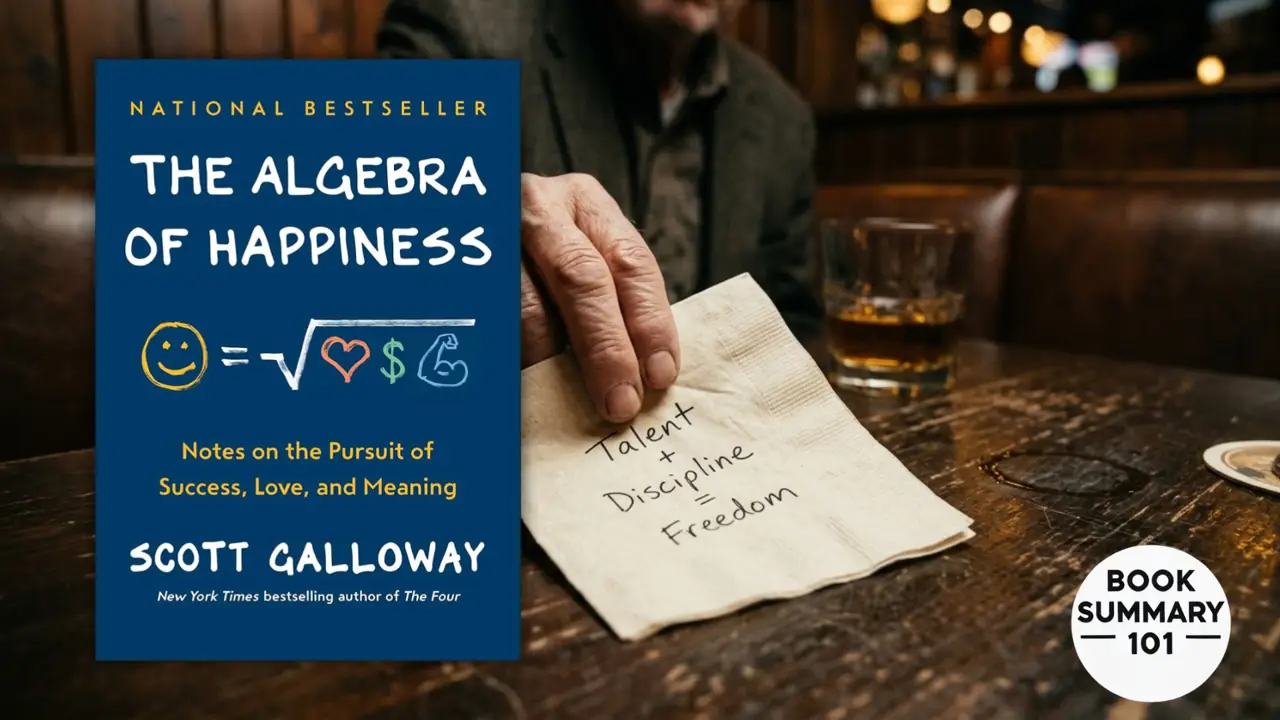
Then, I picked up The Algebra of Happiness by Scott Galloway. Reading it felt like sitting at a dimly lit bar with an older, wiser, slightly cynical but deeply caring mentor who slides a napkin across the table, looks you in the eye, and says, “Here is how the world actually works.”
Galloway doesn’t sugarcoat anything. He uses his background as a business school professor and a multi-millionaire entrepreneur to break down success, love, and meaning into blunt, undeniable mathematical equations. It completely rewired how I view my career, my relationships, and my bank account.
Why Should You Even Bother Reading It?
If you are tired of fluffy, toxic-positive self-help books that tell you to just “manifest your dreams,” this book is your antidote. It is heavily grounded in reality.
Whether you are a recent graduate trying to navigate the workforce, a professional hitting a mid-career slump, or just someone wondering why you feel unfulfilled despite doing everything “right,” this book is for you. Galloway strips away the romanticized myths of modern culture and replaces them with actionable, data-backed realities about what actually brings humans joy and security over a lifetime.
- Why Should You Even Bother Reading It?
- The Equations That Rewrote My Reality
- Stop Following Your Passion (Follow Your Talent)
- The Myth of Balance in Your Twenties and Thirties
- Your Most Important Career Decision is Your Partner
- The Magic of Compounding Returns (In Everything)
- Sweat: The Equation for Physical Vitality
- Experiences Over Things (Escaping the Treadmill)
- My Final Thoughts
- Join the Conversation!
- Frequently Asked Questions (The stuff you’re probably wondering)
The Equations That Rewrote My Reality
Galloway breaks the complexities of a meaningful life down into simple, sometimes painful equations that force you to look in the mirror. Here are the foundational variables you need to master to finally balance your own life’s ledger.
Stop Following Your Passion (Follow Your Talent)
Think of your career like building a house. “Following your passion” is like insisting on building your house out of cotton candy just because you love how it tastes. It’s fun for a minute, but the first time a storm rolls in, you are going to end up cold, wet, and homeless.
Following your talent, on the other hand, is like building your house out of solid, boring bricks. It might not be as thrilling on day one, but it creates a fortress that protects you and allows you to enjoy life on your own terms. Galloway argues that the worst advice we give young people is to follow their passion.
Why? Because the industries people are most passionate about—sports, fashion, film, music—are hyper-competitive and severely underpaid. Everyone wants to do them, which means the market can afford to treat you terribly. Instead, you need to figure out what you are exceptionally good at, even if it’s incredibly boring.
Let’s look at a real-world example. Imagine you love baking cupcakes, but you are also incredibly naturally gifted at corporate tax law. If you open a cupcake shop, you will likely work ninety hours a week, struggle to pay rent, and eventually learn to hate baking.
But, if you lean into tax law, you become irreplaceable. You build wealth, gain autonomy, and achieve financial security. Then, in your free time, you can fly to Paris on the weekends and eat the best cupcakes in the world without an ounce of financial stress.
You don’t need to love the core task of your job. You just need to love the rewards, the mastery, and the lifestyle that being excellent at it provides. Mastery breeds respect, respect breeds wealth, and wealth gives you the freedom to pursue your passions on your own dime.
📖 “The people who tell you to ‘follow your passion’ are already rich. Don’t follow your passion, follow your talent. Determine what you are good at, and commit to becoming great at it.”
Simple Terms: Do what you are exceptionally good at, not what you find the most fun.
The Takeaway: Mastering a profitable skill provides the financial security and freedom you need to actually enjoy your passions outside of working hours.
The Myth of Balance in Your Twenties and Thirties
Imagine a space shuttle sitting on the launch pad. To escape Earth’s gravitational pull, that rocket has to burn roughly ninety percent of its fuel in the first few minutes of flight. It requires a violent, massive, disproportionate explosion of energy just to break free into orbit.
Your career is exactly the same way. Galloway shatters the comforting illusion of “work-life balance” for young professionals. He states bluntly that if you want to reach the top one percent of income or influence, you cannot have balance in your twenties and thirties. You have to burn the rocket fuel.
Society loves to tell us that we can have it all right now. We can be a CEO, a perfect parent, an amateur triathlete, and a culinary master, all while sleeping eight hours a night. Galloway calls this out as a complete mathematical impossibility. If you are striving for elite levels of success, you are competing against people who are working eighty hours a week, skipping vacations, and relentlessly obsessing over their goals.
Consider the real-world reality of building a startup or climbing the corporate ladder at a place like Goldman Sachs or Google. The people who get promoted aren’t the ones logging off promptly at 5:00 PM to go to a pottery class. They are the ones putting in the sweat equity when everyone else is resting.
Does this mean you have to work yourself into an early grave? No. But it does mean you have to acknowledge the trade-off. If you want a comfortable, balanced life with plenty of free time, you can absolutely have that—but you have to accept that you likely won’t be wealthy or in the top tier of your industry. You get to choose your trajectory, but you don’t get to ignore the physics of the launch.
Simple Terms: If you want extraordinary success, you have to put in extraordinary, unbalanced effort early on.
The Takeaway: Work-life balance is a myth for those who want to reach the top; you must be willing to sacrifice your present comfort for future leverage.
Your Most Important Career Decision is Your Partner
Picture trying to run a three-legged race. You are strapped at the ankle to your partner. If you both establish a rhythm, communicate well, and run toward the exact same finish line, you can sprint surprisingly fast. But if one of you wants to run left and the other wants to run right, or if one of you just sits down, you are going to fall flat on your face, no matter how strong of a runner you are individually.
When we think of career decisions, we usually think of college degrees, salary negotiations, or moving to a new city. Galloway argues that the most critical career decision you will ever make has nothing to do with your resume. It is who you choose to marry or partner with for life.
The algebra here is brutally clear. Divorce is the single greatest destroyer of wealth, mental health, and career momentum. If you partner with someone who does not share your fundamental values regarding money, ambition, and child-rearing, your life will become a continuous, exhausting negotiation.
Let’s look at a very common real-world scenario. Imagine an ambitious entrepreneur married to someone who values intense stability and gets highly anxious about financial risk. Every time the entrepreneur wants to invest savings back into the business, it causes a massive, week-long fight. The emotional toll of this misalignment drains the energy the entrepreneur needs to run the company.
Conversely, look at power couples who share a vision. They act as multipliers for each other. When one takes a career hit, the other absorbs the shock. They agree on how much to save, how much to spend, and what success looks like. Galloway urges readers to look past pure romantic chemistry and evaluate a partner on these unsexy, foundational metrics. You need an ally, not an obstacle.
Simple Terms: Who you marry dictates your financial and emotional trajectory more than your job ever will.
The Takeaway: Choose a life partner who aligns perfectly with your goals for money, lifestyle, and family, because misalignment will bankrupt your bank account and your soul.
The Magic of Compounding Returns (In Everything)
Imagine standing at the top of a massive, snow-covered mountain with a tiny snowball in your hands. If you pack it tight and give it a push, it rolls down the hill. At first, it barely gathers any snow. It seems insignificant. But as it rolls for miles and miles, picking up momentum, it eventually becomes an unstoppable, house-sized avalanche.
This is the power of compound interest. In finance, it’s a well-known concept. If you invest a small amount of money into an S&P 500 index fund in your twenties, the interest earns interest, and over forty years, that small sum explodes into a massive retirement nest egg. Galloway highlights this mathematical miracle, but he takes it a crucial step further.
He argues that compounding returns apply to everything in the algebra of happiness, not just money. Your relationships, your health, your career capital, and your reputation all compound over time.
Take friendships, for example. In your twenties, texting a buddy to check in, remembering their birthday, or flying out for their wedding seems like a small, isolated event. But those small, consistent investments compound over decades. By the time you are sixty, that tiny snowball of effort has turned into a massive, impenetrable support system of people who will visit you in the hospital, help you through a crisis, and bring joy to your later years.
📖 “Compound interest is the most powerful force in the universe, and it applies to relationships, your career, and your habits. Small, consistent investments yield massive, life-altering returns over time.”
Conversely, bad habits compound just as aggressively. Eating poorly, skipping workouts, or being slightly dishonest at work might not hurt you today, but over twenty years, they compound into chronic disease, failed careers, and isolation. You have to start rolling the right snowballs as early as possible.
Simple Terms: Small, positive actions done consistently multiply into massive lifelong success.
The Takeaway: Start investing tiny amounts of effort into your finances, friendships, and health right now, because time is the magical multiplier of the universe.
Sweat: The Equation for Physical Vitality
Think of your body like a multi-million-dollar, high-performance Formula 1 race car. If you owned a car like that, you wouldn’t leave it parked in the garage to rust. You wouldn’t fill the tank with cheap, watered-down gasoline, and you wouldn’t ignore the check engine light. You would push it to its limits on the track, maintain it meticulously, and keep the engine roaring.
Yet, millions of us treat our one and only body like a rented dumpster. Galloway introduces a very simple variable into his algebra: Sweat. He argues that physical vitality is the foundational bedrock of everything else. If you don’t have your health, you don’t have the energy to build wealth, maintain relationships, or enjoy your life.
The math is simple: you need to sweat every single day. This isn’t about getting six-pack abs or looking like a fitness model on Instagram. It’s about mental resilience, warding off depression, and maintaining the stamina required to compete in a brutal world.
Look at a real-world example like a high-stress executive who runs three miles every morning. That run isn’t just burning calories; it is burning off cortisol. It is acting as a pressure release valve for the stress of the day. Galloway notes that almost every highly successful person he knows has a strict, non-negotiable physical routine.
As we age, the importance of this equation only increases. You lose muscle mass, your metabolism slows, and the margin for error shrinks. Sweating every day is how you rage against the dying of the light. It is how you ensure that when you finally achieve financial freedom, you actually have the physical capacity to travel, play with your kids, and enjoy the fruits of your labor instead of spending your retirement in doctor’s waiting rooms.
Simple Terms: Exercise vigorously every single day to maintain the energy required to conquer life.
The Takeaway: Physical fitness is not a vanity project; it is the vital engine that drives your career, mental health, and longevity.
Experiences Over Things (Escaping the Treadmill)
Imagine you are incredibly hungry, and I offer you a choice: a massive bowl of brightly colored cotton candy, or a perfectly cooked, nutrient-dense steak dinner. The cotton candy gives you an immediate, explosive sugar rush. It feels amazing for about three minutes. But then it dissolves into nothing, leaving you feeling sick, empty, and hungrier than before. The steak, however, sustains you. It keeps you full and satisfied for hours.
When it comes to spending our hard-earned money, Galloway insists we need to stop buying cotton candy and start buying steak. In economic terms, this is the difference between buying “things” and buying “experiences.”
Humans are victims of a psychological glitch called the hedonic treadmill. When you buy a brand new, luxury car—let’s say a gleaming Porsche—you are euphoric the day you drive it off the lot. But by month three, it’s just the metal box you sit in while stuck in traffic. The thrill depreciates just as fast as the car’s monetary value. You adapt to the luxury, and soon, you are looking for the next thing to buy to get that hit of dopamine.
Now, consider spending that same money taking your family on a two-week trip to Italy. The dynamic is entirely flipped. You get the joy of anticipating the trip. You get the thrill of the trip itself. But most importantly, the memories of that trip actually appreciate in value over time.
Ten years from now, you won’t care about the Porsche you used to drive. But you will sit around the Thanksgiving table laughing until you cry about the time you all got lost in Rome and ate pizza at midnight. Experiences become a part of our identity and bond us to the people we love. Things just end up in landfills.
Simple Terms: Buy memories, not objects, because objects lose value while memories grow sweeter with time.
The Takeaway: To maximize the return on your money, spend it on trips, dinners, and events with loved ones rather than depreciating luxury goods.
My Final Thoughts
Reading The Algebra of Happiness was a massive wake-up call for me. It completely stripped away my excuses. It forced me to look at my life not as a series of random, chaotic events, but as a ledger of investments and returns.
If I am out of shape, it’s because my “sweat” equation is out of balance. If I am broke, it’s because I haven’t put in the unbalanced hours required for elite success. But rather than feeling depressing, this realization is incredibly empowering.
Galloway hands you the chalk and points you to the blackboard. The math of a good life isn’t a secret reserved for the lucky few. It’s simply a matter of making the right investments in your talent, your partner, your health, and your relationships, and letting the magic of time do the rest. You have the formula now. It’s time to start solving.
Join the Conversation!
I’d love to hear from you. Which of Scott Galloway’s equations feels the most “off-balance” in your life right now? Are you struggling with the balance myth, or maybe prioritizing things over experiences? Drop a comment below and let’s figure out the math together!
Frequently Asked Questions (The stuff you’re probably wondering)
1. Do I need to be a math genius or finance bro to understand this book?
Not at all! The “algebra” in the title is just a metaphor. Galloway uses simple equations like “Happiness = Family + Friends” to explain life concepts. There is absolutely no complex math, coding, or financial jargon required. It is written in plain, highly entertaining English.
2. Is this book just for people who want to be rich?
No. While Galloway talks a lot about career success and financial security, the ultimate goal of the book is happiness. He explicitly argues that wealth is useless if you don’t have strong relationships, physical health, and meaningful experiences to go with it.
3. How is this different from every other self-help book?
Most self-help books lean into toxic positivity, telling you that “the universe will provide” if you just believe in yourself. Galloway uses hard data, brutal honesty, and his own failures to show you the practical, sometimes uncomfortable realities of what it actually takes to succeed and be happy.
4. I’m already in my 40s. Is it too late to apply these lessons?
Never. While concepts like compound interest work best the earlier you start, Galloway emphasizes that today is always the best day to start shifting your trajectory. Re-evaluating your relationships, health, and how you spend your money will yield massive returns no matter what age you are.
5. What is the single biggest takeaway from the book?
If you boil the entire book down to one core message, it is this: True happiness and success come from making smart, unsexy, long-term investments in your relationships, your physical health, and your marketable skills, rather than chasing short-term thrills and passions.